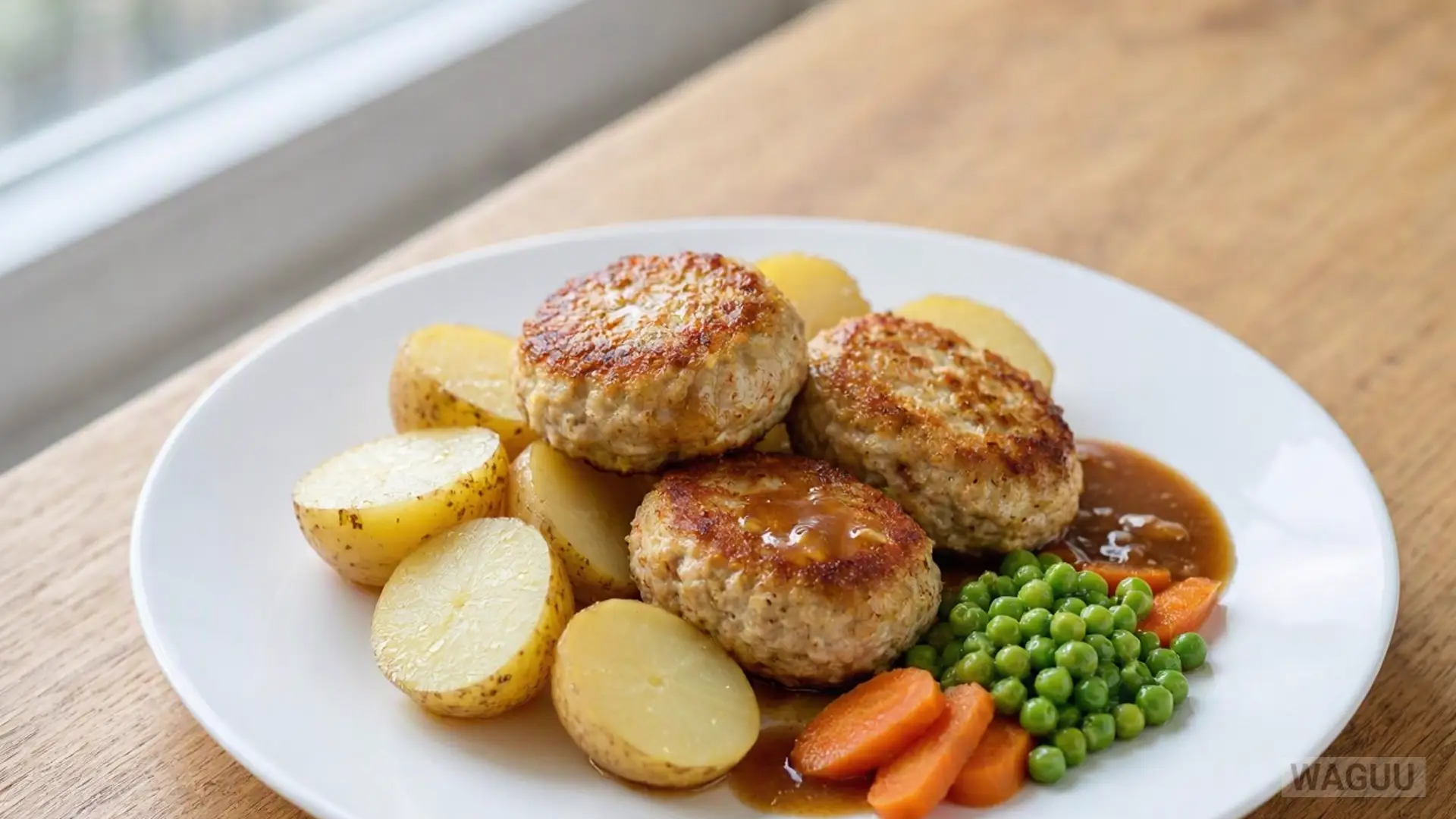
Summary: Traditional Danish pan-fried minced pork and beef patties flavoured with onion, herbs, and warm spices, served with boiled potatoes, rich brown butter gravy, and pickled beetroot. Prepared in 45 minutes for 4 hungry portions.
Did you cook this recipe? Share the result with the community.
Category: Main Dishes, Pork, Scandinavian Cuisine
Success rate: not rated yet% of users successfully made this recipe
Quick overview
- Dish: Frikadeller
- Category: Main Dishes, Pork, Scandinavian Cuisine
- Cuisine: Danish
- Main ingredient: Minced pork and beef, 500 g (medium fat content)
- Guide: 12 most popular Scandinavian dishes: favourite recipes of Scandinavian cuisine
- Total time: 45 minutes (15 min prep + 30 min cooking)
- Difficulty: Easy
- Portions: 4 (Portion weight: 350 g)
- Key technique: Pan-frying with butter and oil blend
- Preparation types: Mixing, shaping, pan-frying, simmering
- Dietary info & Allergens: Contains dairy, eggs, gluten
- Suitable for: Family lunch, traditional dinners
- Nutritional values (per 1 portion): 612 kcal, Protein: 38 g, Fat: 42 g, Carbohydrates: 22 g
- Storage: 3 days in the fridge, 3 months in the freezer
- Pairing: Light Lager, Aquavit, Sparkling water with lemon
- In short: Juicy Danish minced meat patties with crispy crust and buttery pan gravy.
- Last updated: 2025-01-15
WAGUU says: “Mastering Frikadeller is all about achieving the right emulsion in the meat batter before it hits the sizzling skillet.”
How to take it further: Warm the 26 cm plate, plate the portion in the centre with a clean rim; put a glass of cold beer, cutlery and a few herb leaves behind it.
Key facts
| Prep time: | 15 minutes |
| Cooking time: | 30 minutes |
| Temperature: | 170 °C pan temperature |
| Number of portions: | 4 portions |
In a nutshell
Frikadeller are the undisputed kings of Danish comfort food. These rustic yet refined pan-fried meatballs feature a tender, well-aerated interior wrapped in a deeply browned, savory crust. Traditionally served alongside buttery boiled potatoes, homemade brown gravy, and pickled vegetables, they offer a comforting taste of Nordic culinary tradition that warms the soul.
Ingredients
Base portions: 4 portions • Portion weight: 350 g
| Ingredient | Amount | Quality |
|---|---|---|
| Minced pork (20% fat) | 350 g | Freshly minced |
| Minced beef (15% fat) | 150 g | High quality |
| Yellow onion | 1 pc | Finely grated |
| All-purpose wheat flour | 45 g | Fine sifted |
| Milk (3.5% fat) | 150 ml | Whole milk, chilled |
| Large egg | 1 pc | Free-range |
| Fine sea salt | 8 g | Pure salt |
| Ground white pepper | 2 g | Freshly ground |
| Ground allspice | 1 g | Aromatic |
| Butter for frying | 40 g | Unsalted |
| Vegetable oil | 30 ml | Neutral high smoke point |
| Potatoes | 600 g | Waxy boiling potatoes |
Why you will love this recipe
- Authentic taste: Perfectly balances traditional Nordic spices with rich, savory minced meats.
- Unmatched texture: Incorporating chilled milk creates an exceptionally light and juicy interior.
- Versatile comfort: Ideal for cozy weeknight dinners or festive weekend family gatherings.
Success guaranteed: Following the emulsion technique and resting the meat mixture ensures the patties never fall apart during frying.
Recipe overview
Prep: 15 min | Cooking: 30 min | Difficulty: Easy | Portions: 4 | Type: Main course | Origin: Danish
Detailed instructions
Overall progress: 0% complete
Phase 1: Preparing the meat batter – 10 min
Appliances: Mixing bowl, wooden spoon
1. In a large mixing bowl, combine minced pork (350 g) and minced beef (150 g). Add fine sea salt (8 g) and beat vigorously with a wooden spoon for 2 minutes until the meat becomes sticky and forms a cohesive paste. Gradually fold in the grated yellow onion (1 pc), egg (1 pc), ground white pepper (2 g), and ground allspice (1 g).
VKB: VKB means Visual Kitchen Benchmark – ensuring proper protein binding.
Before moving to the next step:
Ensure the meat mixture is sticky and cold before adding the flour and milk.
Phase 2: Incorporating flour and milk – 5 min
Appliances: Whisk, spatula
2. Sift all-purpose wheat flour (45 g) into the meat mixture and stir thoroughly. Slowly pour in chilled milk (150 ml) in three small increments, stirring continuously until fully absorbed and the batter achieves a smooth, thick consistency. Cover the bowl and let it rest in the refrigerator for 15 minutes.
VKB: The milk must be cold to prevent fat separation during mixing.
Before moving to the next step:
Do not skip the resting period, as it allows the flour to hydrate properly.
Phase 3: Boiling the potatoes – 20 min
Appliances: Saucepan (3 l), stove
3. Peel potatoes (600 g) and cut them into even bite-sized pieces. Place them in a saucepan, cover with salted water, and bring to a boil over medium-high heat. Reduce heat to medium and simmer gently for 20 minutes until fork-tender. Drain well and keep warm.
VKB: Test doneness by piercing the center of a potato piece with a sharp knife.
Before moving to the next step:
Ensure potatoes are fully cooked through before draining to avoid hard centers.
Phase 4: Shaping the patties – 10 min
Appliances: Tablespoon, bowl of cold water
4. Dip a tablespoon into cold water. Scoop up portions of the chilled meat batter and shape them into smooth, slightly flattened oval patties, roughly 2 cm thick. Place the shaped patties on a clean cutting board or tray dusted lightly with flour.
VKB: Wetting the spoon prevents the sticky batter from clinging to the utensil.
Before moving to the next step:
Keep patties uniform in size to ensure even cooking times in the skillet.
Phase 5: Pan-frying the Frikadeller – 15 min
Appliances: Large skillet (28 cm), spatula
5. Heat butter for frying (40 g) and vegetable oil (30 ml) in a large skillet over medium heat until foaming. Carefully place the patties in the pan without overcrowding. Fry for 6–7 minutes on each side until deep golden-brown and cooked through to an internal temperature of 72 °C.
VKB: Combining oil with butter prevents the butter solids from burning at high heat.
Before moving to the next step:
Transfer cooked patties to a warm plate and let them rest for 3 minutes before serving.
Phase 6: Plating and serving – 5 min
Appliances: Serving plates, ladle
6. Arrange 3 warm Frikadeller on each plate alongside the boiled potatoes. Spoon pan drippings or light brown gravy generously over the potatoes and patties. Serve hot with pickled beetroot and fresh parsley.
VKB: Check visual appeal and temperature before serving to guests.
Required equipment
| Utensil | Ideal size | Alternative | Risk |
|---|---|---|---|
| Mixing bowl | 3 litres | Large ceramic bowl | Spilling batter during mixing |
| Skillet | 28 cm diameter | Cast iron pan | Overcrowding leading to steaming |
| Saucepan | 3 litres | Standard stockpot | Boiling over if heat is too high |
Shopping list
Nutritional profile
Values per 1 portion (excluding side dishes). Calculated from average nutritional values of ingredients.
| Nutrient | Per 100 g | Per 1 portion | Per 4 portions |
|---|---|---|---|
| Energy | 175.0 kcal | 612.0 kcal | 2448.0 kcal |
| Fat | 12.0 g | 42.0 g | 168.0 g |
| of which saturates | 4.5 g | 15.8 g | 63.2 g |
| Carbohydrates | 6.3 g | 22.0 g | 88.0 g |
| of which sugars | 1.2 g | 4.2 g | 16.8 g |
| Protein | 10.9 g | 38.0 g | 152.0 g |
| Salt | 0.6 g | 2.1 g | 8.4 g |
Reference intake of an average adult (8400 kJ / 2000 kcal).
WAGUU Pro Level
- Pro standard: Verified recipe with precise ratios and visual control points.
- Tip 1: Beat the minced meat with salt first to extract myosin proteins, ensuring the patties hold together without excessive breadcrumbs.
- Tip 2: Use a combination of butter and vegetable oil for frying to achieve a deep caramel crust without burning the milk solids.
- Tip 3: Chill the meat batter for at least 15 minutes before shaping to make handling easier and improve texture.
- Tip 4: Deglace the frying pan with a splash of water or broth to capture the fond for a quick pan gravy.
Scientific background
The exceptional tenderness of Frikadeller stems from protein extraction. When salt is worked into the raw meat before any liquid is added, salt-soluble myofibrillar proteins (myosin and actin) dissolve and form a sticky matrix. This matrix traps moisture and fat globules emulsified by the milk and egg. During pan-frying, this protein network coagulates, locking in juices and creating a firm yet springy texture, while the Maillard reaction between amino acids and reducing sugars generates the signature savory crust.
Fine Dining – Professional techniques
- Plate composition: Place three neatly shaped oval patties leaning slightly against a mound of butter-tossed potatoes, garnished with microgreens.
- Textural contrasts: Pair the crispy exterior of the pan-fried patty with silky smooth potato mash and pickled crunch.
- Temperature contrast: Serve piping hot patties alongside chilled pickled beetroot.
- Aromatic garnishes: Finish with finely chiffonaded flat-leaf parsley and a drizzle of reduced pan juices.
Sensory radar
- Appearance: Golden-brown, glistening oval patties with a rustic, hand-shaped finish.
- Aroma: Rich browned butter, roasted onion, and subtle warm hints of allspice.
- Taste: Savory, well-balanced pork flavor with a mild peppery kick and natural sweetness from onions.
- Texture: Crisp crust giving way to an exceptionally tender, juicy, and springy interior.
Pairing
- BEER: Traditional Danish Pilsner or Amber Ale
- WINE: Light-bodied Pinot Noir or dry Riesling
- NON-ALCOHOLIC: Sparkling apple cider or elderflower cordial
Various preparation variants
- Hakkebøf style: Shape the mixture into thicker patties and top with fried onions and a fried egg.
- Herbed variation: Fold finely chopped fresh dill and parsley into the meat batter for a herbaceous twist.
Allergens and dietary information
Contains: Gluten, dairy, eggs • Gluten: Contains wheat flour • Not suitable for: Celiac diets, lactose intolerance
Suitable for
Family lunch, traditional dinners, weekend gatherings, and hearty comfort food lovers.
Substitution catalog
- Wheat flour: Cornstarch or oat flour for a lighter binding agent.
- Milk: Plant-based unsweetened almond or oat milk.
FAQ
Why do my Frikadeller fall apart in the pan?
This usually happens when the meat was not worked sufficiently with salt at the beginning to form a protein bond, or if the frying pan was not hot enough when adding them.
Can I use 100% pork instead of mixed meat?
Yes, traditional Danish Frikadeller are frequently made using only minced pork with around 20–25% fat content for maximum juiciness.
How do I keep them warm while cooking multiple batches?
Place the fried patties on a wire rack set inside a baking sheet in a preheated oven at 100 °C until ready to serve.
Can I freeze cooked Frikadeller?
Yes, let them cool completely, store them in an airtight container, and freeze for up to 3 months. Reheat gently in a skillet or oven.
WAGUU Petr advises: Cooking for 12 or more people?
12–16 people: Prepare the meat batter in two separate bowls to ensure even mixing and chill in batches. Use two large skillets simultaneously. • 20+ people: Shape all patties in advance, arrange on parchment-lined baking trays, and finish baking them in a convection oven at 180 °C for 18 minutes after initial searing.
Sides and Serving
- Boiled buttered potatoes – gently tossed with fresh parsley (not included in the recipe)
- Pickled beetroot slices – offering a tangy, sweet contrast (not included in the recipe)
Serving: Serve piping hot with brown pan gravy and pickled cucumbers.
Storage and reheating
Fridge: 3 days • Freezer: 3 months • Reheating: Reheat in a skillet over medium-low heat with a splash of water or broth for 5 minutes until warmed through.
Author: WAGUU Petr & Team • Published: 26 Aug 2026 • Updated: 31 Oct 2026
More Recipes from This Article
Other recipes you might be interested in
Why WAGUU?
Recipes on WAGUU undergo checks for the accuracy of ingredients, procedures, and nutritional values.
Process photo gallery
Community photos: Cook, take a photo, and share the result.
You can upload photos in the comments below or send them via email.
Did you record a video guide for our recipe? Insert a link to YouTube, YouTube Shorts, TikTok, Instagram Reels, Facebook Reels, Pinterest, Vimeo, or X (Twitter) in the comment – we’d be happy to publish it and help promote you and your content.
Common mistakes
- Skipping the salt beating step – Failing to work the salt into the meat before adding liquids prevents proper protein bonding, causing patties to crumble.
- Overcrowding the skillet – Adding too many patties at once drops the pan temperature and causes the meat to steam rather than fry.
- Using hot milk – Pouring warm milk into the meat batter can prematurely melt fat and ruin the emulsion structure.
- Rushing the cooking time – Frying on excessively high heat burns the exterior before the center reaches safe internal temperature.