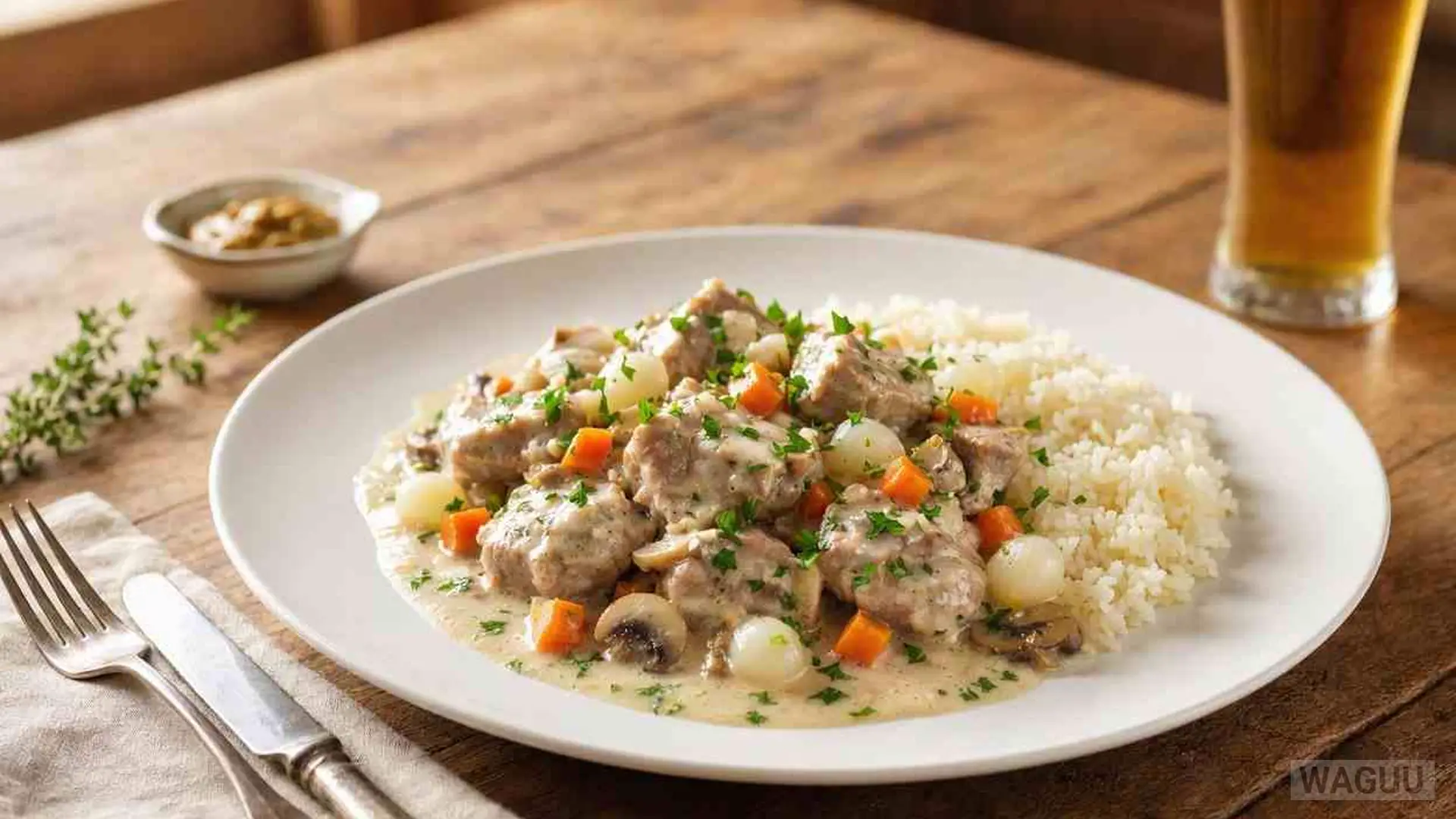
Summary: Blanquette de Veau is a classic French white ragout featuring tender pieces of veal gently simmered without searing in a fragrant aromatic stock, enriched with a velvety velouté sauce finished with cream and egg yolks, and garnished with glazed button onions and mushrooms. This traditional preparation requires patience and precise temperature control, taking 150 minutes in total for 6 portions.
Did you cook this recipe? Share the result with the community.
Category: Beef, French Cuisine
Success rate: 96% of users successfully made this recipe
Quick overview
- Dish: Blanquette de Veau
- Category: Beef, French Cuisine
- Cuisine: French
- Main ingredient: Veal shoulder, 1,200 g (high-quality prime cut)
- Guide: 12 most popular French dishes: favourite recipes of French cuisine
- Total time: 150 minutes (30 min prep + 120 min cooking)
- Difficulty: Medium
- Portions: 6 portions (Portion weight: 450 g)
- Key technique: Gentle braising without searing
- Preparation types: Simmering, braising, sauce thickening
- Dietary info & Allergens: Contains milk, eggs, celery, sulphites
- Suitable for: Sunday lunch, festive gatherings, family dinners
- Nutritional values (per 1 portion): 485.4 kcal, Protein: 42.5 g, Fat: 28.6 g, Carbohydrates: 12.3 g
- Storage: 3 days in the fridge, 3 months in the freezer
- Pairing: Dry cider, Chardonnay, sparkling water with lemon
- In short: Silky, tender veal ragout in a luxurious cream sauce with glazed onions and earthy mushrooms.
- Last updated: 21 September 2026
WAGUU says: “Never let the liquid boil vigorously after adding the veal; maintaining a gentle simmer ensures the meat proteins relax rather than tighten.”
How to take it further: Infuse the cooking liquid with a strip of unwaxed lemon zest for a brighter aromatic lift, or finish the sauce with a tiny grating of fresh nutmeg.
Key facts
| Prep time: | 30 minutes |
| Cooking time: | 120 minutes |
| Temperature: | 85–90 °C simmering |
| Number of portions: | 6 portions |
In a nutshell
Blanquette de Veau is the pinnacle of French home cooking. By omitting the initial searing step, the veal remains exceptionally pale and tender, yielding its pure flavors to a rich broth that is subsequently thickened with butter, flour, cream, and egg yolks to create an unforgettable silky sauce.
Ingredients
Base portions: 6 portions • Portion weight: 450 g
| Ingredient | Amount | Quality |
|---|---|---|
| Veal shoulder | 1,200 g | Trimmed and diced into 4 cm cubes |
| Water for boiling | 1,500 ml | Cold water for initial blanching |
| Veal stock | 800 ml | Clear, high-quality homemade stock |
| Carrots | 300 g | Peeled and cut into thick rounds |
| Leek | 150 g | White part only, tied in a bundle |
| Celery root | 150 g | Peeled and cut into large chunks |
| Button onions | 250 g | Small peeled pearl onions |
| Button mushrooms | 250 g | Fresh white mushrooms, left whole or halved |
| Unsalted butter | 80 g | European style, high fat content |
| Plain flour | 60 g | Standard wheat flour for roux |
| Double cream | 150 ml | Minimum 48% fat content |
| Egg yolks | 2 pcs | Fresh large egg yolks |
| Lemon juice | 15 ml | Freshly squeezed lemon juice |
| Fine sea salt | 15 g | Fine sea salt for seasoning |
| White peppercorns | 3 g | Whole white peppercorns |
| Thyme | 3 g | Fresh thyme sprigs |
| Bay leaf | 2 pcs | Dried bay leaves |
Why you will love this recipe
- Authentic French technique: Learn the traditional method of blanching and simmering meat without browning to achieve an immaculate ivory sauce.
- Unmatched tenderness: Slow cooking breaks down collagen into gelatin, making the veal exceptionally melt-in-the-mouth.
- Velvety richness: The liaison of egg yolks and double cream creates a glossy, luxurious finish without heaviness.
Why it works: Following the exact temperature guidelines prevents the egg yolks from curdling when finishing the sauce, ensuring a velvety smooth texture every single time.
Recipe overview
Prep: 30 min | Cooking: 120 min | Difficulty: Medium | Portions: 6 | Type: Main course | Origin: French
Detailed instructions
Overall progress: 0% complete
Phase 1: Blanching the veal – 15 min
Appliances: Hob
1. Place 1,200 g of diced veal shoulder into a large heavy-bottomed pot and pour in 1,500 ml of cold water. Set the pot over medium-high heat and bring slowly to a rolling boil over 10 minutes, allowing impurities to rise to the surface as a grey foam.
Visual check point (VKB): Impurities form a thick grey layer on the water surface and the meat turns opaque white.
Before moving to the next step:
Drain the blanched veal into a colander, rinse thoroughly under cold running water to remove all surface scum, and wash the pot completely clean.
Phase 2: Simmering the ragout – 75 min
Appliances: Hob
2. Return the cleaned veal to the clean pot. Add 800 ml of clear veal stock, 300 g of peeled carrot rounds, 150 g of tied leek, 150 g of celery root chunks, 3 g of whole white peppercorns, 3 g of fresh thyme sprigs, 2 dried bay leaves, and 10 g of fine sea salt. Bring to a gentle simmer over medium heat, then reduce the heat to low, cover with a tight-fitting lid, and simmer gently for 75 minutes.
VKB: Liquid bubbles very gently with occasional small bubbles breaking the surface, and the meat yields easily to gentle pressure.
Before moving to the next step:
Strain the contents through a fine-mesh sieve into a clean bowl, reserving both the cooking liquid and the tender veal pieces while discarding the spent aromatic vegetables and herbs.
Phase 3: Preparing garnishes – 15 min
Appliances: Hob
3. In a wide sauté pan, melt 30 g of unsalted butter over medium heat. Add 250 g of peeled button onions and 250 g of button mushrooms, sprinkle with 2 g of salt, and pour in 100 ml of water from the reserved stock. Cover and simmer for 15 minutes until tender and glazed.
VKB: Onions are translucent and tender through the center, and the cooking liquid has reduced to a shiny glaze coating the vegetables.
Before moving to the next step:
Transfer the glazed onions and mushrooms into a clean bowl and set aside, keeping the sauté pan ready for making the roux.
Phase 4: Making the velouté base – 10 min
Appliances: Hob
4. In the same pan, melt the remaining 50 g of unsalted butter over low heat. Whisk in 60 g of plain flour and cook gently for 2 minutes without browning. Gradually whisk in 700 ml of the reserved warm cooking stock, stirring continuously to prevent lumps, and simmer for 6 minutes until thickened into a smooth sauce.
VKB: Sauce coats the back of a spoon evenly and leaves a clean line when dragged with a finger.
Before moving to the next step:
Ensure the sauce heat is reduced to the lowest setting before preparing the egg and cream liaison to prevent curdling.
Phase 5: Enriching with cream liaison – 5 min
Appliances: Hob
5. In a small bowl, whisk together 2 fresh egg yolks, 150 ml of double cream, and 15 ml of fresh lemon juice. Temper the mixture by slowly whisking in 100 ml of the hot velouté sauce, then pour this tempered mixture back into the simmering sauce while stirring constantly. Cook over very low heat for 3 minutes without boiling.
VKB: Sauce thickens into a luxurious, glossy cream without any curdling or graininess.
Before moving to the next step:
Remove the finished sauce from the heat source immediately to prevent overheating and egg coagulation.
Phase 6: Final assembly – 10 min
Appliances: Hob
6. Gently fold the cooked veal pieces, sliced fresh boiled carrots, and the glazed onions and mushrooms into the velvety cream sauce. Warm through over very low heat for 10 minutes, checking seasoning with a pinch of salt if needed, before serving hot.
VKB: All components are thoroughly heated through and coated in a thick, velvety white sauce.
Required equipment
| Utensil | Ideal size | Alternative | Risk |
|---|---|---|---|
| Heavy-bottomed pot | 5 l capacity | Dutch oven | Scorching if heat is too high |
| Sauté pan | 28 cm diameter | Deep frying pan | Overcrowding vegetables |
| Fine-mesh sieve | 20 cm diameter | Colander with cheesecloth | Spilling hot stock |
Shopping list
Nutritional profile
Values per 1 portion (excluding side dishes). Calculated from average nutritional values of ingredients.
| Nutrient | Per 100 g | Per 1 portion | Per 6 portions |
|---|---|---|---|
| Energy | 107.9 kcal | 485.4 kcal | 2,912.4 kcal |
| Fat | 6.4 g | 28.6 g | 171.6 g |
| of which saturates | 3.8 g | 17.1 g | 102.6 g |
| Carbohydrates | 2.7 g | 12.3 g | 73.8 g |
| of which sugars | 1.1 g | 5.0 g | 30.0 g |
| Protein | 9.4 g | 42.5 g | 255.0 g |
| Salt | 0.6 g | 2.7 g | 16.2 g |
Reference intake of an average adult (8400 kJ / 2000 kcal).
WAGUU Pro Level
- Pro standard: Verified recipe with precise ratios and visual control points.
- Tip 1: Always blanch the meat in cold water and bring up slowly to extract impurities effectively without browning the surface.
- Tip 2: Use white veal stock rather than dark beef stock to preserve the characteristic ivory hue of the blanquette.
- Tip 3: Whisk a spoonful of hot sauce into the egg and cream mixture off the heat to temper the yolks safely.
- Tip 4: Simmer the pearl onions separately with a touch of butter and water to achieve a tender texture and glossy glaze.
Scientific background
Braising veal shoulder without searing relies on collagen hydrolysis. As the meat simmers gently at 85–90 °C, insoluble collagen molecules transform into soluble gelatin, softening tough connective tissue while keeping muscle fibers tender. The final addition of an egg yolk and cream liaison introduces heat-sensitive proteins that thicken the sauce through controlled coagulation, creating a stable emulsion.
Fine Dining – Professional techniques
- Plate composition: Spoon the tender veal cubes into the center of a warm shallow bowl, arranging glazed pearl onions and whole mushrooms symmetrically around the meat.
- Textural contrasts: Pair the meltingly soft veal with butter-glazed vegetables and crisp herb garnishes.
- Temperature contrast: Ensure the ragout is piping hot while the plate is preheated to maintain optimal serving temperature.
- Aromatic garnishes: Finish with finely chiffonaded fresh chervil for an herbaceous aroma and vibrant green accent.
Sensory radar
- Appearance: Pale ivory sauce coating tender white veal, carrots, and glossy glazed onions.
- Aroma: Delicate buttery fragrance with subtle notes of thyme, bay leaf, and fresh cream.
- Taste: Mild, savory, and creamy with a refreshing hint of lemon juice balancing the richness.
- Texture: Exceptionally tender meat suspended in a velvety, smooth velouté sauce.
Pairing
- BEER: Belgian White Ale with citrus notes
- WINE: Elegant white Burgundy or dry Chardonnay
- NON-ALCOHOLIC: Sparkling apple and elderflower infusion
Various preparation variants
- Blanquette de Dinde: Substitute veal shoulder with succulent turkey breast and thigh meat, reducing the simmering time to 45 minutes for a lighter poultry variation.
- Blanquette de Veau à l’Ancienne: Incorporate quartered button mushrooms cooked in lemon butter and serve with buttery puff pastry vol-au-vent cases.
Allergens and dietary information
Contains: Milk, eggs, celery, sulphites • Gluten: Contains wheat flour in the roux • Not suitable for: Dairy-free, vegan, and gluten-free diets
Suitable for
Sunday lunch, festive gatherings, family dinners
Substitution catalog
- Veal shoulder: Tender neck of veal or boneless rabbit pieces
- Double cream: Crème fraîche for a slightly tangy finish
- Plain flour: Cornflour dissolved in cold water for a gluten-free thickening alternative
FAQ
Why do we blanch the veal instead of searing it?
Blanching removes impurities and keeps the meat and sauce exceptionally pale, which is the defining visual and culinary characteristic of a traditional blanquette.
How do I prevent the cream and egg sauce from curdling?
Always temper the egg yolks with a ladle of hot sauce before stirring into the pot, and never let the sauce boil after the liaison has been added.
Can I prepare Blanquette de Veau in advance?
Yes, the ragout tastes even better when reheated gently the next day, though you should add the cream liaison just before serving if possible.
What is the best cut of meat to use?
Veal shoulder, neck, or breast cut into even cubes provide the ideal balance of lean meat and gelatin-rich connective tissue.
WAGUU Petr advises: Cooking for 12 or more people?
12–16 people: Scale ingredients by multiplying by 2 and use two large heavy-bottomed pots to ensure the meat simmers evenly without overcrowding. 20+ people: Prepare the braised meat and stock base a day in advance, storing them in the refrigerator, and finish the sauce and vegetable liaison in batches just prior to service.
Sides and Serving
- Steamed buttered rice – fluffy grains that absorb the creamy sauce perfectly (not included in the recipe)
- Fresh crusty baguette – ideal for mopping up the velvety velouté (not included in the recipe)
Serving: Serve hot in deep warmed plates garnished with freshly chopped chervil and a wedge of lemon on the side.
Storage and reheating
Fridge: 3 days • Freezer: 3 months • Reheating: Reheat gently in a covered pot over low heat, stirring occasionally, taking care not to let the sauce boil.
Author: WAGUU Petr & Team • Published: 21 Sep 2026 • Updated: 30 Oct 2026
More Recipes from This Article
Guide: 12 most popular French dishes: favourite recipes of French cuisine
Boeuf à la Bourguignonne
Other recipes you might be interested in
Why WAGUU?
Recipes on WAGUU undergo checks for the accuracy of ingredients, procedures, and nutritional values.
Process photo gallery
Community photos: Cook, take a photo, and share the result.
You can upload photos in the comments below or send them via email.
Did you record a video guide for our recipe? Insert a link to YouTube, YouTube Shorts, TikTok, Instagram Reels, Facebook Reels, Pinterest, Vimeo, or X (Twitter) in the comment – we’d be happy to publish it and help promote you and your content.
Common mistakes
- Searing the veal – Browning the meat ruins the pale ivory color required for a traditional blanquette.
- Boiling the cream and egg liaison – High heat causes the egg yolks to curdle, ruining the silky texture of the sauce.
- Skipping the blanching step – Failing to blanch the meat leaves impurities in the broth that create a muddy grey sauce.
- Adding cold stock to the roux – Pouring cold liquid into the flour and butter mixture inevitably creates lumps.