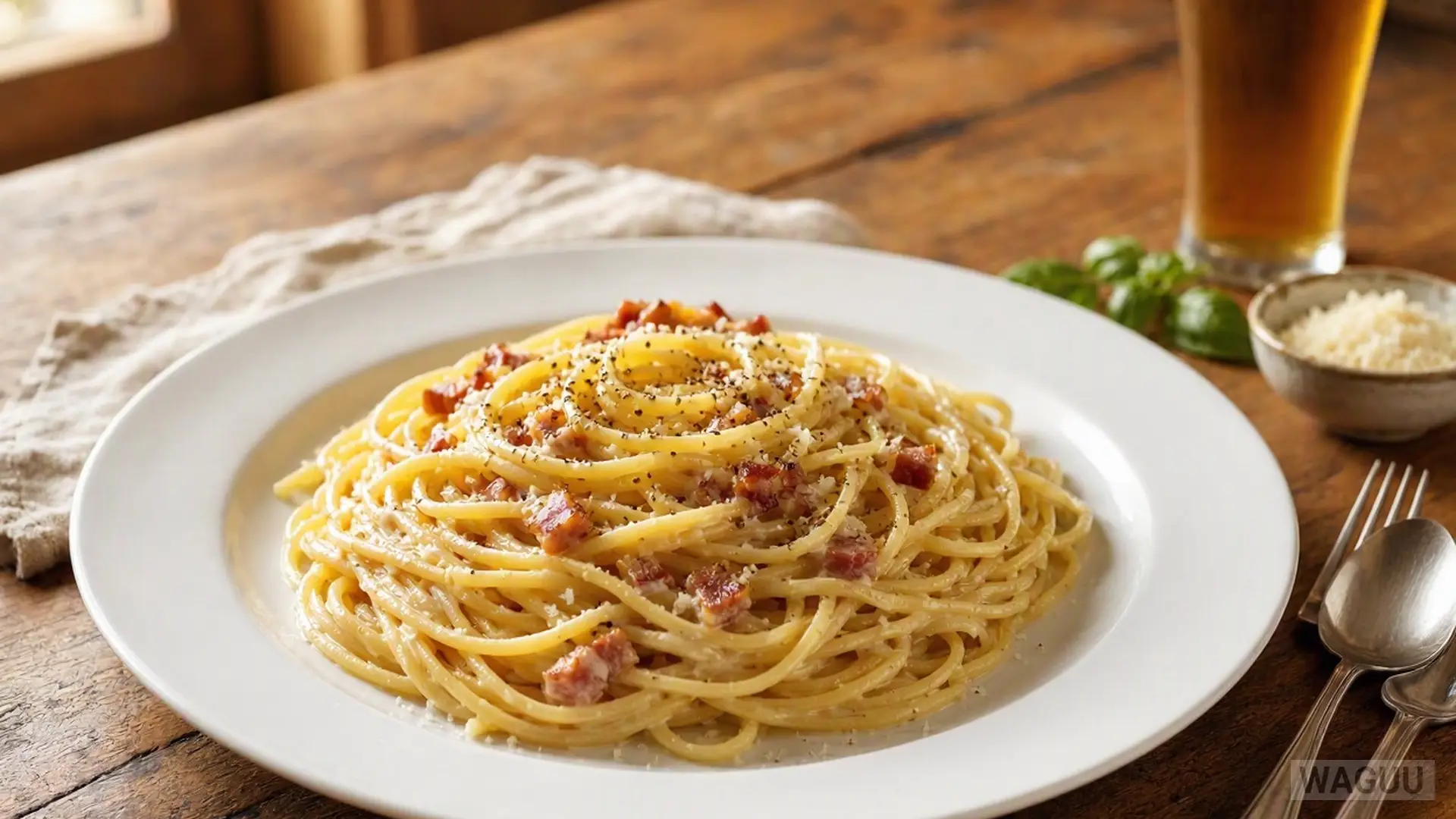
Summary: Authentic Roman Spaghetti alla Carbonara made without cream, featuring crispy guanciale, fresh eggs, aged Pecorino Romano cheese, and coarse black pepper. This traditional technique relies on starchy pasta water and gentle heat to create a glossy, emulsified sauce in 25 minutes for 6 portions.
Did you cook this recipe? Share the result with the community.
Category: Pasta, Italian Cuisine
Success rate: 96% of users successfully made this recipe
Quick overview
- Dish: Spaghetti alla Carbonara
- Category: Pasta, Italian Cuisine
- Cuisine: Italian
- Main ingredient: Spaghetti, 500 g (bronze-die extruded)
- Guide: 12 most popular Italian dishes: favourite recipes of Italian cuisine
- Total time: 25 minutes (10 min prep + 15 min cooking)
- Difficulty: Medium
- Portions: 6 portions (Portion weight: 205.0 g)
- Key technique: Thermal emulsion with egg yolks, cheese, and pasta water
- Preparation types: Boiling, pan-frying, emulsifying
- Dietary info & Allergens: Contains eggs, gluten, milk
- Suitable for: Lunch, dinner, festive occasions
- Nutritional values (per 1 portion): 540.5 kcal, Protein: 22.4 g, Fat: 24.1 g, Carbohydrates: 57.8 g
- Storage: Best consumed immediately. Not suitable for freezing or refrigerator storage due to egg texture.
- Pairing: Craft Pilsner, Frascati Superiore, sparkling water with lemon
- In short: The ultimate Roman pasta classic built on crispy cured pork cheek, rich egg yolks, sharp Pecorino Romano, and starchy water without a drop of cream.
- Last updated: 21 September 2026
WAGUU says: “True Roman carbonara is a masterclass in minimalism where precise temperature control transforms humble ingredients into a velvety emulsion.”
How to take it further: Toast whole black peppercorns in a dry skillet before crushing them for deeper aroma; use a mix of Pecorino Romano and Parmigiano-Reggiano for a slightly milder salinity.
Key facts
| Prep time: | 10 min |
| Cooking time: | 15 min |
| Temperature: | Medium heat, off-heat emulsion |
| Number of portions: | 6 portions |
In a nutshell
Experience the authentic taste of Rome with this traditional Spaghetti alla Carbonara. By eliminating cream and trusting the synergy of rendered guanciale fat, starchy pasta water, creamy egg yolks, and sharp Pecorino Romano, you achieve a luxuriously glossy sauce that clings perfectly to every strand of al dente pasta.
Ingredients
Base portions: 6 portions • Portion weight: 205.0 g
| Ingredient | Amount | Quality |
|---|---|---|
| Spaghetti | 500 g | Bronze-die extruded durum wheat |
| Guanciale | 200 g | Cured pork cheek, sliced 1 cm thick |
| Egg yolk | 6 pcs | Fresh free-range egg yolks |
| Whole egg | 2 pcs | Fresh free-range whole eggs |
| Pecorino Romano cheese | 120 g | Aged sheep milk cheese, finely grated |
| Black peppercorns | 6 g | Whole black peppercorns, coarsely crushed |
| Fine sea salt | 15 g | For boiling pasta water |
| Water for boiling | 4500 ml | Clean tap water |
Why you will love this recipe
- Authentic Roman Tradition: Prepared strictly according to Roman heritage without any cream, relying purely on egg yolks and cheese.
- Unmatched Texture: Bronze-die extruded pasta releases ample starch, bonding with rendered pork fat and cheese into a silky coating.
- Bold Flavor Profile: The intense savoriness of guanciale pairs seamlessly with the sharp tang of Pecorino Romano and aromatic black pepper.
Why it works: Controlling pan temperature and combining starchy water with egg and cheese prevents scrambling while guaranteeing a glossy emulsion.
Recipe overview
Prep: 10 min | Cooking: 15 min | Difficulty: Medium | Portions: 6 portions | Type: Main dish | Origin: Italian
Detailed instructions
Overall progress: 0% complete
Phase 1: Preparing ingredients and boiling water – 5 min
Appliances: Hob
1. Pour 4,500 ml of water into a large stockpot, add 15 g of fine sea salt, and bring to a rolling boil over high heat for 5 minutes. Meanwhile, cut 200 g of guanciale into strips measuring 1 cm in thickness, and finely grate 120 g of Pecorino Romano cheese using a microplane.
VKB: Visual check point (VKB): Water is at a vigorous rolling boil and salt is fully dissolved.
Before moving to the next step:
Ensure the water is boiling heavily before dropping the pasta to secure optimal starch release.
Phase 2: Cooking pasta and rendering guanciale – 10 min
Appliances: Hob
2. Plunge 500 g of spaghetti into the boiling water and cook for 9 minutes, stirring occasionally. Concurrently, place the guanciale strips into a cold frying pan and turn the heat to medium. Sauté for 10 minutes, stirring frequently, until the fat renders completely and the pork pieces turn golden and crispy. Remove the pan from the heat.
VKB: VKB: Guanciale is deeply golden and translucent with a pool of rendered fat, and spaghetti is al dente.
Before moving to the next step:
Reserve 200 ml of starchy pasta water before draining the spaghetti, and let the pan cool slightly.
Phase 3: Mixing eggs and cheese – 5 min
Appliances: None
3. In a large mixing bowl, combine 6 egg yolks and 2 whole eggs. Whisk thoroughly with a fork, then blend in 120 g of grated Pecorino Romano cheese and 6 g of coarsely crushed black peppercorns until a thick, paste-like mixture forms.
VKB: VKB: Egg and cheese mixture is thick, homogeneous, and free of dry cheese lumps.
Before moving to the next step:
Ensure the pan with guanciale has cooled down so the residual heat does not scramble the eggs.
Phase 4: Emulsifying and combining – 5 min
Appliances: Hob
4. Transfer the drained al dente spaghetti directly into the warm frying pan containing the rendered guanciale, tossing for 2 minutes to coat the pasta in the fat. Turn off the heat entirely, pour the contents into the egg and cheese bowl, add 100 ml of reserved pasta water, and stir vigorously for 3 minutes until a glossy, creamy sauce coats every strand.
VKB: VKB: Sauce is glossy, velvety, and completely smooth without any scrambled egg flakes.
Required equipment
| Utensil | Ideal size | Alternative | Risk |
|---|---|---|---|
| Stockpot | 6 l | Large saucepan | Water boiling over if too small |
| Frying pan | 28 cm diameter | Deep skillet | Overcrowding or fat splashing |
| Mixing bowl | 24 cm diameter | Large ceramic bowl | Too small for tossing pasta |
Shopping list
Nutritional profile
Values per 1 portion (excluding side dishes). Calculated from average nutritional values of ingredients.
| Nutrient | Per 100 g | Per 1 portion | Per 6 portions |
|---|---|---|---|
| Energy | 263.7 kcal | 540.5 kcal | 3243.3 kcal |
| Fat | 11.8 g | 24.1 g | 144.9 g |
| of which saturates | 4.5 g | 9.2 g | 55.3 g |
| Carbohydrates | 28.2 g | 57.8 g | 346.6 g |
| of which sugars | 0.5 g | 1.0 g | 6.1 g |
| Protein | 10.9 g | 22.4 g | 134.4 g |
| Salt | 0.8 g | 1.6 g | 9.8 g |
Reference intake of an average adult (8400 kJ / 2000 kcal).
WAGUU Pro Level
- Pro standard: Verified recipe with precise ratios and visual control points.
- Tip 1: Always start guanciale in a cold pan to allow deep fat rendering without burning the exterior.
- Tip 2: Use bronze-die extruded spaghetti to maximize surface roughness and starch release for superior sauce adherence.
- Tip 3: Whisk egg yolks and Pecorino Romano into a thick paste before adding any liquid to prevent lumps.
- Tip 4: Remove the pan from heat completely before combining pasta and eggs to eliminate the risk of curdling.
Scientific background
Carbonara relies on creating a stable water-in-fat emulsion stabilized by egg proteins and cheese starches. When rendered pork fat mixes with starchy pasta water and beaten egg yolks off the heat, lecithin from the yolks and gelatin from the pasta water form a protective colloidal suspension around oil droplets. Keeping the temperature below 65 °C prevents egg protein coagulation, ensuring a silky, custard-like texture rather than scrambled eggs.
Fine Dining – Professional techniques
- Plate composition: Twirl the spaghetti into a tall, tight nest using a chef’s fork and ladle, placing it centrally on a warm ceramic plate.
- Textural contrasts: Crown the pasta with extra crispy guanciale shards for an assertive crunch against the velvety noodles.
- Temperature contrast: Ensure plates are gently preheated so the sauce maintains its ideal velvety consistency from first bite to last.
- Aromatic garnishes: Finish with a light dusting of freshly grated Pecorino Romano and an extra twist of crushed black peppercorns.
Sensory radar
- Appearance: Glossy, golden-yellow coated strands dotted with dark pepper specks and golden-brown pork crisps.
- Aroma: Pungent aged sheep cheese, toasted black pepper, and rich cured pork fat.
- Taste: Savory, deeply umami, pleasantly salty from Pecorino, with a warm pepper kick.
- Texture: Silky, creamy emulsion clinging to al dente pasta with contrasting crisp guanciale bits.
Pairing
- BEER: Crisp Bohemian Pilsner or Italian craft lager with moderate bitterness.
- WINE: Frascati Superiore, Castelli Romani Bianco, or a dry, mineral-driven Verdicchio.
- NON-ALCOHOLIC: Sparkling mineral water with a fresh lemon wedge or artisanal elderflower tonic.
Various preparation variants
- Spaghetti alla Carbonara with Pancetta: Substitutes guanciale with cured pancetta if authentic pork cheek is unavailable, yielding a slightly milder and less spiced flavor profile.
- Rigatoni alla Carbonara: Uses short, ridged rigatoni pasta instead of long spaghetti, allowing rich sauce and crispy meat pieces to get trapped inside the tubes.
Allergens and dietary information
Contains: Eggs, gluten, milk • Gluten: Contains wheat from pasta • Not suitable for: Vegetarians, vegans, individuals with dairy, egg, or wheat allergies
Suitable for
Lunch, dinner, weekend cooking, traditional Italian dinner parties
Substitution catalog
- Guanciale: Pancetta (not quite as rich, but works well)
- Pecorino Romano: Parmigiano-Reggiano (milder and less salty flavor)
- Spaghetti: Rigatoni or Bucatini
FAQ
Why is there no cream in traditional Carbonara?
Traditional Roman carbonara achieves its creamy texture entirely through the emulsion of egg yolks, aged cheese, rendered pork fat, and starchy pasta water. Cream masks the delicate flavors and is never used in authentic Italian recipes.
How do I prevent the eggs from scrambling?
Always remove the pan from the heat source before adding the egg and cheese mixture. The residual heat of the pasta and pan is more than enough to cook the eggs gently into a creamy sauce without curdling them.
Can I use bacon instead of guanciale?
Smoked British bacon introduces a smoky flavor profile that alters the authentic taste of carbonara. If guanciale is unavailable, unsmoked pancetta is a much closer substitute.
Why do I need to reserve pasta water?
Pasta water is rich in released starches that act as an emulsifying agent, binding the fat and egg proteins together into a cohesive, glossy sauce.
WAGUU Petr advises: Cooking for 12 or more people?
12–16 people: Cook the pasta in two separate large stockpots simultaneously to maintain a vigorous boil and ensure even cooking. Prepare the egg and cheese mixture in two separate large bowls to avoid overcrowding during emulsification. • 20+ people: Divide the cooking into distinct batches of 6 to 8 portions. Carbonara relies on immediate, precise temperature control off the heat, making large single-batch scaling impractical for maintaining the perfect glossy sauce.
Sides and Serving
- Crispy green leaf salad with lemon vinaigrette – adds refreshing acidity to balance the rich pasta (not included in the recipe)
- Warm crusty sourdough bread – ideal for scooping up any remaining sauce (not included in the recipe)
Serving: Serve immediately in preheated shallow bowls, garnished with extra grated Pecorino Romano and freshly cracked black pepper.
Storage and reheating
Fridge: 1 days • Freezer: 0 months • Reheating: Carbonara is designed to be eaten immediately upon preparation. Reheating causes the eggs to scramble and the fat to separate. If leftovers must be warmed, do so gently in a non-stick pan over very low heat with a splash of hot water, though texture will be compromised.
Author: WAGUU Petr & Team • Published: 21 Sep 2026 • Updated: 30 Oct 2026
More Recipes from This Article
Other recipes you might be interested in
Why WAGUU?
Recipes on WAGUU undergo checks for the accuracy of ingredients, procedures, and nutritional values.
Process photo gallery
Community photos: Cook, take a photo, and share the result.
You can upload photos in the comments below or send them via email.
Did you record a video guide for our recipe? Insert a link to YouTube, YouTube Shorts, TikTok, Instagram Reels, Facebook Reels, Pinterest, Vimeo, or X (Twitter) in the comment – we’d be happy to publish it and help promote you and your content.
Common mistakes
- Adding cream – Using cream disrupts the authentic emulsion and masks the natural richness of eggs and Pecorino.
- Scrambling the eggs – Mixing eggs and cheese into a pan that is too hot causes the proteins to coagulate into solid egg lumps.
- Using bacon or ham – Substituting guanciale with smoked bacon introduces foreign smoke flavors that clash with traditional Roman seasoning.
- Failing to reserve pasta water – Forgetting to save starchy pasta water leaves the sauce dry and prevents proper emulsification.