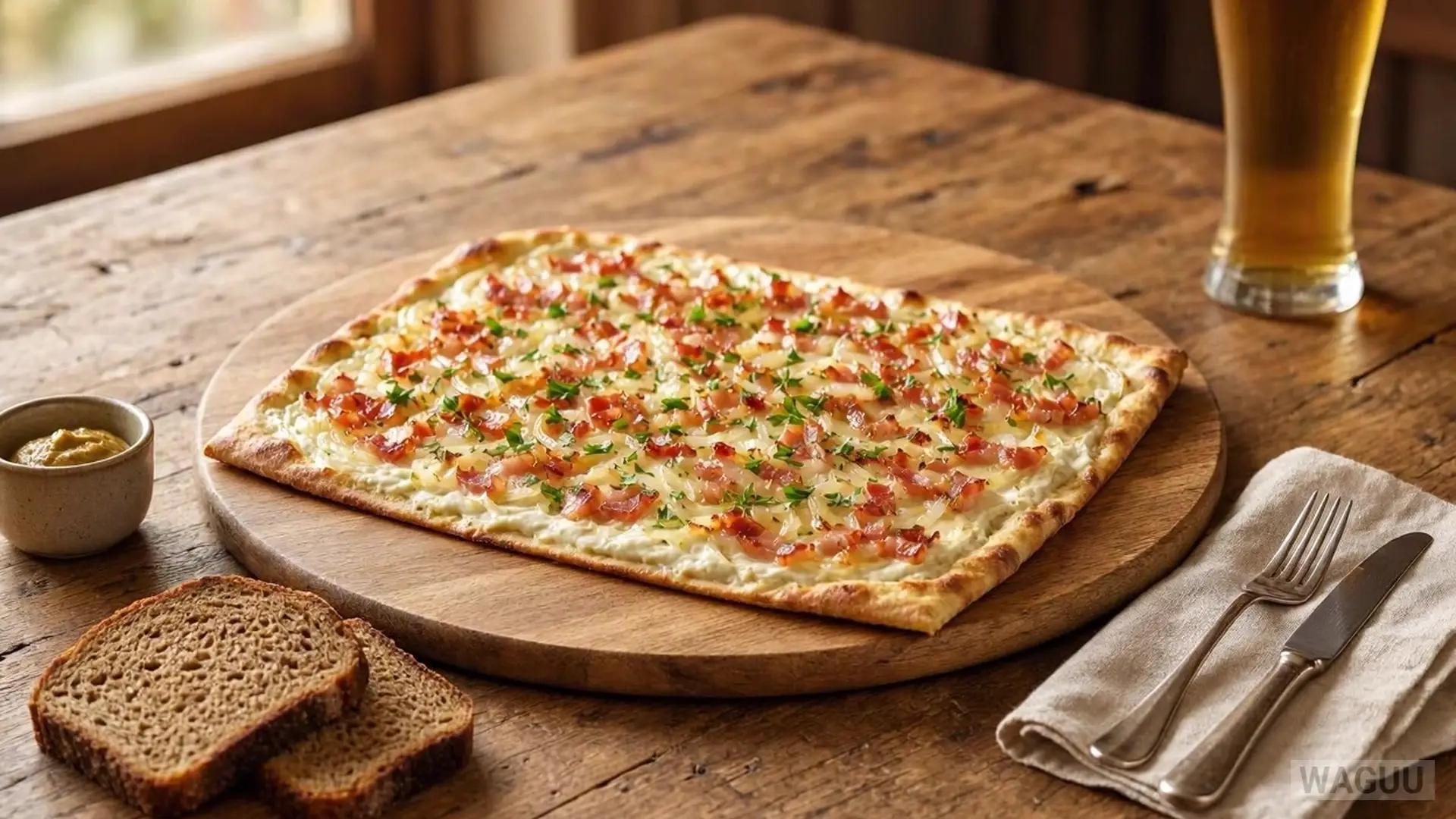
Summary: Flammkuchen is a traditional Alsatian and German flatbread featuring an exceptionally thin, crisp, yeast-free dough rolled out on a wooden paddle, spread with rich crème fraîche and quark, and topped with smoky lardons and translucent onions. Baked at a very high temperature in a stone oven for 8 minutes, it achieves a blistered, crackling crust. This recipe yields 6 portions, perfect as a shared appetiser or rustic main course.
Did you cook this recipe? Share the result with the community.
Category: Bread and Pastry, German Cuisine
Success rate: 98% of users successfully made this recipe
Quick overview
- Dish: Flammkuchen
- Category: Bread and Pastry, German Cuisine
- Cuisine: Alsatian / German
- Main ingredient: Plain flour, 300 g (high gluten strength)
- Guide: 12 most popular German dishes: favourite recipes of German cuisine
- Total time: 45 minutes (30 min prep + 15 min cooking)
- Difficulty: Easy
- Portions: 6 portions (Portion weight: 210.0 g)
- Key technique: Dough kneading and high-temperature baking
- Preparation types: Kneading, sweating onions, baking
- Dietary info & Allergens: Contains gluten, milk
- Suitable for: Family dinner, weekend gathering
- Nutritional values (per 1 portion): 375.4 kcal, Protein: 12.5 g, Fat: 18.2 g, Carbohydrates: 41.5 g
- Storage: LEDNICE 2 days in the fridge, MRAZAK 1 months in the freezer
- Pairing: Riesling, local dry white wine, sparkling water
- In short: An authentic, paper-thin Alsatian flatbread baked until crisp with a creamy topping, smoked bacon lardons, and sweet onions.
- Last updated: 21 September 2026
WAGUU says: “The secret to an authentic Flammkuchen is rolling the dough so thin that you can almost read a newspaper through it before topping.”
How to take it further: Add a pinch of freshly grated nutmeg to the quark mixture, or scatter fresh thyme leaves over the baked flatbread.
Key facts
| Prep time: | 30 minutes |
| Cooking time: | 15 minutes |
| Temperature: | 250 °C |
| Number of portions: | 6 portions |
In a nutshell
Experience the rustic charm of Alsace and Southern Germany right in your own kitchen with this traditional Flammkuchen. Combining a crackling, yeast-free crust with a velvety blend of crème fraîche and quark, smoky lardons, and sweet, softened onions, this dish offers a symphony of contrasting textures and comforting flavors that bake to perfection in minutes.
Ingredients
Base portions: 6 portions • Portion weight: 210.0 g
| Ingredient | Amount | Quality |
|---|---|---|
| Plain flour | 300 g | High gluten strength |
| Rapeseed oil | 30 ml | Cold-pressed |
| Water for dough | 150 ml | Lukewarm |
| Table salt | 6 g | Fine grain |
| Crème fraîche | 200 g | Full fat |
| Low-fat quark | 150 g | Smooth |
| White onion | 300 g | Fresh, sliced thin |
| Smoked bacon lardons | 200 g | Quality smoked pork |
| Ground black pepper | 2 g | Freshly ground |
Why you will love this recipe
- Incredibly crisp crust: Achieving a blistered, paper-thin base without needing any yeast or complicated long fermentation.
- Balanced creamy topping: A harmonious blend of rich crème fraîche and smooth quark that stays luscious during baking.
- Smoky and sweet flavour profile: Perfectly balanced salty smoked bacon lardons paired with translucent, gently sweated onions.
Why it works: High-heat baking on a preheated surface causes moisture in the thin dough to evaporate instantly, creating a crisp structure that supports the rich dairy and savory toppings without becoming soggy.
Recipe overview
Prep: 30 min | Cooking: 15 min | Difficulty: Easy | Portions: 6 portions | Type: Bread and Pastry | Origin: German / Alsatian
Detailed instructions
Overall progress: 0% complete
Phase 1: Preparing the yeast-free dough – 15 min
Appliances: Hob
1. Weigh 300 g of plain flour into a mixing bowl, add 6 g of table salt, 30 ml of rapeseed oil, and 150 ml of lukewarm water for dough. Mix thoroughly with a wooden spoon for 3 minutes until a cohesive mass forms, then knead vigorously on a clean work surface for 7 minutes until smooth and elastic. Wrap the dough in cling film and let it rest at room temperature for 15 minutes to relax the gluten network.
Visual check point (VKB): The dough surface is smooth, pliable, and springs back slightly when pressed with a finger.
Before moving to the next step:
Ensure the dough has rested adequately so it can be rolled out paper-thin without snapping back.
Phase 2: Preparing toppings and dairy base – 10 min
Appliances: Hob
2. Peel 300 g of white onion and slice them as thinly as possible into half-moons. In a medium mixing bowl, combine 200 g of crème fraîche and 150 g of low-fat quark, stirring until smooth and uniform. Season the dairy mixture with 2 g of freshly ground black pepper. Heat a frying pan over medium heat and sauté 200 g of smoked bacon lardons for 5 minutes until rendered and lightly browned, then remove from heat and set aside.
VKB: The crème fraîche and quark are thoroughly blended into a rich, spreadable cream without lumps.
Before moving to the next step:
Preheat your oven to 250 °C with a baking stone or inverted baking tray placed inside to accumulate maximum heat.
Phase 3: Rolling and assembling – 10 min
Appliances: Oven
3. Divide the rested dough into equal portions for individual handling. On a lightly floured work surface, roll out each piece of dough using a rolling pin until it is paper-thin, approximately 1 mm thick. Transfer the flattened dough sheet onto a piece of baking parchment. Evenly spread a generous layer of the dairy mixture over the dough, leaving a small border around the edges. Scatter the sliced onions and rendered smoked bacon lardons evenly across the surface.
VKB: The dough is translucent and evenly coated with the cream, onions, and bacon without tearing.
Before moving to the next step:
Confirm the oven has reached 250 °C and the baking stone is fully heated before sliding the flatbread in.
Phase 4: High-temperature baking – 10 min
Appliances: Oven
4. Carefully slide the assembled Flammkuchen along with its baking parchment directly onto the preheated baking stone in the oven. Bake at 250 °C for 8 to 10 minutes until the edges of the crust turn deeply golden and crisp, and the cream topping bubbles with lightly charred spots on the onions. Remove from the oven and transfer to a wooden board.
VKB: The crust is crisp and brittle at the rim, and the bottom is uniformly browned.
Required equipment
| Utensil | Ideal size | Alternative | Risk |
|---|---|---|---|
| Mixing bowl | 3 l capacity | Large ceramic bowl | Spilling flour during mixing |
| Rolling pin | Standard size | Glass bottle | Uneven dough thickness |
| Baking stone | 30 x 40 cm | Inverted heavy baking tray | Insufficient bottom crispness |
Shopping list
Nutritional profile
Values per 1 portion (excluding side dishes). Calculated from average nutritional values of ingredients.
| Nutrient | Per 100 g | Per 1 portion | Per 6 portions |
|---|---|---|---|
| Energy | 178.8 kcal | 375.4 kcal | 2252.5 kcal |
| Fat | 8.7 g | 18.2 g | 109.3 g |
| of which saturates | 5.1 g | 10.8 g | 64.6 g |
| Carbohydrates | 19.8 g | 41.5 g | 249.2 g |
| of which sugars | 2.2 g | 4.6 g | 27.8 g |
| Protein | 6.0 g | 12.5 g | 75.2 g |
| Salt | 0.9 g | 1.9 g | 11.3 g |
Reference intake of an average adult (8400 kJ / 2000 kcal).
WAGUU Pro Level
- Pro standard: Verified recipe with precise ratios and visual control points.
- Tip 1: Use a very hot baking stone to replicate traditional wood-fired stone oven conditions.
- Tip 2: Ensure the onions are sliced paper-thin so they soften and caramelise without burning during the quick bake.
- Tip 3: Mixing quark with rich crème fraîche prevents the dairy topping from drying out in high heat.
- Tip 4: Let the dough rest thoroughly so it retains its shape when rolled out extremely thin.
Scientific background
High-temperature baking at 250 °C triggers rapid water vaporization within the yeast-free dough structure, causing steam pockets to expand and form a characteristic blistered and crisp crust. Concurrently, the Maillard reaction occurs on the surface of the smoked bacon and onion sugars, generating complex savory aroma compounds and deep browning.
Fine Dining – Professional techniques
- Plate composition: Serve individual rectangular portions on dark slate boards to highlight the golden crust.
- Textural contrasts: The brittle, shattering crispness of the base juxtaposed against the velvety smoothness of the cream topping.
- Temperature contrast: Enjoy piping hot straight from the oven against the cool, fresh notes of any accompanying green garnish.
- Aromatic garnishes: Finish with finely chopped chives or microgreens just before serving for an aromatic lift.
Sensory radar
- Appearance: Paper-thin golden flatbread with charred edges, creamy white spread, and scattered brown bacon and onions.
- Aroma: Rich smoked pork aroma combined with sweet baked onions and creamy dairy notes.
- Taste: Savoury and salty from the bacon, balanced by the sweet onions and tangy, creamy dairy base.
- Texture: Exceptionally crisp and crackling crust with a soft, creamy topping.
Pairing
- BEER: Crisp regional Pilsner or traditional wheat beer
- WINE: Dry Alsatian Riesling or Pinot Blanc
- NON-ALCOHOLIC: Sparkling mineral water with lemon slice
Various preparation variants
- Vegetarian Flammkuchen: Replace the bacon lardons with sautéed sliced mushrooms and fresh herbs for a rich, meat-free alternative.
- Apple and Calvados Flammkuchen: Substitute the bacon and onions with thinly sliced apples, a dusting of cinnamon, and a drizzle of Calvados for a classic dessert variation.
Allergens and dietary information
Contains: Gluten, milk • Gluten: Contains wheat flour • Not suitable for: Lactose intolerance, vegans
Suitable for
Family dinner, weekend gathering, casual entertaining
Substitution catalog
- Crème fraîche: Sour cream or thick Greek yogurt
- Low-fat quark: Cream cheese or ricotta
FAQ
Why is there no yeast in the dough?
Traditional Flammkuchen dough relies on flour, water, oil, and salt without leavening agents, allowing it to be rolled paper-thin and bake into a crackling crisp crust.
Can I prepare the dough in advance?
Yes, you can wrap the kneaded dough in cling film and store it in the refrigerator for up to 24 hours before rolling.
What is the best way to transfer the flatbread into the oven?
Assembling the flatbread directly on a piece of baking parchment allows you to slide it effortlessly onto a preheated baking stone.
Why mix crème fraîche and quark?
The combination provides a rich flavour from the crème fraîche while keeping the moisture level balanced with the lighter quark.
WAGUU Petr advises: Cooking for 12 or more people?
12–16 people: Prepare the double amount of dough and divide into smaller portions, rolling them out in advance and layering between parchment paper • 20+ people: Set up a rolling and assembly station where guests can customize their toppings while flatbreads bake successively on multiple baking stones.
Sides and Serving
- Crisp green salad with mustard vinaigrette – Light acidity cuts through the rich dairy topping (not included in the recipe)
- Pickled gherkins – Adds a sharp crunch to contrast the flatbread (not included in the recipe)
Serving: Cut into large rectangular slices and serve piping hot directly on wooden boards.
Storage and reheating
Fridge: 2 days • Freezer: 1 months • Reheating: Reheat in a preheated oven at 200 °C for 4 minutes to restore crispness.
Author: WAGUU Petr & Team • Published: 21 Sep 2026 • Updated: 30 Oct 2026
More Recipes from This Article
Guide: 12 most popular German dishes: favourite recipes of German cuisine
Other recipes you might be interested in
Why WAGUU?
Recipes on WAGUU undergo checks for the accuracy of ingredients, procedures, and nutritional values.
Process photo gallery
Community photos: Cook, take a photo, and share the result.
You can upload photos in the comments below or send them via email.
Did you record a video guide for our recipe? Insert a link to YouTube, YouTube Shorts, TikTok, Instagram Reels, Facebook Reels, Pinterest, Vimeo, or X (Twitter) in the comment – we’d be happy to publish it and help promote you and your content.
Common mistakes
- Rolling the dough too thick – Results in a soft, bread-like texture rather than the traditional shattering crispness.
- Baking at too low a temperature – Fails to create the necessary steam expansion and rapid browning required for an authentic crust.
- Overloading with toppings – Excess moisture from heavy cream or onions will make the center soggy instead of crisp.
- Skipping the dough resting time – Causes the dough to snap back and resist being rolled out paper-thin.
