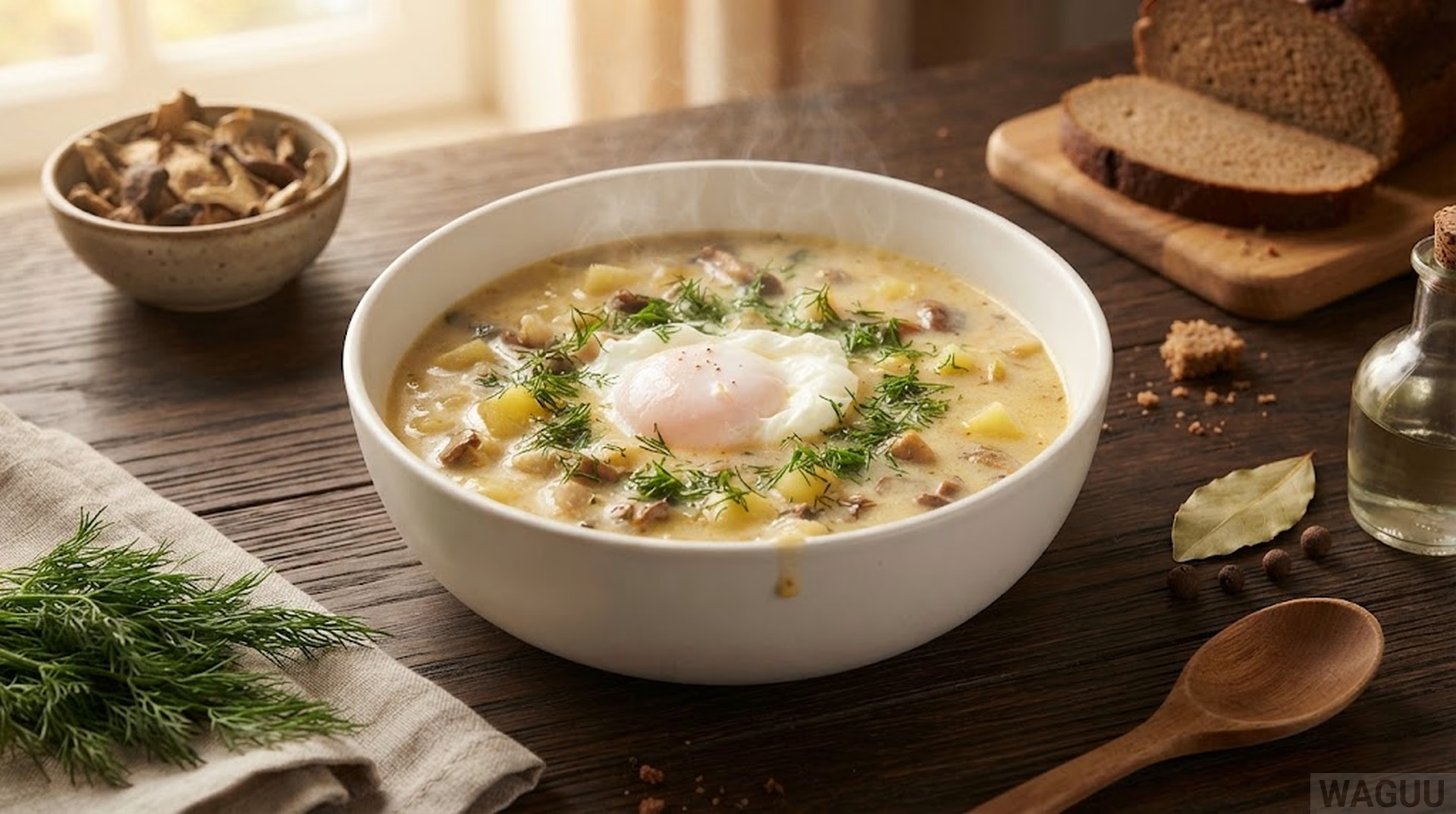
Summary: A creamy potato and mushroom soup from South Bohemia, finished with cream, fresh dill and vinegar, and served with a poached egg. Ready in 45 minutes, serves 6.
Cooked this recipe? Share your result with the community.
Category: Soups, Czech Cuisine
Success rate: not rated yet % of users mastered this recipe
Quick overview
- Dish: Kulajda Soup
- Category: Soups, Czech Cuisine
- Cuisine: Czech
- Main ingredient: Waxy potatoes, 600 g, and fresh mushrooms, 300 g
- Guide: 20 Most Famous Czech Dishes
- Total time: 45 minutes (15 min preparation + 30 min cooking)
- Difficulty: Easy
- Servings: 6 (Portion weight: 350 g)
- Key technique: Simmering
- Preparation types: Simmering, poaching
- Dietary info & allergens: Contains gluten, dairy, eggs
- Suitable for: Light lunches, everyday cooking, autumn and winter meals
- Nutritional values (per serving): 320 kcal, Protein: 12 g, Fat: 18 g, Carbohydrates: 28 g
- Storage: 2 days in the fridge • Freezer: not recommended (cream splits)
- Pairing: Pilsner, dry white wine, sparkling water
- In short: A pale, creamy potato soup with mushrooms, fresh dill and a poached egg – South Bohemia in a bowl.
- Last updated: 18 September 2026
WAGUU says: “Kulajda is a soup of small details. The vinegar lifts it, the dill lifts it, the egg lifts it. Take any of those away and you have a plain potato soup. Together they make something memorable.”
Key facts
| Preparation time: | 15 minutes |
| Cooking time: | 30 minutes |
| Temperature: | Gentle simmer (95 °C on the hob) |
| Servings: | 6 |
At a glance
A pale, creamy soup with soft potatoes, mushrooms and fresh dill, finished with a splash of vinegar and topped with a poached egg. The vinegar and dill are what make it taste like kulajda and not just any potato soup.
Ingredients
Base servings: 6 • Portion weight: 350 g
| Ingredient | Amount | Quality |
|---|---|---|
| Waxy potatoes | 600 g | Charlotte or similar |
| Fresh mushrooms | 300 g | button or wild, sliced |
| Onion | 1 piece | brown, medium, finely chopped |
| Butter | 40 g | unsalted |
| Plain flour | 30 g | fine |
| Vegetable stock | 1200 ml | good quality |
| Bay leaf | 1 piece | dried |
| Allspice berries | 4 pieces | whole |
| Caraway seeds | 0.5 tsp | whole |
| Double cream | 200 ml | 33–36% fat |
| White wine vinegar | 2 tbsp | good quality |
| Fresh dill | 20 g | fresh, finely chopped |
| Eggs | 6 pieces | fresh, for poaching |
| Fine sea salt | 2 tsp | fine |
| Black pepper | 0.5 tsp | freshly ground |
| Caster sugar | 1 tsp | fine |
| Fresh dill (for serving) | 5 g | a few sprigs |
Why you will love this recipe
- Ready in 45 minutes: Unlike most Czech classics, kulajda comes together quickly. Perfect for a weekday lunch or a light dinner.
- Simple ingredients, layered flavour: Potatoes, mushrooms, cream, dill and vinegar. Five ordinary things that together taste like a South Bohemian forest.
- The poached egg on top: When you break it, the yolk runs into the soup and makes it richer. That moment is the whole point of the dish.
Why it works: Waxy potatoes hold their shape during simmering, which gives the soup body without making it gluey. The roux thickens the broth gently, and the cream adds richness without masking the dill. The vinegar is added at the very end – it lifts the cream and keeps the soup from tasting flat. Fresh dill is stirred in off the heat because its aromatic compounds (mainly carvone) break down above 60 °C. The poached egg is the final element: the yolk adds fat and colour, the white adds texture.
Recipe overview
Preparation: 15 min | Cooking: 30 min | Difficulty: Easy | Servings: 6 | Type: Soup | Origin: Czech
Detailed method
Total progress: 0 % done
Phase 1: Preparation – 15 min
Equipment: Chopping board, sharp knife, vegetable peeler
1. Peel the potatoes and cut them into 2 cm cubes. Put them in a bowl of cold water to stop them browning. Clean the mushrooms with a damp cloth or a soft brush – do not wash them under running water, they soak up liquid. Slice them into 5 mm thick pieces. Peel and finely chop the onion.
VKB: The potatoes are cut into even cubes so they cook at the same rate. The mushrooms are clean but dry. The onion is chopped fine enough to melt into the soup.
Before you continue:
Do not wash mushrooms under running water. They act like sponges and will release water into the soup, diluting the flavour. Clean them with a damp cloth or a soft brush.
Phase 2: Mushroom base – 10 min
Equipment: Large pot (4 litres), wooden spoon
2. Melt the butter in a large pot over medium heat. Add the chopped onion and cook for 3 minutes until soft and translucent. Add the sliced mushrooms and cook for 5 minutes, stirring occasionally, until they release their liquid and it evaporates. The mushrooms should be slightly golden and smell nutty, not wet.
VKB: The mushrooms are soft, slightly golden and smell sweet and nutty. There is no liquid pooling at the bottom of the pot.
Before you continue:
Do not rush the mushrooms. They need the full 5 minutes to lose their water and start browning. If they are still wet when you add the stock, the soup will taste watery.
Phase 3: Roux and stock – 5 min
Equipment: Same pot, whisk
3. Sprinkle the flour over the mushrooms and onions and stir for 1 minute. The flour should coat everything evenly and start to smell faintly nutty – but it should not brown. Pour in the vegetable stock slowly, whisking constantly to prevent lumps. Add the bay leaf, allspice berries and caraway seeds.
VKB: The flour has disappeared into the mushrooms and onions. The stock is smooth, no lumps. The pot smells of mushrooms, caraway and bay.
Before you continue:
Do not let the flour brown. A brown roux will darken the soup and change its taste. Keep it pale – 1 minute is enough.
Phase 4: Simmering the potatoes – 20 min
Equipment: Same pot, lid, wooden spoon
4. Drain the potatoes and add them to the pot. Bring to a gentle simmer, cover with a lid and cook for 20 minutes. The potatoes should be soft enough to break with a spoon but should not fall apart. Stir once or twice during cooking to prevent sticking. Remove the bay leaf and allspice berries with a slotted spoon.
VKB: The potatoes are soft but hold their shape. A spoon pressed against a cube breaks it easily. The soup has thickened slightly.
Before you continue:
Never let the soup boil hard. A rolling boil breaks the potatoes into a mush and clouds the broth. Keep it at a gentle simmer.
Phase 5: Cream, dill and vinegar – 5 min
Equipment: Small bowl, whisk
5. Take the pot off the heat. In a small bowl, mix the cream with a ladleful of the hot soup – this tempers the cream so it does not split. Pour the tempered cream back into the pot and stir. Add the vinegar, sugar, salt and pepper. Taste and adjust. Now stir in the chopped fresh dill. Do not cook the soup after adding the dill.
VKB: The soup is pale cream with visible green flecks of dill. It tastes creamy, slightly tangy from the vinegar and fresh from the dill. The salt is balanced but present.
Before you continue:
Never pour cold cream straight into boiling soup. It will split into greasy flakes. Always temper it first with a ladleful of hot soup.
Phase 6: Poaching the eggs – 5 min
Equipment: Shallow pan, slotted spoon, small bowl
6. Bring a shallow pan of water to a gentle simmer. Add a splash of vinegar to the water. Crack each egg into a small bowl and slide it into the water. Poach for 3 minutes for a runny yolk. Remove with a slotted spoon and drain on kitchen paper. Ladle the soup into warm bowls and place one poached egg in the centre of each. Scatter a few fresh dill sprigs on top and serve immediately.
VKB: The egg white is set, the yolk still soft. When you break the yolk with a spoon, it runs into the soup and swirls with the cream. The soup is served hot but not boiling.
Required equipment
| Equipment | Ideal size | Alternative | Risk |
|---|---|---|---|
| Large pot | 4 litres, with lid | Dutch oven | Too small = soup splashes |
| Shallow pan | 24 cm | Deep frying pan | Too deep = eggs sink and stick |
| Slotted spoon | Standard kitchen spoon | Spatula | Spoon without slots drains poorly |
| Whisk | Balloon whisk | Fork | Fork leaves lumps |
Shopping list
Nutritional profile
Values per serving (with poached egg). Calculated from average nutritional values of ingredients.
| Nutrient | Per 100 g | Per serving | Per 6 servings |
|---|---|---|---|
| Energy | 91 kcal | 320 kcal | 1920 kcal |
| Fat | 5.1 g | 18 g | 108 g |
| of which saturated | 2.9 g | 10 g | 60 g |
| Carbohydrates | 8 g | 28 g | 168 g |
| of which sugars | 1.4 g | 5 g | 30 g |
| Protein | 3.4 g | 12 g | 72 g |
| Salt | 0.6 g | 2 g | 12 g |
Reference intake of an average adult (8400 kJ / 2000 kcal).
WAGUU Pro level
- Pro standard: Tested recipe with exact ratios and visual control points.
- Tip 1: Use wild mushrooms if you can – a handful of dried porcini soaked in warm water, or fresh chanterelles – for a deeper, earthier flavour.
- Tip 2: Add a small piece of dried mushroom to the stock for 10 minutes, then remove it. It deepens the mushroom flavour without adding texture.
- Tip 3: If you have time, poach the eggs in the soup itself instead of water. This adds egg flavour to the broth, but makes serving more complicated.
- Tip 4: Serve the soup in warm bowls. Kulajda cools quickly, and a cold bowl makes it taste flat.
Scientific background
The characteristic flavour of kulajda comes from three separate chemical systems working together. First, the mushrooms contain guanylate, a nucleotide that intensifies the umami of the vegetable stock by many times – this is why kulajda tastes richer than its simple ingredients would suggest. Second, the fresh dill contains carvone and limonene, volatile compounds that break down at temperatures above 60 °C – this is why the dill is added off the heat. Third, the vinegar lowers the pH of the soup slightly, which brightens the flavour and prevents the cream from tasting heavy. The poached egg adds lecithin (from the yolk), an emulsifier that helps the fat in the cream stay evenly dispersed in the broth.
Fine Dining – Professional techniques
- Plate composition: Serve in a wide, shallow bowl. Place the poached egg slightly off-centre, so it does not look like a bullseye.
- Texture contrasts: The soft potatoes and mushrooms contrast with the runny yolk and the cream.
- Temperature contrast: Serve the soup very hot and the poached egg just-warm, so the yolk stays soft when it meets the soup.
- Aromatic additions: A few drops of dill oil (or a pinch of lemon zest) over the top, and a small sprig of dill laid across the egg.
Sensory radar
- Appearance: Pale cream soup with visible potato cubes, mushroom slices and green flecks of dill
- Aroma: Mushrooms, dill, cream, a hint of vinegar
- Taste: Creamy, earthy from the mushrooms, fresh from the dill, gently tangy from the vinegar
- Texture: Soft potatoes, tender mushrooms, silky broth, runny yolk
Pairing
- BEER: Pilsner Urquell or a light wheat beer
- WINE: Dry white – Grüner Veltliner or Sauvignon Blanc
- SOFT DRINK: Sparkling water with lemon
Other preparation variations
- Kulajda with smoked mushrooms: Replace half the fresh mushrooms with smoked mushrooms. The soup takes on a deeper, almost meaty flavour.
- Lighter kulajda: Replace the double cream with single cream and skip the butter in the mushroom phase (use 1 tbsp of oil). The soup is thinner but much lighter.
Allergens and dietary information
Contains: Gluten, dairy, eggs • Gluten: Yes (roux) • Not suitable for: Coeliac disease, lactose intolerance (without substitutions)
Suitable for
Light lunches, everyday cooking, autumn and winter meals, meat-free days
Substitution catalogue
- Fresh mushrooms: Dried porcini, rehydrated (30 g dried replaces 300 g fresh), or frozen wild mushrooms
- Waxy potatoes: Any yellow-fleshed potato; avoid floury varieties
- Double cream: Crème fraîche or lactose-free cream
- White wine vinegar: Apple cider vinegar or lemon juice
FAQ
My soup tastes flat. How do I fix it?
Add a splash more vinegar and a pinch of salt. Kulajda needs both – the vinegar lifts the cream, the salt brings out the mushrooms. If it is still flat, add a teaspoon of soy sauce or a small piece of dried mushroom for 5 minutes, then remove it.
My soup is too thick. How do I fix it?
Add a splash of warm vegetable stock or milk. Stir gently and taste again. Do not add water – it dilutes the flavour.
Can I make this without eggs?
Yes. The soup works as a vegetarian potato and mushroom soup without the egg. It is lighter but still very good. Add a little more dill to compensate for the missing richness.
Can I freeze kulajda?
Not recommended. Cream-based soups separate when frozen and thawed. If you must freeze it, do so before adding the cream and dill. Add those fresh when reheating.
WAGUU Petr advises: Cooking for 6 or more?
6–8 people: Increase all ingredients by 30% and use a 5-litre pot. 10+ people: Double the recipe but poach the eggs in batches – the water cools down if you add too many eggs at once.
Storage and reheating
Fridge: 2 days • Freezer: Not recommended • Reheating: Gently on the hob, stirring often. Do not boil. If the soup has thickened, add a splash of milk or stock. Poach fresh eggs when serving.
Author: WAGUU Petr & Team • Published: 18 Sep 2026
More recipes from this article
Guide: 20 Most Famous Czech Dishes
Roast Pork with Dumplings and Sauerkraut
Garlic Roast Pork with Spinach and Dumplings
More recipes you might like
Why WAGUU?
Recipes on WAGUU are checked for accuracy of ingredients, methods and nutritional values.
Photo gallery from the process
Photos from the community: Cook, take a photo and share your result.
You can upload photos in the comments below or send them by email.
Have you filmed a video of our recipe? Post a link to YouTube, YouTube Shorts, TikTok, Instagram Reels, Facebook Reels, Pinterest, Vimeo or X (Twitter) in the comments – we will gladly publish it and help promote you and your content.
Most common mistakes
- Washing the mushrooms – they soak up water and release it into the soup, diluting the flavour. Clean them with a damp cloth.
- Adding the dill too early – dill loses its aroma above 60 °C. Stir it in off the heat, just before serving.
- Pouring cream into boiling soup – the cream splits into greasy flakes. Temper it first with a ladleful of hot soup.
- Not enough vinegar – without the vinegar, kulajda tastes flat and heavy. Add it at the end, one spoon at a time, tasting as you go.