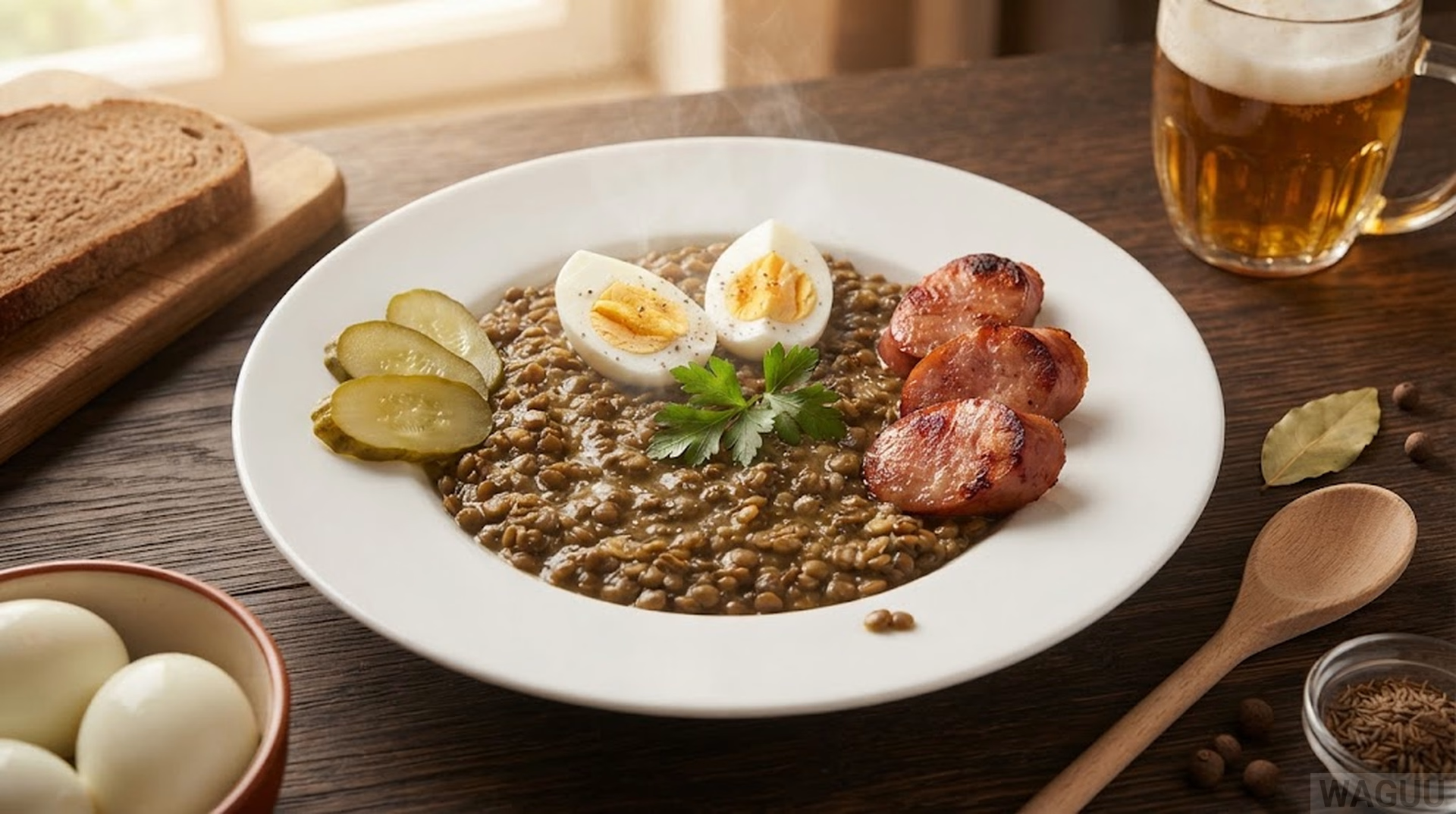
Summary: Brown lentils simmered with root vegetables and bay leaf, finished with vinegar, caramelised onion and a light roux. Served with a fried egg or smoked sausage. Ready in 60 minutes, serves 6.
Cooked this recipe? Share your result with the community.
Category: Meatless Dishes, Czech Cuisine
Success rate: not rated yet % of users mastered this recipe
Quick overview
- Dish: Sour Lentils (Čočka na kyselo)
- Category: Meatless Dishes, Czech Cuisine
- Cuisine: Czech
- Main ingredient: Brown lentils, 500 g (whole, dried)
- Guide: 20 Most Famous Czech Dishes
- Total time: 60 minutes (15 min preparation + 45 min cooking)
- Difficulty: Easy
- Servings: 6 (Portion weight: 380 g)
- Key technique: Simmering
- Preparation types: Simmering, frying
- Dietary info & allergens: Contains gluten, dairy, eggs
- Suitable for: Everyday cooking, meat-free days, New Year’s Eve, light dinners
- Nutritional values (per serving): 420 kcal, Protein: 22 g, Fat: 12 g, Carbohydrates: 56 g
- Storage: 3 days in the fridge • Freezer: 2 months
- Pairing: Pilsner, dry white wine, sparkling water
- In short: Soft, earthy brown lentils finished with vinegar, sweet caramelised onion and a fried egg on top.
- Last updated: 18 September 2026
WAGUU says: “Czech lentils are not a soup and not a stew. They are somewhere in between – soft but not mushy, tangy from vinegar, sweet from onions. A fried egg on top makes it a meal.”
Key facts
| Preparation time: | 15 minutes |
| Cooking time: | 45 minutes |
| Temperature: | Gentle simmer (95 °C on the hob) |
| Servings: | 6 |
At a glance
Soft brown lentils cooked with root vegetables, bay leaf and a pinch of caraway, then lifted with vinegar and sweet caramelised onion. Topped with a fried egg and served with bread or boiled potatoes. A simple dish that New Year’s Eve in Czech households has made famous.
Ingredients
Base servings: 6 • Portion weight: 380 g
| Ingredient | Amount | Quality |
|---|---|---|
| Brown lentils | 500 g | dried, whole, rinsed |
| Onions | 2 pieces | brown, medium, finely chopped |
| Carrots | 100 g | medium, sliced |
| Celeriac | 60 g | sliced |
| Bay leaves | 2 pieces | dried |
| Caraway seeds | 1 tsp | whole, lightly crushed |
| Ground allspice | 0.25 tsp | ground |
| Pork lard | 50 g | or butter |
| Plain flour | 30 g | fine |
| White wine vinegar | 3 tbsp | good quality |
| Caster sugar | 1 tbsp | fine |
| Fine sea salt | 2 tsp | fine |
| Black pepper | 0.5 tsp | freshly ground |
| Eggs | 6 pieces | large, for frying |
| Butter (for eggs) | 30 g | unsalted |
| Smoked sausage | 200 g | optional, for serving |
| Fresh parsley | 10 g | fresh, chopped, for serving |
Why you will love this recipe
- Ready in one hour: Dried lentils cook quickly compared to beans. No overnight soaking, no pressure cooker, no fuss.
- Better the next day: The vinegar and onion deepen overnight. Reheat gently and the dish tastes richer than on the first day.
- Vegetarian or not – your choice: The base is fully meat-free. Add a fried egg, smoked sausage or both. The dish works either way.
Why it works: Brown lentils hold their shape during cooking but soften enough to absorb flavours. The bay leaf, caraway and allspice are the traditional Czech trio for legumes – they cut through the earthy, slightly dusty flavour that lentils have on their own. Vinegar is added at the end, after the lentils have softened: too early and the acid keeps the lentil skins tough. The roux, made with lard and flour, gives the dish body without turning it into a soup. The caramelised onion is stirred in at the very end so it stays sweet and does not dissolve into the mass.
Recipe overview
Preparation: 15 min | Cooking: 45 min | Difficulty: Easy | Servings: 6 | Type: Main course | Origin: Czech
Detailed method
Total progress: 0 % done
Phase 1: Preparation – 15 min
Equipment: Colander, chopping board, sharp knife, vegetable peeler
1. Put the lentils in a colander and rinse them under cold running water. Pick through them with your fingers and remove any small stones or damaged lentils. Peel and finely chop the onions. Peel the carrots and celeriac and cut them into 1 cm slices. Peel and crush the garlic if you are using it (optional).
VKB: The lentils are free of stones and dirt. The onions are chopped fine. The vegetables are sliced evenly.
Before you continue:
Always pick through the lentils. Small stones the same colour as the lentils can hide at the bottom of the bag and break a tooth. A minute of your time is worth it.
Phase 2: Cooking the lentils – 30 min
Equipment: Large pot (4 litres), wooden spoon, lid
2. Put the rinsed lentils into a large pot with the carrots, celeriac, one chopped onion, bay leaves, caraway seeds and ground allspice. Add 1500 ml of cold water – the lentils should be covered by about 3 cm. Bring to a gentle simmer and cook, partially covered, for 25–30 minutes. Do not add salt at this stage – salt hardens the lentil skins and they will take twice as long to soften. Stir occasionally and check that the lentils are always just covered with water; add a splash more if needed.
VKB: The lentils are soft – press one against the side of the pot with a spoon and it gives way easily. They hold their shape but are no longer firm. The liquid has reduced and thickened slightly.
Before you continue:
Do not add salt or vinegar while the lentils are cooking. Both harden the skins and the lentils will never fully soften. Salt goes in at the end, after the lentils are cooked.
Phase 3: Roux – 5 min
Equipment: Small pan, whisk or wooden spoon
3. While the lentils cook, make the roux. Melt half the lard in a small pan over medium heat. Add the flour and stir constantly for 2 minutes. The roux should be pale golden and smell faintly nutty, not raw. Take the pan off the heat and set it aside. Do not let it brown – a dark roux would change the colour and flavour of the lentils.
VKB: The roux is smooth, pale golden and smells nutty. It runs off the spoon slowly. No lumps, no dark spots.
Before you continue:
Keep the roux pale. If it browns, it will darken the lentils and give them a roasted flavour that does not belong in this dish.
Phase 4: Thickening and finishing – 10 min
Equipment: Same pot, ladle, whisk
4. When the lentils are soft, add the roux. Spoon the roux into the pot and whisk it in thoroughly – if you just stir it, it will form lumps. Cook for 5 minutes on low heat so the flour cooks out and the dish thickens. Now add the salt, sugar and vinegar. Taste and adjust: lentils should be tangy and slightly sweet, not sour and not sweet. If the mixture is too thick, add a splash of water. If it is too thin, cook uncovered for another 5 minutes.
VKB: The lentils are soft, hold their shape but are coated in a light sauce. The taste is balanced – tangy from the vinegar, sweet from the sugar, salty from the salt. No taste of raw flour.
Before you continue:
Add the vinegar one tablespoon at a time and taste after each. It is easier to add more than to fix an over-sour pot. The vinegar is what makes Czech lentils taste like Czech lentils – but too much ruins the dish.
Phase 5: Caramelised onion – 10 min
Equipment: Frying pan, wooden spoon
5. While the lentils finish, heat the remaining lard in a frying pan over medium heat. Add the second chopped onion and cook for 8–10 minutes, stirring often, until the onion is deep golden and sweet, not just soft. If it starts to catch, add a teaspoon of water. When the onion is ready, stir it into the lentils. This is the sweet note that balances the vinegar.
VKB: The onion is deep golden and sticky. It smells sweet, not sharp. There are no burnt spots.
Before you continue:
The onion needs the full 8–10 minutes to become properly sweet. Pale onion does not balance the vinegar. Do not rush this step.
Phase 6: Fried eggs and serving – 10 min
Equipment: Frying pan, spatula, warm plates
6. Fry the eggs in butter over medium heat – sunny side up, with the yolk still soft. Fry two eggs per person if they are the only topping, or one if you are also serving smoked sausage. Ladle the lentils onto warm plates, place the fried egg on top, scatter with fresh chopped parsley and add a slice or two of warmed smoked sausage on the side if using. Serve with rye bread or boiled potatoes.
VKB: The egg white is set, the yolk still soft. When you cut into the yolk, it runs into the lentils and mixes with the sauce. The parsley is bright green on top.
Required equipment
| Equipment | Ideal size | Alternative | Risk |
|---|---|---|---|
| Large pot | 4 litres, with lid | Dutch oven | Too small = lentils dry out |
| Small pan for roux | 18 cm | Heavy-bottomed saucepan | Thin pans burn the flour |
| Frying pan for onion | 24 cm | Any heavy pan | Thin pans catch the onion |
| Whisk | Balloon whisk | Fork | Fork leaves lumps in the roux |
Shopping list
Nutritional profile
Values per serving (with 1 fried egg). Calculated from average nutritional values of ingredients.
| Nutrient | Per 100 g | Per serving | Per 6 servings |
|---|---|---|---|
| Energy | 111 kcal | 420 kcal | 2520 kcal |
| Fat | 3.2 g | 12 g | 72 g |
| of which saturated | 1.3 g | 5 g | 30 g |
| Carbohydrates | 14.7 g | 56 g | 336 g |
| of which sugars | 1.4 g | 5 g | 30 g |
| Protein | 5.8 g | 22 g | 132 g |
| Salt | 0.6 g | 2.3 g | 13.8 g |
Reference intake of an average adult (8400 kJ / 2000 kcal).
WAGUU Pro level
- Pro standard: Tested recipe with exact ratios and visual control points.
- Tip 1: Use brown or green lentils, not red. Red lentils break down into mush and the dish loses its texture.
- Tip 2: Add a teaspoon of the onion’s caramelised fat to the lentils just before serving. It ties the sweet and tangy elements together.
- Tip 3: If you have a piece of smoked bacon or ham bone, add it to the pot while the lentils cook. Remove it before serving. This is the traditional way and it deepens the flavour without making the dish heavy.
- Tip 4: The dish is even better reheated the next day. Make it in advance and gently reheat on the hob, adding a splash of water if needed.
Scientific background
Lentils are legumes, and like all legumes they contain pectin in their cell walls. During cooking, the pectin dissolves and the lentils soften – but the process is sensitive to acid and salt. Adding salt or vinegar early in the cooking raises the temperature at which pectin dissolves, so the lentils stay hard. This is why both go in at the end. The earthy, slightly dusty flavour of lentils comes from a group of compounds called pyrazines, which develop during storage and are carried in the skin. The bay leaf, caraway and allspice in this recipe do not just add flavour – their aromatic compounds (eucalyptol, carvone and eugenol) mask the pyrazine notes and let the lentil’s natural sweetness come through. The vinegar works on two levels: its acetic acid brightens the flavour and lowers the pH, which preserves the lentils’ colour. The caramelised onion adds Maillard-reaction compounds that deepen the whole dish.
Fine Dining – Professional techniques
- Plate composition: Spoon the lentils into a shallow bowl, place the fried egg on top slightly off-centre, and add a slice of smoked sausage on the side. Scatter with parsley.
- Texture contrasts: The soft lentils contrast with the runny yolk and the slightly crisp edge of the fried egg white.
- Temperature contrast: Serve the lentils hot, the fried egg hot, the parsley cold from the fridge.
- Aromatic additions: A small pinch of freshly ground black pepper over the egg, and a few drops of vinegar over the lentils just before serving.
Sensory radar
- Appearance: Brown lentils in a pale brown sauce, with deep golden onion, a fried egg on top and green parsley
- Aroma: Earthy lentils, sweet onion, bay, a hint of vinegar
- Taste: Earthy, tangy from the vinegar, sweet from the onion, rich from the egg yolk
- Texture: Soft lentils, silky sauce, runny yolk, crisp egg white edges
Pairing
- BEER: Pilsner Urquell or a dark lager like Kozel Černý
- WINE: Dry white – Riesling or Grüner Veltliner
- SOFT DRINK: Sparkling water with lemon
Other preparation variations
- Sour lentils with smoked sausage: Add 200 g of sliced smoked sausage in the last 10 minutes. The smoke deepens the lentils and turns the dish into a complete meal.
- Lighter sour lentils: Replace the lard with butter and use less roux (20 g flour). The dish is lighter but less authentic.
Allergens and dietary information
Contains: Gluten, dairy, eggs • Gluten: Yes (roux) • Not suitable for: Coeliac disease (without substitutions), lactose intolerance (without substitutions)
Suitable for
Everyday cooking, meat-free days, New Year’s Eve, light dinners, autumn and winter meals
Substitution catalogue
- Brown lentils: Green lentils (similar cooking time) or Puy lentils (firmer texture)
- Pork lard: Butter or sunflower oil (for vegetarian version)
- White wine vinegar: Apple cider vinegar or lemon juice
- Plain flour: Gluten-free flour blend for the roux
FAQ
My lentils are still hard. What went wrong?
You probably added salt or vinegar too early. Both harden the lentil skins. They should go in at the very end, after the lentils are already soft. If they are still hard, add a pinch of bicarbonate of soda and cook for another 10 minutes – it softens them.
My lentils are mushy. What went wrong?
They cooked too long or you used red lentils, which break down very quickly. Brown or green lentils hold their shape better. Next time, check them at 20 minutes – they should be soft but hold their shape.
My lentils taste flat. How do I fix it?
Add a splash more vinegar and a pinch more salt. The two work together – the vinegar lifts the flavour, the salt brings out the lentils. If it is still flat, add a teaspoon of soy sauce or a small piece of smoked bacon.
Can I make sour lentils in advance?
Yes. Make them fully and refrigerate for up to 3 days. Reheat gently on the hob, adding a splash of water if they have thickened. The flavour deepens overnight – many Czechs say the second day is better than the first. Fry the eggs fresh when serving.
WAGUU Petr advises: Cooking for 6 or more?
6–8 people: Use 700 g of lentils and 2.2 litres of water. Keep the roux and vinegar the same at first, then adjust after tasting. 10+ people: Cook in two pots to keep the lentils from crowding. Crowded lentils do not cook evenly and can stick to the bottom.
Storage and reheating
Fridge: 3 days • Freezer: 2 months (without eggs) • Reheating: Gently on the hob, adding a splash of water or stock if the lentils have thickened. Do not boil. Fry fresh eggs when serving.
Author: WAGUU Petr & Team • Published: 18 Sep 2026
More recipes from this article
Guide: 20 Most Famous Czech Dishes
Roast Pork with Dumplings and Sauerkraut
Garlic Roast Pork with Spinach and Dumplings
More recipes you might like
Why WAGUU?
Recipes on WAGUU are checked for accuracy of ingredients, methods and nutritional values.
Photo gallery from the process
Photos from the community: Cook, take a photo and share your result.
You can upload photos in the comments below or send them by email.
Have you filmed a video of our recipe? Post a link to YouTube, YouTube Shorts, TikTok, Instagram Reels, Facebook Reels, Pinterest, Vimeo or X (Twitter) in the comments – we will gladly publish it and help promote you and your content.
Most common mistakes
- Adding salt or vinegar too early – both harden the lentil skins and the lentils never fully soften. Add them at the very end.
- Using red lentils – they break down into mush and lose their shape. Use brown or green lentils.
- Not enough vinegar – without the vinegar, lentils taste flat and heavy. Add it one spoon at a time and taste after each.
- Rushing the caramelised onion – it needs the full 8–10 minutes to become sweet. Pale onion does not balance the vinegar.