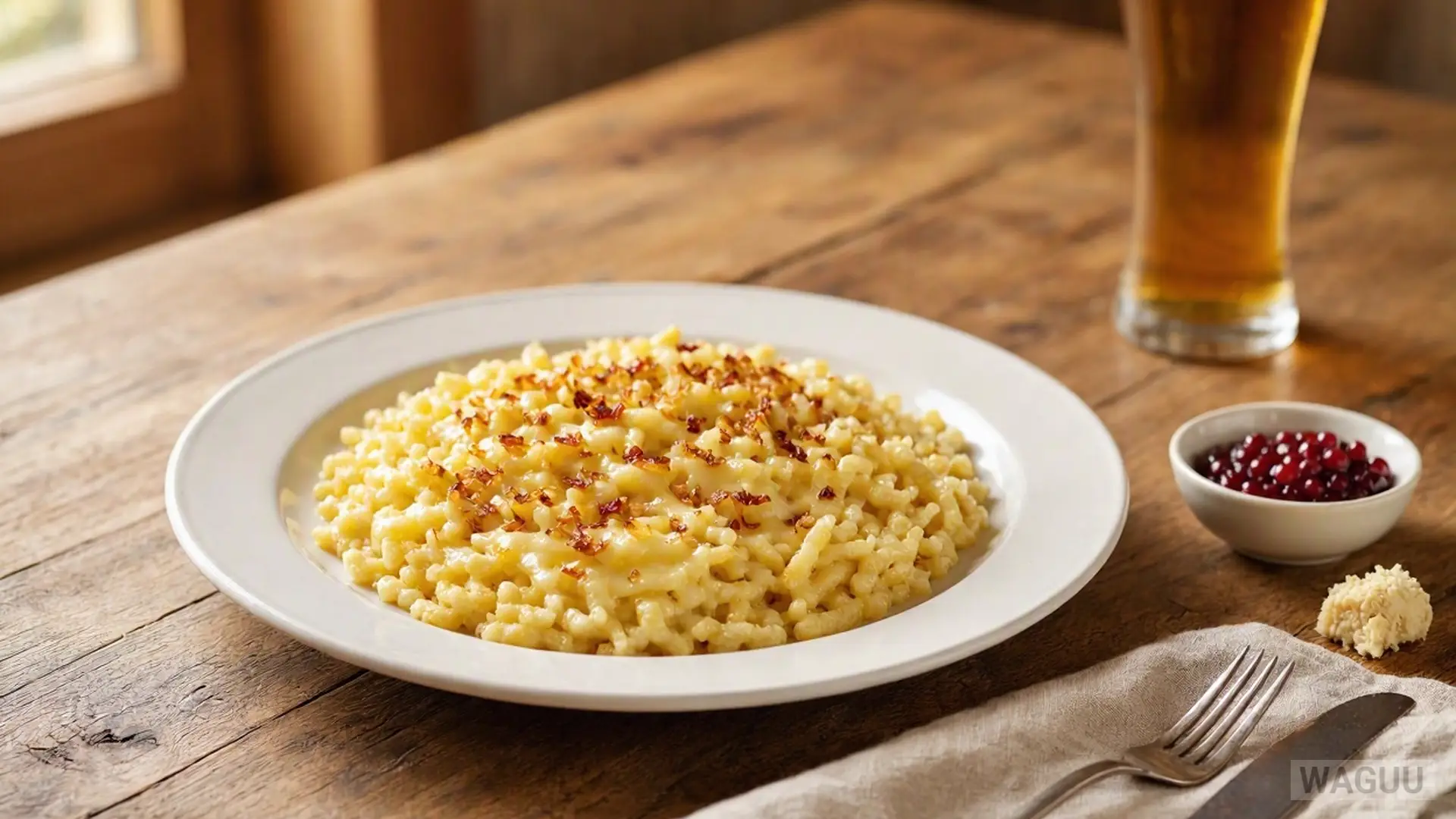
Summary: Käsespätzle is a quintessential Alpine comfort dish featuring tender, handmade egg noodles tossed with a blend of pungent mountain cheeses and sweet, caramelized onions. This traditional preparation focuses on achieving the perfect ratio of elastic dough to rich, molten cheese, requiring precision in boiling and folding techniques. Preparation takes approximately 45 minutes for 6 servings.
Did you make this recipe? Share the result with the community.
Category: Meatless Dishes, Austrian Cuisine
Success rate: 98% of users successfully made this recipe
Quick overview
- Dish: Käsespätzle
- Category: Meatless Dishes, Austrian Cuisine
- Cuisine: Austrian
- Main ingredient: All-purpose flour, 1.5 lb (handmade egg noodles)
- Guide: 12 Most Popular Austrian Dishes
- Total time: 45 minutes (15 min prep + 30 min cooking)
- Difficulty: Intermediate
- Servings: 6 (Serving weight: 350 g)
- Key technique: Dough scraping and cheese folding
- Preparation types: Boiling and broiling
- Dietary info & Allergens: Contains gluten, milk, eggs
- Suitable for: Vegetarian
- Nutritional values (per 1 serving): 620 kcal, Protein: 24 g, Fat: 28 g, Carbs: 68 g
- Storage: 2 days in the fridge, 2 months in the freezer
- Pairing: Grüner Veltliner, Lager beer, Sparkling water
- In a nutshell: Rich, cheesy, and deeply satisfying—the ultimate Alpine soul food.
- Last updated: September 21, 2026
WAGUU says: “The secret to authentic Käsespätzle lies in the consistency of the dough and the quality of the mountain cheese. Never rush the caramelization of the onions; their sweetness provides the necessary contrast to the sharp, salty cheese profile.”
How to take it further: Add a pinch of freshly grated nutmeg to the dough and finish the dish with a dusting of fresh chives.
Key facts
| Prep time: | 15 min |
| Cooking time: | 30 min |
| Temperature: | 400 °F |
| Number of servings: | 6 |
In a nutshell
Käsespätzle is a beloved Austrian classic. This recipe uses a high-hydration egg dough, scraped directly into boiling water to create irregular, rustic noodles. These are then layered with a mixture of sharp mountain cheese and finished with crispy fried onions. It is a hearty, vegetarian-friendly dish perfect for cold days.
Ingredients
Base servings: 6 servings • Serving weight: 350 g
| Ingredient | Quantity | Quality |
|---|---|---|
| All-purpose flour | 1.5 lb | High protein content |
| Large eggs | 6 pc | Room temperature |
| Mountain cheese (Emmental/Gruyère) | 1 lb | Coarsely grated |
| Yellow onions | 3 pc | Thinly sliced |
| Butter | 4 oz | Unsalted |
| Salt | 1.5 tsp | Fine sea salt |
Why you’ll love this recipe
- Authentic Texture: The handmade scraping technique creates noodles with a superior chew compared to extruded versions.
- Rich Flavor Profile: The combination of nutty mountain cheese and sweet, caramelized onions creates a balanced savory depth.
- Comforting Simplicity: Using basic, high-quality pantry staples, this dish delivers sophisticated flavors with minimal complexity.
Why it works: The high egg content in the dough ensures the noodles remain tender even after being folded with cheese, while the salt content in the cheese is balanced by the natural sweetness of the caramelized onions.
Recipe overview
Prep: 15 min | Cooking: 30 min | Difficulty: Intermediate | Servings: 6 | Type: Main Dish | Origin: Austrian
Detailed instructions
Overall progress: 0% completed
Phase 1: Dough Preparation – 10 min
Appliances: Mixing bowl
1. In a large mixing bowl, combine the flour, eggs, and 1 tsp salt. Mix vigorously with a wooden spoon until the dough is smooth and elastic, forming long threads when pulled. Let it rest for 10 minutes.
VKB: The dough should be thick enough to hold its shape on a scraper but sticky enough to pull slightly.
Before moving to the next step:
Ensure the dough has rested properly to relax the gluten, making it easier to scrape.
Phase 2: Caramelizing Onions – 15 min
Appliances: Skillet
2. Melt 2 oz of butter in a skillet over medium heat. Add the sliced onions and sauté, stirring frequently, until they turn golden brown and sweet, approximately 12–15 minutes.
VKB: The onions must be deeply caramelized and soft, not burnt or crunchy.
Before moving to the next step:
Remove the onions from the heat and set aside to keep them crisp.
Phase 3: Boiling Noodles – 5 min
Appliances: Pot
3. Bring a large pot of salted water to a boil. Using a spaetzle scraper or a knife, scrape small strips of dough into the boiling water. Once the noodles float to the surface, they are cooked; remove them immediately with a slotted spoon.
VKB: Noodles should be firm yet tender, not mushy.
Before moving to the next step:
Drain the noodles briefly, ensuring they remain hot for the cheese assembly.
Phase 4: Assembly – 0 min
Appliances: Oven
4. In a warm casserole dish, layer the hot noodles with the grated cheese. Repeat until all ingredients are used, ending with a layer of cheese.
VKB: The heat from the noodles should begin melting the cheese immediately.
Phase 5: Broiling – 0 min
Appliances: Oven
5. Place the casserole under the broiler at 400 °F for 2–3 minutes until the cheese is bubbly and slightly golden. Remove from the oven and top with the caramelized onions.
VKB: The cheese should be fully melted and the top lightly browned.
Required equipment
| Utensil | Ideal size | Alternative | Risk |
|---|---|---|---|
| Spaetzle scraper | Standard | Knife and board | Uneven noodle size |
| Mixing bowl | Large | Pot | Difficult mixing |
| Casserole dish | Medium | Skillet | Overflow |
Shopping list
Nutrition profile
Values per 1 serving (excluding side dishes). Calculated from average ingredient nutrition values.
| Nutrient | Per 3.5 oz (100 g) | Per 1 serving | Per 6 servings |
|---|---|---|---|
| Energy | 177.1 kcal | 620.0 kcal | 3720.0 kcal |
| Fat | 8.0 g | 28.0 g | 168.0 g |
| of which saturates | 4.5 g | 15.7 g | 94.2 g |
| Carbohydrates | 19.4 g | 68.0 g | 408.0 g |
| of which sugars | 1.4 g | 5.0 g | 30.0 g |
| Protein | 6.8 g | 24.0 g | 144.0 g |
| Salt | 0.3 g | 1.0 g | 6.0 g |
Reference intake of an average adult (8400 kJ / 2000 kcal).
WAGUU Pro level
- Pro standard: Verified recipe with precise ratios and visual checkpoints.
- Tip 1: Use a mix of Emmental and Gruyère for the best flavor balance.
- Tip 2: Ensure the pasta dough is kept at room temperature before scraping.
- Tip 3: Use a wide-mouth pot to prevent noodles from clumping during boiling.
- Tip 4: Keep the casserole dish warm before assembly to prevent the cheese from seizing.
Scientific background
The formation of the noodle structure relies on the coagulation of egg proteins and the development of gluten in the flour. When combined, these create a resilient texture. The cheese melting process is a function of protein cross-linking; high-quality mountain cheese provides the correct pH for smooth, non-stringy melting.
Fine Dining – Professional techniques
- Plate composition: Serve in individual cast-iron skillets to maintain heat.
- Texture contrasts: The soft noodles against the crunch of fried onions provide depth.
- Temperature contrast: Serve with a cool, crisp side salad to cut the richness.
- Aromatic garnishes: Finish with fresh wild garlic or chives for brightness.
Sensory radar
- Appearance: Golden, bubbly, with visible strands of caramelized onion.
- Aroma: Nutty, cheesy, with sweet caramelized onion notes.
- Taste: Savory, salty, with a subtle sweetness from the onions.
- Texture: Soft, chewy noodles enveloped in molten cheese.
Pairing
- BEER: A crisp, refreshing Helles lager.
- WINE: A dry, high-acid Grüner Veltliner.
- NON-ALCOHOLIC: Sparkling mineral water with a slice of lemon.
Various preparation methods
- Stovetop Finish: Instead of the oven, finish the noodles directly in the pan with a lid until melted.
- Herb Infused: Mix finely chopped parsley or chives directly into the noodle dough.
Allergens and dietary information
Contains: Gluten, milk, eggs • Gluten: Contains wheat flour • Not suitable for: Vegans, lactose-intolerant individuals
Suitable for
Vegetarians and comfort food enthusiasts.
Substitution guide
- Mountain cheese: Use a blend of Sharp Cheddar and Fontina if mountain cheese is unavailable.
FAQ
Can I use store-bought noodles?
Yes, but the texture will be less authentic than handmade scraped spaetzle.
Why did my cheese clump?
The heat was likely too high; ensure the oven is at 400 °F and watch carefully.
Can I make this ahead?
It is best served fresh but can be reheated gently in the oven.
What if the dough is too stiff?
Add an extra tablespoon of water or egg until the desired consistency is reached.
WAGUU Petr advises: Cooking for 12 or more people?
12–16 people: Prepare the noodles in two batches and use two separate casserole dishes for even melting. 20+ people: Use a large commercial-grade oven and prepare the onion topping in a separate large pot to ensure even caramelization.
Sides and serving
- Green Side Salad – A crisp salad with vinaigrette balances the cheese (not included in the recipe)
- Pickled Cucumbers – Provides acidity to cut the richness (not included in the recipe)
Serving: Serve directly in the dish while hot and bubbling.
Storage and reheating
Fridge: 2 days • Freezer: 2 months • Reheating: Bake covered at 350 °F until heated through.
Author: WAGUU Petr & Team • Published: 21 Sep 2026 • Updated: 30 Oct 2026
More Recipes in This Article
Guide: 12 Most Popular Austrian Dishes
Schweinsbraten mit Knödeln
Salzburger Nockerl
Apfelstrudel
Kaiserschmarrn
Other recipes you might enjoy
Why WAGUU?
Recipes on WAGUU undergo checks for ingredient accuracy, procedures, and nutritional values.
Process photo gallery
Community photos: Cook, take a picture, and share your results.
You can upload photos in the comments below or send them via email.
Did you record a video of your process for our recipe? Paste a link to YouTube, YouTube Shorts, TikTok, Instagram Reels, Facebook Reels, Pinterest, Vimeo, or X (Twitter) in the comments – we’d love to share it and help give you and your content more visibility.
Common mistakes
- Overcooking the noodles: Results in mushy texture instead of firm-tender.
- Using low-quality cheese: Poor melting properties ruin the sauce consistency.
- Burning the onions: Bitter notes overwhelm the dish’s natural sweetness.
- Improper layering: Not alternating cheese and noodles leads to uneven melting.