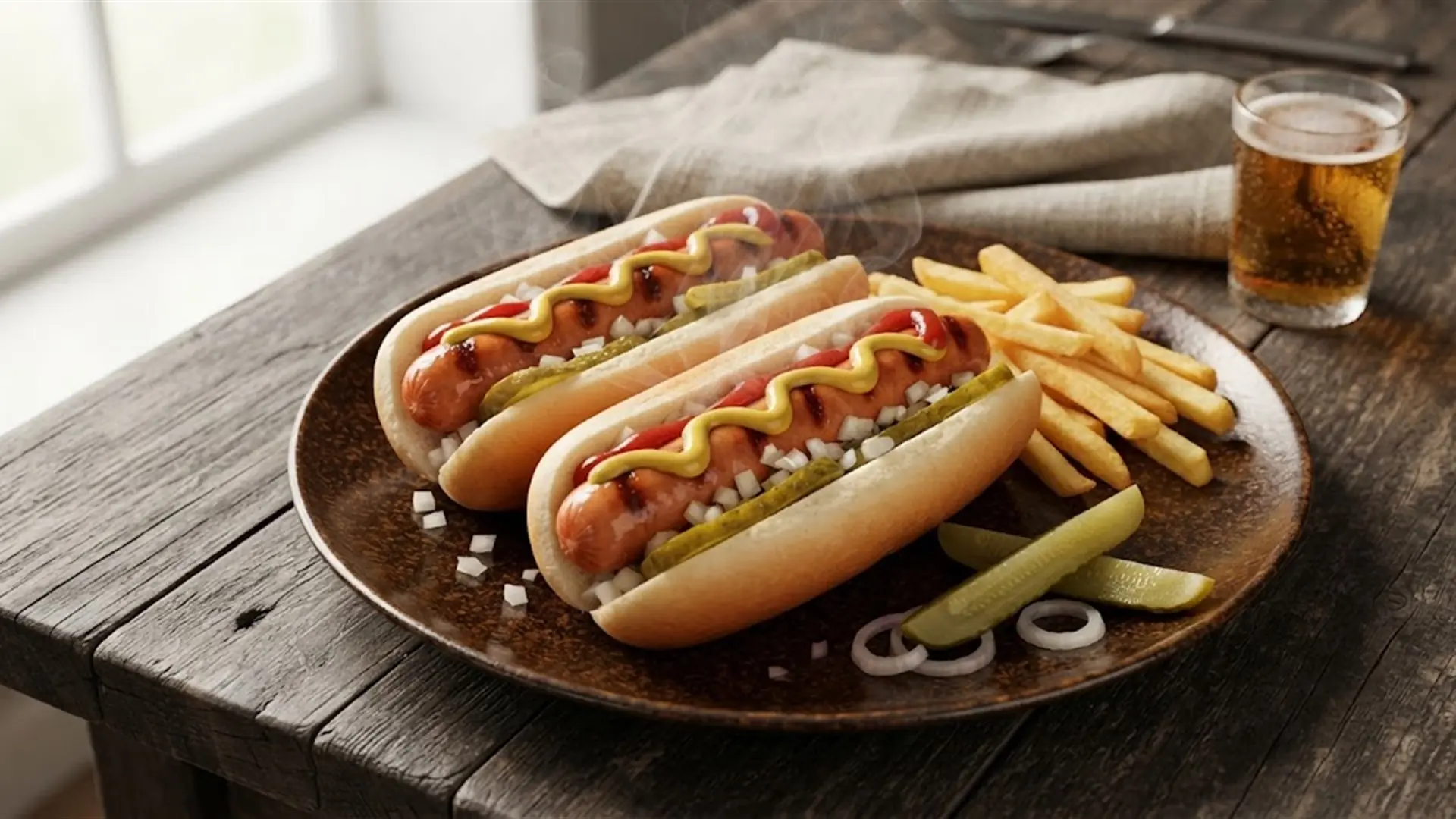
Summary: Hot Dog – quality pork sausages warmed in water just below a simmer or grilled, tucked into a split, toasted bun. Topped with yellow mustard, ketchup, diced onion, pickles, pickled peppers, and Cheddar. Total time 24 minutes, makes 6 servings.
Did you make this recipe? Share your result with the community.
Category: Pork, American cuisine
Success rate: not rated yet% of users nailed this recipe
Quick overview
- Dish: Hot Dog – grilled or boiled sausages in a long bun, traditionally served with mustard, ketchup, onion, or other toppings
- Category: Pork, American cuisine
- Cuisine: American
- Main ingredient: Pork sausages, 6 links (meat content above 85%, no mechanically separated meat)
- Guide: 12 most famous American dishes: traditional American recipes
- Total time: 24 minutes (12 min prep + 12 min cooking)
- Difficulty: Easy
- Servings: 6 (Serving size: 211 g)
- Key technique: Heating in water just below a simmer (around 175°F) and toasting the split bun
- Cooking methods: Classic boiling, grilling and broiling, pan-frying, baking
- Dietary info & allergens:gluten, milk, mustard
- Great for: Quick homemade fast food, grilling, parties, picnics, family dinner
- Nutrition (per serving): 482 kcal, Protein: 18.0 g, Fat: 29.2 g, Carbs: 36.7 g
- Storage: 2 days in the fridge, 1 month in the freezer
- Pairing: Pale lager, dry rosé, homemade lemonade
- In short: What matters is a sausage with high meat content and the water temperature – around 175°F is enough; a rolling boil will split the casing.
WAGUU says: “A hot dog is a sausage, a bun, and sauce – three things that can go wrong in three ways: a split sausage, a soggy bun, and sauces added before the bun has had a chance to seal from toasting.”
Key facts
| Prep time: | 12 minutes |
| Cook time: | 12 minutes |
| Temperature: | Water around 175°F (just below a simmer); grill or pan 400–425°F; oven 350°F for buns |
| Servings: | 6 |
At a glance
The sausage is heated in water just below a simmer so it stays smooth and doesn’t split. The bun is split, toasted inside with butter, and brushed with mustard, which creates a fatty layer between the bread and the juices. Only then do the cold toppings go on. In twenty-four minutes you have food that tastes like a street cart but stands on specific ingredients.
Ingredients
Base servings: 6 servings • Serving size: 211 g
| Ingredient | Amount | Quality |
|---|---|---|
| Pork sausages | 6 links | Pork sausages with meat content above 85%, no mechanically separated meat and no excessive starch |
| Hot dog buns | 6 buns | Soft hot dog buns, 6 inches long, fresh, not overly absorbent |
| Butter | 1.0 oz | Unsalted butter, at least 82% fat |
| Yellow mustard | 0.7 oz | Smooth yellow mustard, not whole-grain Dijon |
| Ketchup | 2.0 oz | Tomato ketchup without high-fructose corn syrup |
| Onion | 5.5 oz | Yellow onion, firm, finely diced |
| Pickles | 3.0 oz | Sour pickles in a sweet-and-sour brine, firm |
| Pickled peppers | 0.09 oz | Pickled pepperoncini or banana peppers in brine |
| Cheddar | 2.5 oz | Aged Cheddar, coarsely grated |
| Water | 8.5 cups | Drinking water for heating the sausages |
| Fine sea salt | 0.5 tsp | Fine sea salt for the buns |
| Ground black pepper | 0.04 oz | Freshly ground black pepper |
Why you’ll love this recipe
- Done in half an hour: From unwrapping the sausages to the first bite takes 24 minutes, 12 of which are just the water heating and the buns toasting in the oven.
- A specific temperature instead of guesswork: Water around 175°F heats the sausage evenly and keeps the casing intact. A cooking thermometer is more useful here than any amount of experience.
- Great for parties: Ingredients can be prepped ahead and chopped into bowls. Everyone builds their own hot dog, and the host just stands by the pot.
Why it works: Water around 175°F transfers heat to the sausage more slowly than boiling water, so the inside warms through before the steam pressure inside the casing overcomes the strength of the casing – the sausage stays smooth and doesn’t split. Toasting the split bun evaporates some surface moisture and the butter fat seals the bread’s pores, so ketchup and sausage juices don’t soak into the crumb. Mustard goes on the butter layer and creates another barrier.
Recipe overview
Prep: 12 min | Cook: 12 min | Difficulty: Easy | Servings: 6 | Type: Main dish | Origin: American
Detailed instructions
Overall progress: 0 % done
Phase 1: Prep ingredients and workspace – 5 min
Appliances: none
0.5 Take the pork sausages out of the package, pat them dry with a paper towel, and let them sit at room temperature for 10 minutes. Pour water into a tall pot – the level should reach about 2 inches above the sausages. On a cutting board, finely dice the yellow onion, slice the pickles and peppers into thin rounds, and coarsely grate the Cheddar. Get out the yellow mustard, ketchup, butter, and fine sea salt.
VKB: The sausages are matte and dry on the surface, with no wet film left on the towel. The onion is diced into about 1/16-inch pieces, the pickles and peppers into 1/8-inch rounds. All toppings are in bowls within reach of the stove.
Before you move on:
Don’t rinse the sausages. Surface water turns to steam during heating and splits the casing. Pat them dry with a paper towel and give them ten minutes to come to room temperature.
Phase 2: Scoring and heating the sausages – 7 min
Appliances: Tall pot, kitchen thermometer, stove
2. Make three to four shallow diagonal cuts about 1/16 inch deep on each sausage with the tip of a knife. Bring the pot of water to a boil, then lower the heat so the water just barely bubbles, and check with the thermometer that the temperature stays around 175°F. Add the sausages and heat for 5–6 minutes, until warmed through to the center. Turn them once during heating.
VKB: The water surface only vibrates gently, with occasional bubbles at the bottom that don’t rise to the surface. The sausages float up, the casing is smooth and glossy, and the cuts have opened. When pierced at a cut, clear juices run out.
Before you move on:
If the water boils hard, the sausage splits and some fat leaks into the water. Lower the heat so the surface just shimmers, and let the sausages finish in the hot water. If you’re heating the sausages in a pan or on the grill, use medium heat and turn them along their whole length.
Phase 3: Toasting the buns – 5 min
Appliances:Oven 350°F, skillet, parchment paper
0.5Split the buns lengthwise, but don’t cut all the way through – the bottom should hold together. Open them up and brush the insides with a thin layer of softened butter so the fat gets into the entire crumb. Place them in the oven preheated to 350°F for 3–4 minutes, buttered side up, until the crumb takes on a golden hue. A dry skillet over medium heat gives the same result. After removing, sprinkle the insides with fine sea salt.
VKB:The insides of the buns are golden, dry to the touch, and the butter has soaked in. The crumb springs back when pressed. The bun holds its open shape and doesn’t close on its own.
Before you move to the next step:
Don’t butter the buns on the outside or toast them dry. The fat belongs inside – it creates a layer that keeps ketchup from soaking into the crumb. A bun without this layer gets soggy within two minutes.
Phase 4: Assembly and Serving – 4 min
Equipment:Tongs, serving platter
4.Into the warm bun, first spread a thin layer of yellow mustard, then ketchup. Add the warmed hot dog and top with chopped onion, pickles, and pickled peppers. Finally, sprinkle with shredded Cheddar. Finish the hot dogs with freshly ground black pepper and serve immediately.
VKB:The sauces stay on the butter layer and don’t soak into the crumb. The Cheddar begins to soften on the warm hot dog but doesn’t form a solid mass. The bun holds its shape even when filled and doesn’t fall apart when squeezed.
Required equipment
| Tools | Ideal size | Alternative | Risk |
|---|---|---|---|
| Large pot | 4 qt capacity, 9.5 in diameter | Deep skillet with lid | A shallow vessel doesn’t hold temperature; hot dogs need to be turned by hand |
| Kitchen thermometer | Range up to 250°F, accuracy 2°F | Experienced eye – the surface only shimmers, no bubbles rise | Without a thermometer, it’s easy to exceed boiling point and the hot dog casing bursts |
| Serving tongs | 12 in length, serrated | Two forks or a spatula | Piercing the hot dog in the middle – juice runs out into the water |
Shopping list
Nutritional profile
Values per 1 serving of 211 g (without sides). Calculated from average nutritional values of ingredients; water for heating hot dogs is not included in serving weight.
| Nutrient | Per 100 g | Per 1 serving | Per 6 servings |
|---|---|---|---|
| Energy | 229 kcal | 482 kcal | 2895 kcal |
| Fat | 13.9 g | 29.2 g | 175.4 g |
| of which saturated | 5.9 g | 12.5 g | 74.9 g |
| Carbohydrates | 17.4 g | 36.7 g | 220.3 g |
| of which sugars | 3.7 g | 7.7 g | 46.4 g |
| Protein | 8.6 g | 18.0 g | 108.1 g |
| Salt | 1.15 g | 2.42 g | 20.64 g |
Reference intake of an average adult (8400 kJ / 2000 kcal).
WAGUU Pro level
- Pro standard: Verified recipe with precise ratios and visual checkpoints.
- Tip 1: Score the hot dogs diagonally before heating – steam escapes through the cuts, the casing stays intact, and the hot dog heats more evenly than when submerged whole.
- Tip 2: Open the bun and toast it cut-side up. The butter fat seals the surface pores of the bread, so ketchup stays on the surface and doesn’t soak into the crumb.
- Tip 3: Chop the onion an hour ahead and soak it briefly in ice water – it loses its bite but stays crisp.
- Tip 4: Apply ketchup and mustard to the butter layer in this order: mustard first, then ketchup. Mustard clings to the bread, and ketchup spreads evenly over it.
Scientific background
A hot dog is an emulsion of meat, fat, and water stabilized by proteins. When heated above 140°F, proteins coagulate and shrink, increasing internal pressure. In boiling water, steam pressure inside the casing rises faster than the casing can expand, and the hot dog bursts. In water around 175°F, heat transfer is slower, internal temperature rises gradually, and the casing holds. When pan-frying or grilling, Maillard reactions occur on the surface between amino acids and reducing sugars – creating a brown crust and aromatic compounds that give the hot dog a smoky, roasted undertone. Butter creates a hydrophobic layer on the crumb when toasting buns; the starch in the bread absorbs less of the watery component of ketchup, and the bun holds its shape. Acetic acid in pickled vegetables and citric acid in ketchup lower the pH on the surface of the bite, which we perceive as freshness and balances the richness of the hot dog and Cheddar.
Fine Dining – Professional techniques
- Plate composition: Place the hot dog diagonally on a white rectangular plate, add three quenelles of onion relish alongside and a fan of pickles. Apply ketchup and mustard inside the bun, not on the plate.
- Texture contrasts: To the crisp bun and tender hot dog, add crispy fried onions and a delicate Cheddar cream served separately in a small bowl.
- Temperature contrast: Serve the hot dog and bun hot, the pickled vegetables and onion ice-cold. The temperature difference in one bite highlights the flavor of the hot dog.
- Aromatic accents: Before serving, add a little freshly ground black pepper over the hot dog and a few drops of smoked grilled pepper oil.
Sensory radar
- Appearance: Golden bun with a lengthwise slit, a smooth, glossy hot dog with opened scores, colorful layers of Cheddar, onion, and pickled vegetables on top.
- Aroma: Smoky aroma of the hot dog, buttery aroma of warm bread, sharp vinegar note from pickled vegetables.
- Taste: Salty and smoky hot dog, sweet-and-sour ketchup, pungent mustard, pronounced salty Cheddar, tangy pickled vegetables.
- Texture: Crisp crust of the bun, springy hot dog casing, juicy interior, crunchy onion, and firm pickles.
Pairings
- Beer: Pale lager with higher bitterness or wheat beer. Bitterness cuts the richness of the hot dog and Cheddar.
- Wine: Dry rosé or a lighter red with low tannin, such as Beaujolais. Tannins would taste metallic with the salty hot dog.
- Non-alcoholic: Homemade lemonade with lemon and mint, iced tea, or cucumber water.
Various preparation methods
- On the grill: Grill hot dogs for 6–8 minutes over medium heat, turning along their entire length. They get a smoky flavor and a more pronounced crust.
- In a skillet: Pan-fry hot dogs for 8 minutes over medium heat with a tablespoon of oil. Suitable for a version with a more pronounced crust and without a pot.
- In the oven: Bake hot dogs and split buns for 10 minutes at 350°F on a baking sheet lined with parchment paper. The simplest option for a larger number of servings.
Allergens and dietary information
Contains: milk (Cheddar, butter); celery (ketchup, pork hot dogs); sulfites (ketchup, pork hot dogs); mustard (yellow mustard, pork hot dogs); wheat/gluten (pork hot dogs, hot dog buns) • Gluten: Yes, in the long bun. A gluten-free version requires a gluten-free bun and checking the composition of the hot dogs • Not suitable for: people with gluten or lactose intolerance or allergy to mustard and egg, on a gluten-free diet
Suitable for
Quick fast food at home, backyard grilling, celebrations and parties, picnics, dinner for kids and adults, beginner cooking, last-minute preparation.
Substitution catalog
- Pork hot dogs: Chicken or turkey hot dogs with a high meat content. The flavor is lighter, heating time is the same.
- Long buns: Gluten-free bun, baguette cut into 6-inch pieces, or a milk roll split lengthwise.
- Butter: Ghee or canola oil. Ghee withstands higher oven temperatures and doesn’t smoke.
- Yellow mustard: Whole-grain or Dijon mustard. Both are sharper, use half the amount.
- Cheddar: Aged Cheddar, Gouda, or smoked cheese. Lower melt, milder flavor.
- Pickles: Fresh cucumber with a tablespoon of vinegar and a pinch of sugar. Keeps the crunch, brighter flavor.
- Pickled peppers: Fresh chiles sliced into thin rings or smoked paprika.
FAQ
Why does a hot dog split in boiling water?
Pressure builds inside the sausage as it heats. In boiling water it rises too fast and the casing gives way. Water around 180°F transfers heat more slowly, so the inside warms through before the pressure reaches the casing’s breaking point. Shallow slits also help steam escape.
How do I know a quality hot dog?
Check the label. Look for meat content above 85% and no mechanically separated meat. The shorter the ingredient list, the better. A high-meat hot dog floats and holds its shape when heated; one with a lot of starch stays at the bottom and feels pasty.
Can I make a hot dog without a pot?
Yes. On a grill, cook the sausages 6–8 minutes over medium heat, turning along their length. In a skillet, sear 8 minutes. In the oven at 350°F, bake sausages and split buns 10 minutes on a sheet pan lined with parchment.
How do I keep the bun from getting soggy?
Brush the inside of the split bun with butter and toast briefly at 350°F until the crumb turns golden. The fat seals the surface pores, so ketchup stays on top. Order helps too: mustard first, then ketchup.
Can I heat the sausages ahead and let them sit?
Heated sausages hold in hot water off the heat for about 20 minutes. Keep the water around 165–175°F; longer sitting softens the casing and the sausage loses snap. Best served within 10 minutes of pulling them out.
How many sausages per person?
One as a main dish, two when grilling or at a party with multiple dishes. This recipe is built for six servings, so six sausages and six buns. The serving adjuster scales all ingredients proportionally.
Are pickled peppers required?
No. In the classic version they’re part of the standard lineup, but mustard-and-onion-only versions are popular too. If you skip the peppers, reduce the amount in the shopping list accordingly—the recipe doesn’t change otherwise.
Can hot dogs be made ahead?
Prep only the cold parts ahead—sliced onion, pickles, peppers, shredded Cheddar, and sauces in bowls. Heat the sausages just before serving and toast the buns in the last five minutes. An assembled hot dog loses its crunch within minutes.
WAGUU Petr advises: Cooking for 6 or more?
6–8 people: Use two pots or one large pot and heat the sausages in a single batch. Toast the buns on two sheet pans at once and hold them in the oven at 175°F until needed. Set out toppings in six bowls with a spoon in each. 10+ people: Set up a buffet—sausages in hot water in a slow cooker, buns in a basket lined with a towel, and each topping in its own bowl with a spoon. Replenish sausages in batches and keep the water above 165°F.
Sides and serving
Storage and reheating
Refrigerator: 2 days • Freezer: 1 month • Reheating: Don’t reheat assembled hot dogs—they get soggy. Store sausages, buns, and toppings separately. Reheat sausages in water around 180°F for 5 minutes, toast buns 3 minutes at 350°F, and keep toppings cold. Thaw frozen sausages overnight in the fridge and reheat more slowly—they’re softer than fresh after thawing.
Author: WAGUU Petr & Team • Published: 6 Oct 2026 • Updated: 9 Oct 2026
More recipes from the article
Guide: 12 most famous American dishes: traditional recipes from American cuisine
Barbecue Ribs – slow-roasted or smoked pork ribs brushed with barbecue sauce
Pulled Pork – slow-roasted or smoked pork shredded into strands and served with barbecue sauce
Mac and Cheese – pasta with a rich cheese sauce, often Cheddar, baked until golden
Gumbo – thick Louisiana stew-like dish with meat or seafood, vegetables, and a boldly seasoned base
More recipes you might like
Why WAGUU?
WAGUU recipes are checked for accuracy of ingredients, methods, and nutrition.
Photo gallery from the process
Community photos: Cook, snap a photo, and share the result.
Upload photos in the comments below or send them by email.
Did you film a video of our recipe? Drop a link to YouTube, YouTube Shorts, TikTok, Instagram Reels, Facebook Reels, Pinterest, Vimeo, or X (Twitter) in the comments—we’re happy to feature it and help get you and your content seen.
Most common mistakes
- Sausage in boiling water – a hard boil raises steam pressure inside the casing and the sausage bursts, leaking fat into the water. Keep the water around 180°F; the surface should just shimmer. Three shallow slits on each sausage also help.
- Untoasted bun – a cold or merely warmed bun gets soggy within two minutes. Brush the inside of the split bun with butter and toast 3–4 minutes at 350°F until the crumb turns golden.
- Too many sauces directly on the crumb – ketchup soaks into the bread and the bun falls apart. Apply a thin layer of mustard first, then ketchup, and keep each sauce below the rim of the bun.
- Cold toppings added too early – an assembled hot dog waiting on a platter loses crunch and the Cheddar firms up. Prepare sausages, buns, and toppings separately and assemble on the plate in front of your guest.