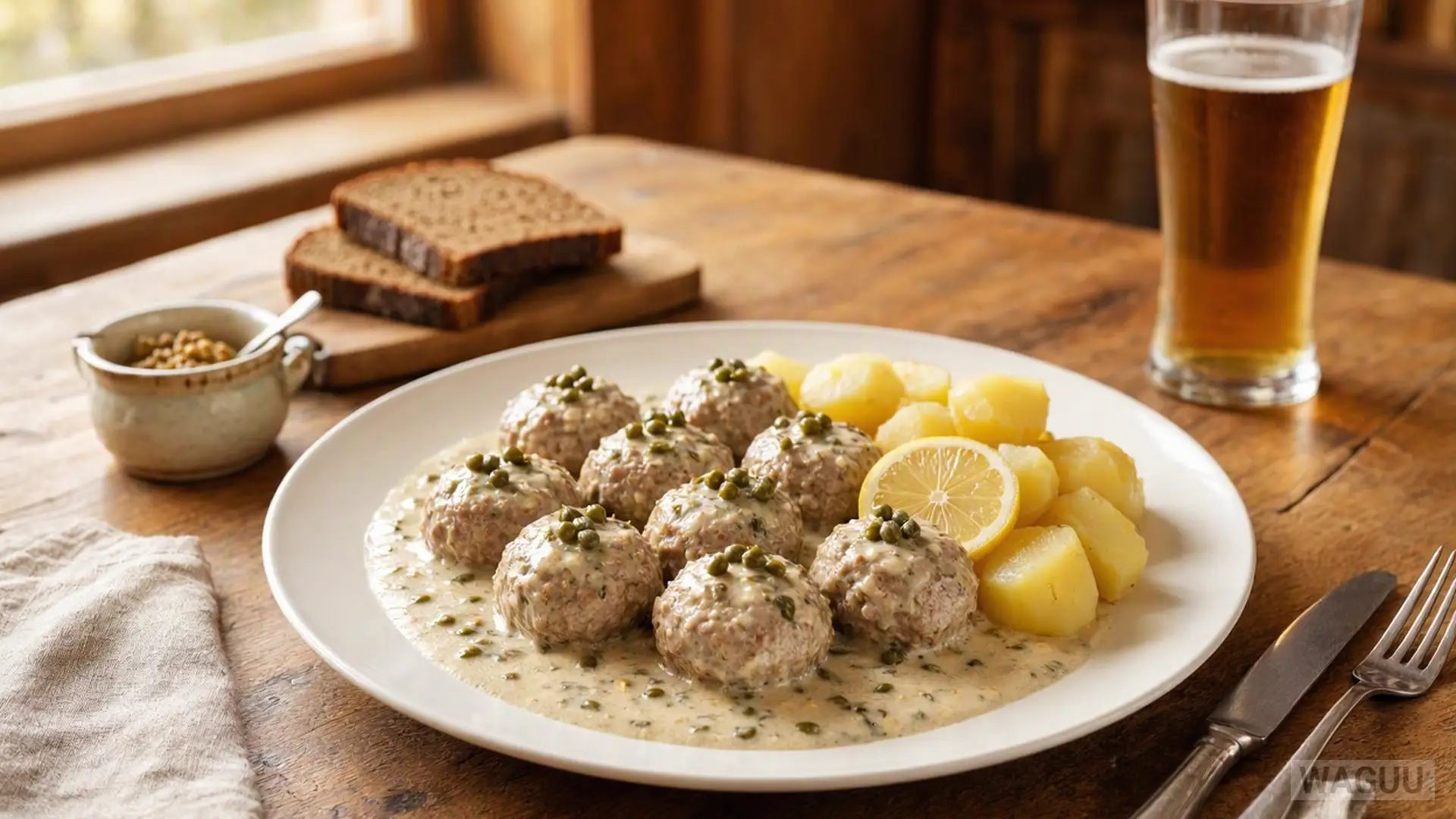
Summary: Königsberger Klopse features tender, juicy meatballs made from a balanced mix of ground veal and pork, gently simmered in a velvety, rich white velouté sauce enriched with heavy cream, tangy capers, and a splash of fresh lemon juice. This classic dish relies on precise temperature control during simmering to ensure the meatballs remain light and airy rather than dense, creating a comforting culinary experience.
Did you make this recipe? Share the result with the community.
Category: Pork, German Cuisine
Success rate: 98% of users successfully made this recipe
Quick overview
- Dish: Königsberger Klopse
- Category: Pork, German Cuisine
- Cuisine: German
- Main ingredient: Ground veal and pork, 1 lb 8 oz (high quality, freshly ground)
- Guide: 12 Most Popular German Foods: Favorite Recipes of German Cuisine
- Total time: 65 minutes (30 min prep + 35 min cooking)
- Difficulty: Medium
- Servings: 6 servings (Serving weight: 380 g)
- Key technique: Poaching meatballs in a seasoned broth and finishing with a creamy caper roux sauce
- Preparation types: Mixing, simmering, roux making, emulsification
- Dietary info & Allergens: Contains wheat, dairy, eggs, fish (anchovies)
- Suitable for: Family dinners, festive Sunday lunches, traditional comfort food lovers
- Nutritional values (per 1 serving): 540 kcal, Protein: 32.5 g, Fat: 38.0 g, Carbs: 18.2 g
- Storage: 3 days in the fridge, 3 months in the freezer
- Pairing: German Pilsner, Dry Riesling, Sparkling water with lemon
- In a nutshell: Tender veal and pork meatballs swimming in a silky, tangy caper cream sauce.
- Last updated: September 21, 2026
WAGUU says: “The secret to authentic Königsberger Klopse lies in incorporating finely minced salt-cured anchovies directly into the meat mixture, which melts away during simmering to impart a deep, savory umami backbone without tasting fishy.”
How to take it further: Add a pinch of freshly grated nutmeg to the meat mixture or garnish with finely minced fresh dill just before serving.
Key facts
| Prep time: | 30 minutes |
| Cooking time: | 35 minutes |
| Temperature: | 180 °F (Simmering broth) |
| Number of servings: | 6 servings |
In a nutshell
Experience the quintessential taste of East Prussia with tender meatballs bathed in a luxurious, creamy caper sauce that balances richness with bright acidity.
Ingredients
Base servings: 6 servings • Serving weight: 380 g
| Ingredient | Quantity | Quality |
|---|---|---|
| Ground veal | 12 oz | Fresh, medium grind |
| Ground pork | 12 oz | Fresh, 80/20 fat ratio |
| Yellow onion | 1 cup | Finely minced |
| White bread | 2 slices | Stale, crusts removed |
| Whole milk | 0.33 cup | For soaking bread |
| Large eggs | 1 piece | Fresh whole egg |
| Anchovy fillets | 2 pieces | Salt-cured, finely minced |
| Kosher salt | 1.5 tsp | Fine grain |
| Black pepper | 0.5 tsp | Freshly ground |
| Beef broth | 4 cups | Rich and homemade |
| Bay leaves | 2 pieces | Dried whole leaves |
| Black peppercorns | 6 pieces | Whole black peppercorns |
| Unsalted butter | 3 tbsp | High-fat European style |
| All-purpose flour | 3 tbsp | Unbleached flour |
| Heavy cream | 0.5 cup | 36% milkfat |
| Capers | 0.33 cup | Drained, in brine |
| Lemon juice | 2 tbsp | Freshly squeezed |
| Fresh parsley | 0.25 cup | Finely chopped (not part of the recipe) |
Why you’ll love this recipe
- Unmatched texture: Combining veal and pork with soaked bread creates extraordinarily tender meatballs that melt in your mouth.
- Balanced flavors: The rich cream sauce is brilliantly cut by briny capers and bright fresh lemon juice for a sophisticated profile.
- Culinary heritage: An authentic traditional German recipe crafted with precise techniques for guaranteed success in your home kitchen.
Why it works: Simmering the meatballs directly in the broth infuses the liquid with rich meaty flavor, which then forms the savory base of the velvety roux-thickened sauce.
Recipe overview
Prep: 30 min | Cooking: 35 min | Difficulty: Medium | Servings: 6 | Type: Main course | Origin: German
Detailed instructions
Overall progress: 0% completed
Phase 1: Preparing the Meatball Mixture – 10 min
Appliances: None
1. Tear 2 slices of white bread into small pieces and place them in a small bowl. Pour 0.33 cup whole milk over the bread and let it soak for 5 minutes until fully saturated and soft. Squeeze out any excess milk gently with your hands.
Visual check point (VKB): Bread is thoroughly softened, absorbed the milk, and excess liquid is squeezed out.
Before moving to the next step:
Ensure the bread is completely soft without hard crust lumps before mixing into the meat.
Phase 2: Shaping the Meatballs – 10 min
Appliances: None
2. In a large mixing bowl, combine 12 oz ground veal, 12 oz ground pork, 1 cup finely minced yellow onion, the soaked bread, 1 large egg, 2 minced anchovy fillets, 1.5 tsp kosher salt, and 0.5 tsp freshly ground black pepper. Mix thoroughly with your hands until fully unified, then shape the mixture into even balls, roughly 2 inches in diameter.
VKB: Meat mixture is tacky and cohesive; formed meatballs hold their shape firmly.
Before moving to the next step:
Verify that all meatballs are uniform in size to ensure even cooking time during poaching.
Phase 3: Poaching the Meatballs – 15 min
Appliances: Stove
3. In a wide pot or Dutch oven, bring 4 cups beef broth, 2 dried bay leaves, and 6 whole black peppercorns to a gentle simmer at 180 °F over medium heat. Carefully drop the shaped meatballs into the simmering broth in a single layer. Poach gently for 15 minutes, maintaining a gentle simmer without a vigorous boil, until the internal temperature of the meatballs reaches 160 °F. Remove the cooked meatballs with a slotted spoon and set them aside on a warm plate.
VKB: Broth bubbles gently around the edges; meatballs float to the surface when cooked.
Before moving to the next step:
Strain 2 cups of the poaching broth through a fine-mesh sieve to reserve for the sauce base.
Phase 4: Preparing the Roux – 5 min
Appliances: Stove
4. In a separate saucepan, melt 3 tbsp unsalted butter over medium-low heat. Add 3 tbsp all-purpose flour and whisk continuously for 2 minutes to cook out the raw flour taste, forming a pale blonde roux without browning.
VKB: Roux smells nutty and foamy, maintaining a pale golden color.
Before moving to the next step:
Ensure the roux is completely smooth and free of lumps before incorporating the liquid.
Phase 5: Building the Velouté Sauce – 5 min
Appliances: Stove
5. Gradually whisk in 2 cups of the reserved strained poaching broth into the roux, ladle by ladle, whisking vigorously to prevent lumps. Bring the sauce to a gentle simmer and let it cook for 3 minutes until thickened to a smooth, glossy consistency.
VKB: Sauce coats the back of a spoon smoothly without any flour lumps.
Before moving to the next step:
Reduce heat to low before adding dairy to prevent curdling.
Phase 6: Finishing and Combining – 5 min
Appliances: Stove
6. Stir in 0.5 cup heavy cream, 0.33 cup drained capers, and 2 tbsp fresh lemon juice into the sauce. Taste and adjust seasoning with salt and pepper if needed. Gently return the cooked meatballs to the creamy sauce, simmering for 2 minutes until heated through. Serve hot.
VKB: Sauce is velvety, glossy, creamy, and coats the meatballs completely.
Required equipment
| Utensil | Ideal size | Alternative | Risk |
|---|---|---|---|
| Dutch oven | 5-quart | Wide saucepan | Overcrowding meatballs |
| Saucepan | 2-quart | Small pot | Scorching roux |
| Wire whisk | 10-inch | Fork | Lumpy sauce |
Shopping list
Nutrition profile
Values per 1 serving (excluding side dishes). Calculated from average ingredient nutrition values.
| Nutrient | Per 3.5 oz (100 g) | Per 1 serving | Per 6 servings |
|---|---|---|---|
| Energy | 142.1 kcal | 540.0 kcal | 3240.0 kcal |
| Fat | 10.0 g | 38.0 g | 228.0 g |
| of which saturates | 4.5 g | 17.1 g | 102.6 g |
| Carbohydrates | 4.8 g | 18.2 g | 109.2 g |
| of which sugars | 1.1 g | 4.2 g | 25.2 g |
| Protein | 8.5 g | 32.5 g | 195.0 g |
| Salt | 0.9 g | 3.4 g | 20.4 g |
Reference intake of an average adult (8400 kJ / 2000 kcal).
WAGUU Pro level
- Pro standard: Verified recipe with precise ratios and visual checkpoints.
- Tip 1: Use freshly ground veal and pork with a balanced fat content to ensure the meatballs remain juicy without shrinking excessively.
- Tip 2: Soak the white bread in milk rather than water to add extra richness and tenderness to the meatball interior.
- Tip 3: Never let the poaching broth come to a rolling boil; gentle simmering at 180 °F prevents the meatballs from breaking apart.
- Tip 4: Whisk the heavy cream into the warm sauce off direct high heat to maintain a perfectly smooth emulsion without curdling.
Scientific background
The exceptional tenderness of Königsberger Klopse relies on protein denaturation and hydration. Soaking bread in milk introduces moisture and starches that swell between the meat proteins, preventing them from bonding too tightly during cooking. This creates a porous matrix that retains juices. Furthermore, the salt-cured anchovies undergo enzymatic breakdown, releasing glutamates that synergize with natural meat nucleotides to create a powerful umami sensation.
Fine Dining – Professional techniques
- Plate composition: Arrange three perfectly round meatballs in the center of a warm shallow bowl, generously napped with glossy white sauce and scattered with vibrant green capers.
- Texture contrasts: Soft, pillowy meatballs paired with the pleasant, subtle pop of tender capers in a silky smooth sauce.
- Temperature contrast: Serve piping hot immediately after resting to highlight the aromatic notes of lemon and butter.
- Aromatic garnishes: Finish with finely chiffonaded fresh parsley (not part of the recipe) for a pop of color and herbaceous freshness.
Sensory radar
- Appearance: Pale, ivory-colored velvety sauce cloaking light-colored meatballs accented with dark green capers.
- Aroma: Rich buttery notes, warm veal broth, subtle fermented anchovy depth, and a bright hint of fresh lemon.
- Taste: Savory and rich with a distinct, pleasant tang from capers and lemon balancing the creamy richness.
- Texture: Incredibly tender, moist meatballs in a smooth, clinging velouté sauce.
Pairing
- BEER: Traditional German Pilsner with crisp bitterness to cut through the rich cream sauce.
- WINE: Dry German Riesling featuring high acidity that mirrors the tangy caper and lemon notes.
- NON-ALCOHOLIC: Sparkling mineral water infused with a fresh lemon wheel.
Various preparation methods
- Classic East Prussian Style: Incorporates a splash of white wine into the poaching broth and adds a liaison of egg yolks and cream at the very end.
- Modern Bistro Style: Uses browned butter in the roux and serves the dish with buttered parsley potatoes and pickled beetroot wedges.
Allergens and dietary information
Contains: Wheat, dairy, eggs, fish • Gluten: Contains gluten (all-purpose flour, bread) • Not suitable for: Vegetarians, vegans, lactose-intolerant individuals
Suitable for
Family dinners, traditional holiday gatherings, comforting Sunday meals
Substitution guide
- Ground veal: Ground chicken or lean ground turkey (though flavor profile will differ)
- Anchovy fillets: Worcestershire sauce or caper brine
FAQ
Why do my meatballs fall apart in the broth?
Meatballs usually fall apart if the poaching liquid boils too vigorously or if the meat mixture lacks sufficient binding from the egg and soaked bread. Always keep the liquid at a gentle simmer.
Can I make Königsberger Klopse ahead of time?
Yes, you can poach the meatballs and store them in the broth in the refrigerator for up to 2 days. Prepare the fresh cream and caper sauce just before reheating and serving.
Do I have to use anchovies if I don’t like fish?
The anchovies melt away during cooking and do not make the dish taste fishy; instead, they provide essential umami depth. You can substitute Worcestershire sauce if preferred.
What is the traditional side dish for this recipe?
Boiled potatoes dusted with chopped parsley and pickled beetroot are the traditional accompaniments served alongside.
WAGUU Petr advises: Cooking for 12 or more people?
12–16 people: Double all ingredient quantities and poach the meatballs in two separate batches in a large stockpot to prevent overcrowding and temperature drops. • 20+ people: Triple the recipe and prepare the sauce in a large commercial saucepan, keeping the poached meatballs warm in a low oven bathed in a portion of the broth before coating in sauce.
Sides and serving
- Boiled potatoes – buttered and sprinkled with fresh parsley (not included in the recipe)
- Pickled beetroot wedges – providing an earthy, sweet-and-sour contrast (not included in the recipe)
Serving: Serve steaming hot in deep bowls, ensuring each portion has three meatballs smothered in plenty of creamy caper sauce.
Storage and reheating
Fridge: 3 days • Freezer: 3 months • Reheating: Reheat gently on the stovetop over low heat with a splash of milk or broth, stirring occasionally until hot.
Author: WAGUU Petr & Team • Published: 21 Sep 2026 • Updated: 30 Oct 2026
More Recipes in This Article
Guide: 12 Most Popular German Foods: Favorite Recipes of German Cuisine
Other recipes you might enjoy
Why WAGUU?
Recipes on WAGUU undergo checks for ingredient accuracy, procedures, and nutritional values.
Process photo gallery
Community photos: Cook, take a picture, and share your results.
You can upload photos in the comments below or send them via email.
Did you record a video of your process for our recipe? Paste a link to YouTube, YouTube Shorts, TikTok, Instagram Reels, Facebook Reels, Pinterest, Vimeo, or X (Twitter) in the comments – we’d love to share it and help give you and your content more visibility.
Common mistakes
- Boiling the meatballs too aggressively – causes them to break apart and lose their tender texture; always maintain a gentle simmer.
- Skipping the anchovies – removes the essential umami depth that defines authentic Königsberger Klopse flavor.
- Adding dairy over high heat – causes the heavy cream to curdle and ruin the silky texture of the sauce.
- Overworking the meat mixture – results in dense, tough meatballs instead of light, tender ones.