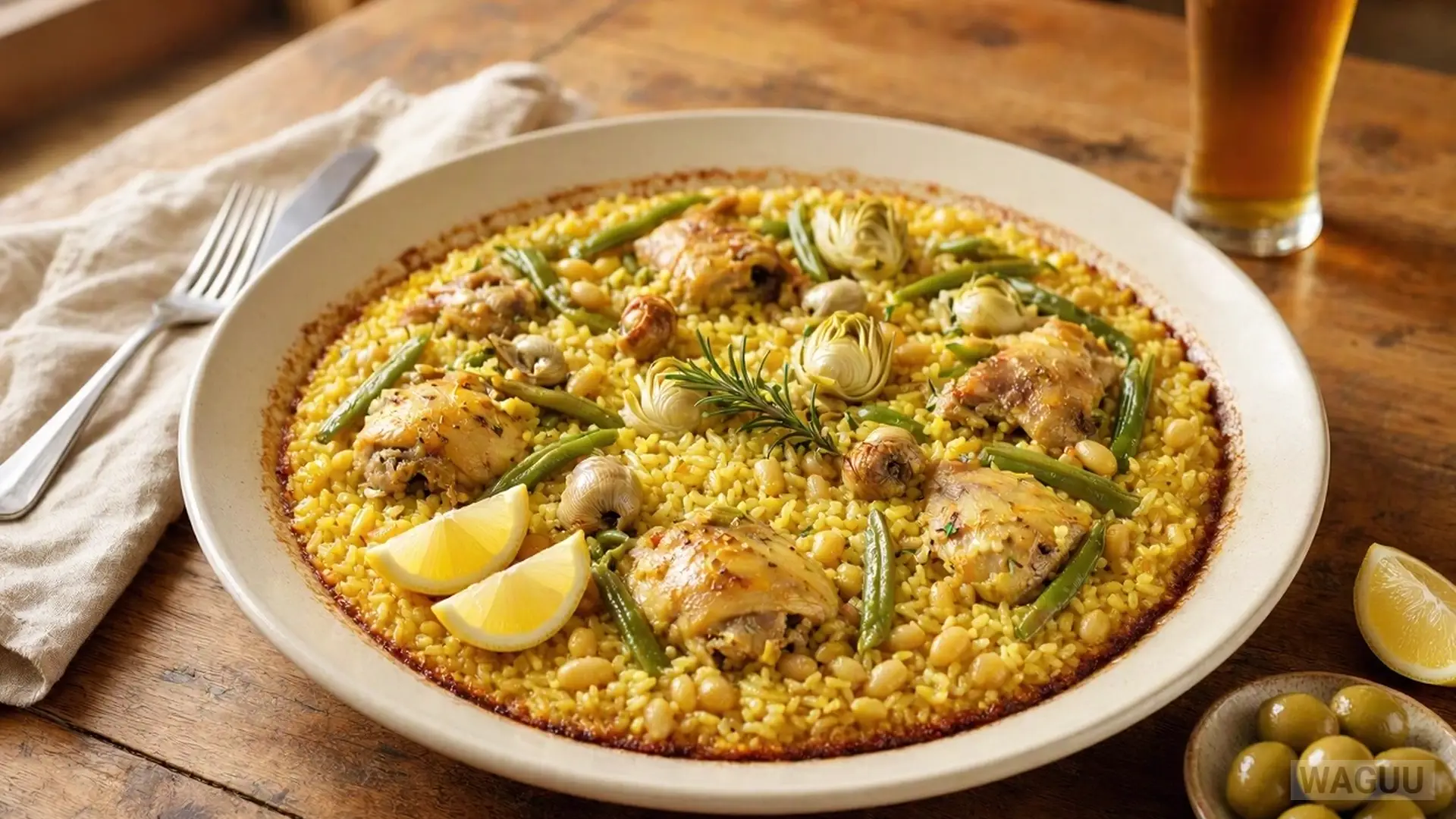
Summary: Paella Valenciana is the quintessential traditional Spanish rice dish featuring short-grain rice, tender chicken, rabbit, green beans, tomatoes, saffron, and extra virgin olive oil, all expertly prepared in a wide, shallow steel pan. This iconic Mediterranean specialty relies on precise heat management and caramelization to develop a deeply flavorful toasted bottom crust, known as socarrat. Designed for family gatherings and festive weekend lunches, this authentic recipe delivers rich, aromatic layers in approximately 65 minutes of active preparation and simmering.
Did you make this recipe? Share the result with the community.
Category: Main Dishes, Spanish Cuisine
Success rate: 96% of users successfully made this recipe
Quick overview
- Dish: Paella Valenciana
- Category: Main Dishes, Spanish Cuisine
- Cuisine: Spanish
- Main ingredient: Short-grain rice, 1 lb chicken thighs
- Guide: 12 Most Popular Spanish Dishes: Favorite Recipes of Spanish Cuisine
- Total time: 65 minutes (20 min prep + 45 min cooking)
- Difficulty: Advanced
- Servings: 6 servings (Serving weight: 450 g)
- Key technique: Stovetop simmering and bottom crust development
- Preparation types: Searing, simmering, roasting
- Dietary info & Allergens: Gluten-free, dairy-free
- Suitable for: Family dinners, weekend feasts, festive gatherings
- Nutritional values (per 1 serving): 540 kcal, Protein: 32.0 g, Fat: 18.5 g, Carbs: 58.0 g
- Storage: 2 days in the fridge, 1 month in the freezer
- Pairing: Amber Ale, Rioja Crianza, Sparkling Water with Lemon
- In a nutshell: An authentic Valencian paella featuring tender poultry, earthy beans, aromatic saffron, and a coveted crisp bottom crust.
- Last updated: September 21, 2026
WAGUU says: “The secret to a genuine Paella Valenciana lies in browning the meats thoroughly in extra virgin olive oil before adding water, building a rich broth right in the paella pan.”
How to take it further: Add fresh rosemary sprigs during the final ten minutes of simmering, or infuse the stock with a pinch of sweet smoked paprika.
Key facts
| Prep time: | 20 minutes |
| Cooking time: | 45 minutes |
| Temperature: | Medium-high heat, 375 °F |
| Number of servings: | 6 servings |
In a nutshell
Experience the authentic flavors of eastern Spain with this traditional Paella Valenciana. Combining succulent chicken thighs and rabbit pieces with fresh green beans, ripe tomatoes, fragrant saffron threads, and high-absorption Bomba rice, this recipe delivers a magnificent centerpiece meal. Master the art of heat distribution in a wide steel pan to achieve the legendary golden bottom crust.
Ingredients
Base servings: 6 servings • Serving weight: 450 g
| Ingredient | Quantity | Quality |
|---|---|---|
| Extra virgin olive oil | 4 tbsp | Spanish cold-pressed |
| Chicken thighs | 1 lb | Bone-in, cut into pieces |
| Rabbit meat | 1 lb | Fresh, cut into pieces |
| Flat green beans | 1.5 cups | Fresh, cut into 1-inch lengths |
| Ripe tomatoes | 1 cup | Grated |
| Saffron threads | 1 tsp | High-grade Spanish |
| Sweet paprika | 1 tsp | Spanish pimentón |
| Water | 6 cups | Warm |
| Bomba rice | 2.5 cups | Short-grain Spanish rice |
| Kosher salt | 1.5 tsp | Fine grain |
Why you’ll love this recipe
- Authentic Heritage: Follows time-tested Valencian principles using traditional meats and short-grain rice.
- Exceptional Texture: Features fluffy individual rice grains combined with a golden, crispy socarrat bottom.
- Rich Aromas: Infused with premium saffron and sweet Spanish paprika for unmatched depth of flavor.
Why it works: Searing the bone-in meats directly in the paella pan builds deep fond, while precise liquid-to-rice ratios guarantee tender grains without stirring.
Recipe overview
Prep: 20 min | Cooking: 45 min | Difficulty: Advanced | Servings: 6 | Type: Main Dishes | Origin: Spanish
Detailed instructions
Overall progress: 0% completed
Phase 1: Searing Meats – 15 min
Appliances: Stovetop
1. Place a 15-inch carbon steel paella pan over medium-high heat and pour in 4 tbsp extra virgin olive oil. Season 1 lb chicken thighs and 1 lb rabbit meat with 1 tsp kosher salt, then place them into the hot pan. Sear the meat for 12–15 minutes, turning occasionally, until deep golden-brown on all sides and the pan bottom develops a rich browned fond. Visual check point (VKB): Meats show a deeply caramelized crust and juices run clear.
CP: Deep golden-brown meat crust.
Before moving to the next step:
Ensure the meats are fully browned to build the necessary flavor foundation in the pan.
Phase 2: Vegetables and Aromatics – 10 min
Appliances: Stovetop
2. Push the seared chicken and rabbit to the cooler outer rim of the paella pan. Add 1.5 cups flat green beans to the center of the pan and sauté for 4 minutes until slightly tender and blistered. Push the beans to the edges, add 1 cup grated ripe tomatoes and 1 tsp sweet paprika to the center, and cook for 5 minutes, stirring constantly until the tomato moisture evaporates and turns into a thick, jammy soffritto. VKB: Tomatoes form a dark, concentrated paste.
CP: Tomatoes reduced to a thick paste.
Before moving to the next step:
Cook out the tomato acidity completely before adding water.
Phase 3: Broth Formation – 10 min
Appliances: Stovetop
3. Pour 6 cups warm water and 1 tsp kosher salt into the pan, scraping up all the caramelized fond from the bottom with a wooden spatula. Crumble 1 tsp saffron threads directly into the liquid. Bring the mixture to a vigorous boil over high heat, then reduce the heat to medium and let it simmer for 10 minutes so the meats infuse the water with rich flavor. VKB: Broth turns golden-yellow and fragrant.
CP: Aromatic golden broth simmering.
Before moving to the next step:
Check liquid level against the rivet line of the pan handles.
Phase 4: Adding Rice – 5 min
Appliances: Stovetop
4. Sprinkle 2.5 cups Bomba rice in a diagonal line across the center of the pan (from handle to handle), then gently distribute the grains evenly across the pan using the spatula so every grain is submerged in the broth. Distribute the chicken, rabbit, and green beans evenly. Do not stir the rice from this point forward. VKB: Rice grains form an even, level layer.
CP: Rice evenly distributed, no stirring.
Before moving to the next step:
Verify that the rice is completely flat and submerged.
Phase 5: Simmering and Absorption – 15 min
Appliances: Stovetop
5. Maintain a medium-high heat for the first 8 minutes so the liquid bubbles vigorously and reduces rapidly. Then reduce the heat to low for the remaining 7 minutes as the liquid absorbs into the rice. Watch for small steam holes to appear across the surface of the rice. VKB: Rice swells and liquid is fully absorbed.
CP: Steam vents visible on rice surface.
Before moving to the next step:
Ensure all liquid has evaporated before attempting socarrat formation.
Phase 6: Socarrat and Resting – 5 min
Appliances: Stovetop
6. Increase the heat to medium-high for 60–90 seconds to toast the bottom rice layer, listening closely for a gentle crackling sound that indicates the formation of the socarrat crust. Remove the pan from the heat, cover it loosely with a clean kitchen towel, and let it rest for 5 minutes before serving. VKB: Faint crackling sound and toasted aroma.
CP: Crisp bottom crust achieved.
Required equipment
| Utensil | Ideal size | Alternative | Risk |
|---|---|---|---|
| Paella pan | 15-inch carbon steel | Wide cast-iron skillet | Uneven heat distribution |
| Wooden spatula | Standard | Silicone spatula | Scratching pan surface |
| Kitchen towel | Clean cotton | Aluminum foil tent | Loss of steam trapping |
Shopping list
Nutrition profile
Values per 1 serving (excluding side dishes). Calculated from average ingredient nutrition values.
| Nutrient | Per 3.5 oz (100 g) | Per 1 serving | Per 6 servings |
|---|---|---|---|
| Energy | 120.0 kcal | 540.0 kcal | 3240.0 kcal |
| Fat | 4.1 g | 18.5 g | 111.0 g |
| of which saturates | 0.9 g | 4.0 g | 24.0 g |
| Carbohydrates | 12.9 g | 58.0 g | 348.0 g |
| of which sugars | 0.8 g | 3.5 g | 21.0 g |
| Protein | 7.1 g | 32.0 g | 192.0 g |
| Salt | 0.3 g | 1.4 g | 8.4 g |
Reference intake of an average adult (8400 kJ / 2000 kcal).
WAGUU Pro level
- Pro standard: Verified recipe with precise liquid absorption ratios and visual checkpoints.
- Tip 1: Use a traditional carbon steel paella pan to ensure proper heat conduction and rapid moisture evaporation.
- Tip 2: Never stir the rice after the liquid is distributed, as agitation releases excess starch and creates a gummy texture.
- Tip 3: Grind saffron threads gently with a mortar before infusing to release maximum aromatic oils.
- Tip 4: Control burner flames evenly across the entire base of the pan to prevent localized scorching.
Scientific background
Bomba rice is a Spanish short-grain variety characterized by its high amylose content, which allows the grains to absorb up to three times their volume in liquid without bursting. During the final minute of cooking, turning up the heat vaporizes the remaining moisture at the pan base, triggering the Maillard reaction between residual starches and olive oil to form the coveted socarrat crust.
Fine Dining – Professional techniques
- Plate composition: Serve family-style directly in the center of the table from the polished steel pan.
- Texture contrasts: Combine tender, fluffy rice grains with the crisp, toasted socarrat crust at the base.
- Temperature contrast: Serve piping hot, allowing the aromatic saffron steam to engage the senses.
- Aromatic garnishes: Garnish with fresh lemon wedges for a vibrant acidic accent.
Sensory radar
- Appearance: Vibrant golden-yellow rice grains studded with browned meats and green beans.
- Aroma: Rich aroma of toasted olive oil, sweet paprika, and floral saffron.
- Taste: Deeply savory poultry broth flavor with earthy vegetable notes.
- Texture: Firm, separated rice grains complemented by a crunchy bottom crust.
Pairing
- BEER: Crisp Spanish Lager or Amber Ale
- WINE: Medium-bodied Rioja Crianza or dry white Albariño
- NON-ALCOHOLIC: Sparkling mineral water with fresh lemon slice
Various preparation methods
- Seafood Paella: Replace chicken and rabbit with shrimp, mussels, and squid rings, using seafood stock instead of water.
- Vegetarian Paella: Substitute meats with artichoke hearts, butter beans, mushrooms, and vegetable broth.
Allergens and dietary information
Contains: None • Gluten: Gluten-free • Not suitable for: Strict vegetarians
Suitable for
Family dinners, weekend feasts, festive gatherings, outdoor grilling events
Substitution guide
- Bomba rice: Calasparra rice or Arborio rice
- Rabbit meat: Chicken drumsticks or turkey thighs
FAQ
Why shouldn’t I stir the rice?
Stirring releases starch from the grains, which transforms the light, fluffy texture into a heavy, risotto-like porridge.
How do I achieve the perfect socarrat?
Increase the burner heat for the final 90 seconds of cooking until you hear a crackling sound, indicating the bottom rice has toasted without burning.
Can I use chicken breast instead of thighs?
Chicken thighs with bone-in are recommended because they add more flavor to the broth and remain juicy during the long simmer.
What if I cannot find Bomba rice?
Calasparra rice is the best direct substitute, though short-grain Arborio can work in a pinch if adjusted for liquid absorption.
WAGUU Petr advises: Cooking for 12 or more people?
12–16 people: Use a larger 24-inch paella pan and double all ingredient quantities proportionally while maintaining an even rice layer • 20+ people: Cook in two separate 18-inch pans to ensure even heat distribution and prevent uneven rice cooking.
Sides and serving
- Fresh crusty baguette – (not included in the recipe)
- Tomato and onion salad – (not included in the recipe)
Serving: Serve piping hot directly from the center of the pan, garnished with fresh lemon wedges.
Storage and reheating
Fridge: 2 days • Freezer: 1 month • Reheating: Reheat gently in a skillet with a splash of water over medium heat until warmed through.
Author: WAGUU Petr & Team • Published: 21 Sep 2026 • Updated: 30 Oct 2026
More Recipes in This Article
Other recipes you might enjoy
Why WAGUU?
Recipes on WAGUU undergo checks for ingredient accuracy, procedures, and nutritional values.
Process photo gallery
Community photos: Cook, take a picture, and share your results.
You can upload photos in the comments below or send them via email.
Did you record a video of your process for our recipe? Paste a link to YouTube, YouTube Shorts, TikTok, Instagram Reels, Facebook Reels, Pinterest, Vimeo, or X (Twitter) in the comments – we’d love to share it and help give you and your content more visibility.
Common mistakes
- Stirring the rice – Agitating the grains during simmering releases starch, creating a sticky, risotto-like consistency rather than fluffy individual grains.
- Incorrect liquid ratio – Adding too much water without adjusting heat causes overcooked, mushy rice grains.
- Skipping the meat sear – Failing to brown the chicken and rabbit thoroughly reduces the foundational fond needed for a rich broth.
- Rushing the socarrat – Turning up the heat too early or burning the bottom ruins the delicate toasted flavor of the crust.