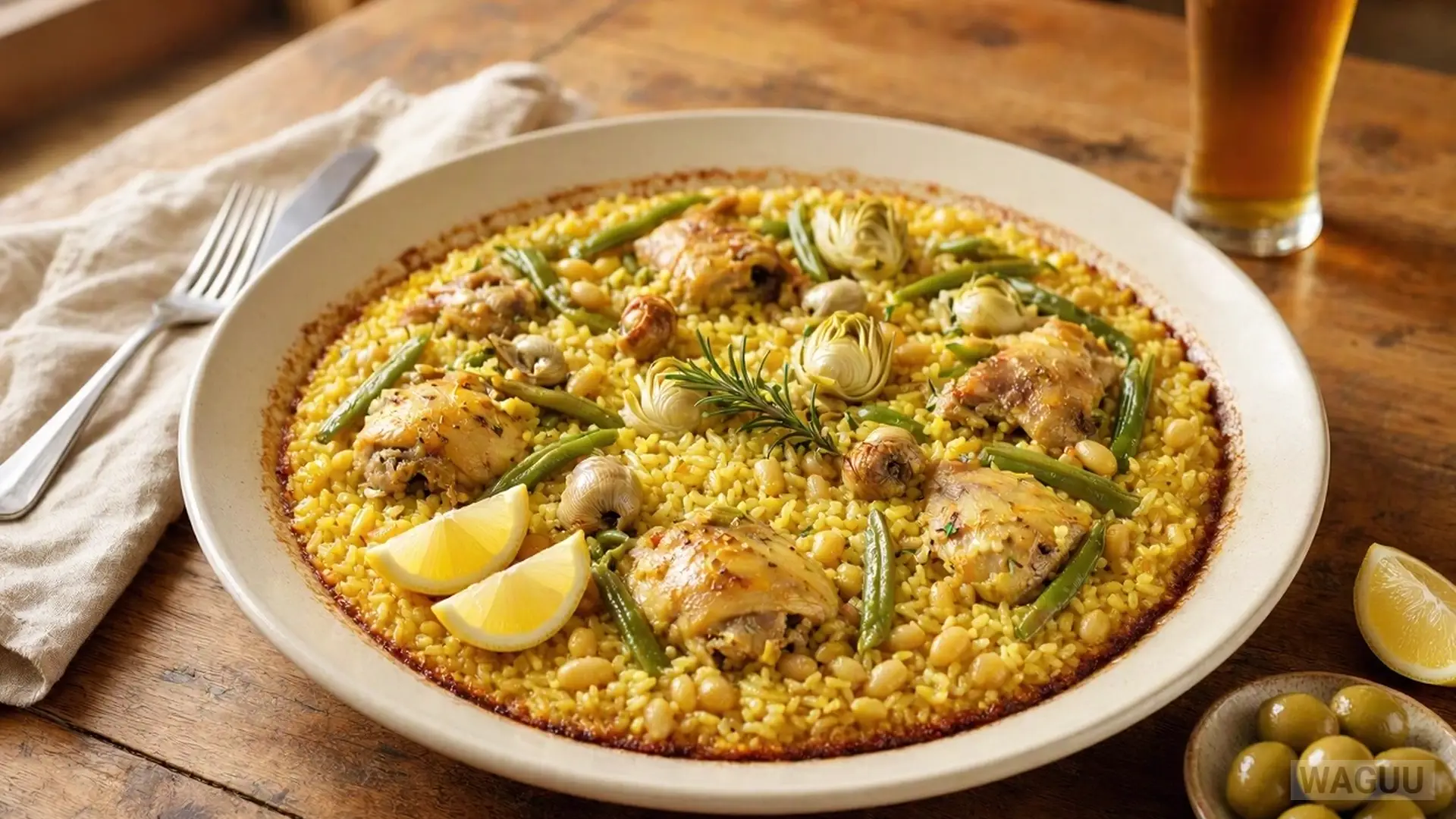
Summary: Authentic Paella Valenciana featuring short-grain Bomba rice, free-range chicken and rabbit meat, flat green beans, butter beans, fresh tomatoes, saffron, and Spanish extra virgin olive oil, meticulously prepared in a traditional wide carbon-steel paella pan over a controlled heat source.
Did you cook this recipe? Share the result with the community.
Category: Main Dishes, Spanish Cuisine
Success rate: not rated yet% of users successfully made this recipe
Quick overview
- Dish: Paella Valenciana
- Category: Main Dishes, Spanish Cuisine
- Cuisine: Spanish
- Main ingredient: Bomba rice, 500 g (Protected Designation of Origin quality)
- Guide: 12 most popular Spanish dishes: favourite recipes of Spanish cuisine
- Total time: 65 minutes (20 min prep + 45 min cooking)
- Difficulty: Medium
- Portions: 6 portions (Portion weight: 420.0 g)
- Key technique: Sofrito building, stock reduction, and socarrat formation
- Preparation types: Stovetop braising, simmering, and pan-roasting
- Dietary info & Allergens: None (Gluten-free, lactose-free)
- Suitable for: Family gatherings, weekend lunches, festive dining
- Nutritional values (per 1 portion): 540.5 kcal, Protein: 34.2 g, Fat: 18.5 g, Carbohydrates: 58.6 g
- Storage: 2 days in the fridge, 2 months in the freezer
- Pairing: Spanish lager beer, Rioja Blanco wine, sparkling mineral water
- In short: The definitive Spanish masterpiece combining tender meats, aromatic saffron broth, and perfectly crisp bottom rice.
- Last updated: 21 September 2026
WAGUU says: “True paella is defined by the shallow pan, the dry-cooked rice that absorbs every nuance of the saffron-infused stock, and the prized crust known as socarrat.”
How to take it further: Add a sprig of fresh rosemary right at the final simmering stage, or finish with a drizzle of infused garlic oil.
Key facts
| Prep time: | 20 minutes |
| Cooking time: | 45 minutes |
| Temperature: | Medium-high to low stovetop heat |
| Number of portions: | 6 portions |
In a nutshell
Experience the culinary soul of eastern Spain with this traditional Paella Valenciana. Built upon a foundation of succulent chicken and rabbit pieces browned in aromatic extra virgin olive oil, tender flat green beans, sweet butter beans, grated tomatoes, and genuine Spanish saffron threads, this recipe guides you through the precise water-to-rice ratios required to achieve individual grains that remain separate, tender, and crowned with a golden, caramelized crust at the base.
Ingredients
Base portions: 6 portions • Portion weight: 420.0 g
| Ingredient | Amount | Quality |
|---|---|---|
| Chicken thighs, chopped | 600 g | Free-range, bone-in |
| Rabbit pieces, chopped | 400 g | Fresh, bone-in |
| Extra virgin olive oil | 80 ml | Spanish premium grade |
| Flat green beans (bajoqueta) | 200 g | Fresh, cut into 3 cm lengths |
| Large butter beans (garrofó) | 120 g | Cooked or soaked large lima beans |
| Ripe tomatoes, grated | 150 g | Fresh, skin discarded |
| Sweet Spanish paprika (pimentón dulce) | 5 g | Ground red pepper |
| Saffron threads | 1 g | High-grade Spanish saffron |
| Water for simmering | 1800 ml | Filtered drinking water |
| Bomba rice | 500 g | Denomination of Origin Valencia |
| Fine sea salt | 22 g | Pure sea salt |
| Fresh rosemary sprig | 5 g | Fresh garden herb (not part of the recipe) |
Why you will love this recipe
- Authentic Heritage: Follows the strict culinary traditions of the Valencian region without modern shortcuts or unauthorized ingredients.
- Unmatched Texture: Utilizes Bomba rice which expands longitudinally, absorbing rich broths while maintaining a firm bite.
- The Golden Socarrat: Learn the precise heat control technique needed to develop the legendary toasted rice crust at the pan base.
Why it works: Browning the meats directly on the bare metal of the paella pan builds deep fond, while precise water measurements guarantee complete evaporation at the exact moment the rice reaches al dente perfection.
Recipe overview
Prep: 20 min | Cooking: 45 min | Difficulty: Medium | Portions: 6 portions | Type: Main Dish | Origin: Spanish
Detailed instructions
Overall progress: 0% complete
Phase 1: Browning the Meats and Building the Fond – 15 min
Appliances: Stovetop hob
1. Place a 46 cm carbon-steel paella pan level over two burners on the hob. Pour in 80 ml of extra virgin olive oil and heat over medium-high heat for 2 minutes until shimmering. Add 600 g of chopped chicken thighs and 400 g of chopped rabbit pieces to the pan. Season the meats directly with 11 g of fine sea salt. Pan-roast the pieces for 13 minutes, turning every 3 minutes, until the skin turns deeply golden brown and a rich caramelised fond coats the bottom of the pan.
Visual check point (VKB): The meat pieces must display a deep amber-brown crust and render their fats completely into the oil.
Before moving to the next step:
Ensure the meats are thoroughly browned and pushed to the outer perimeter of the paella pan to clear the center for vegetable frying.
Phase 2: Adding Vegetables and Creating the Sofrito – 10 min
Appliances: Stovetop hob
2. Push the browned chicken and rabbit pieces to the outer rim of the paella pan where the heat is lowest. In the cleared center of the pan, add 200 g of cut flat green beans and 120 g of large butter beans. Sauté the beans in the remaining hot oil and rendered fat for 5 minutes over medium heat, stirring frequently. Add 150 g of grated ripe tomatoes and 5 g of sweet Spanish paprika directly into the center vegetables. Stir the tomato and paprika mixture continuously for 5 minutes, allowing the moisture to evaporate until a thick, dark red sofrito paste forms.
VKB: The tomatoes must reduce into a thick jammy paste and lose their raw acidic aroma before liquid is introduced.
Before moving to the next step:
Incorporate the browned meats from the outer edges back into the center sofrito and bean mixture, tossing everything together for 30 seconds.
Phase 3: Pouring Water, Saffron Infusion, and Broth Simmering – 15 min
Appliances: Stovetop hob
3. Pour 1800 ml of filtered water directly into the paella pan, filling it up to the inner rivets of the handle mounts. Add 1 g of saffron threads and the remaining 11 g of fine sea salt into the liquid. Bring the liquid to a rolling boil over high heat for 5 minutes, then reduce the heat to medium-low and let it simmer gently for 10 minutes. This creates a rich, aromatic meat broth directly inside the pan, reducing the liquid level so that it sits just below the level of the pan rivets.
VKB: The broth must turn a vibrant golden-yellow hue, and the liquid line must sit precisely below the rivet heads.
Before moving to the next step:
Verify that the liquid level is correct; if too much has evaporated, top up with boiling water before adding the rice.
Phase 4: Adding Rice and Initial Boiling – 8 min
Appliances: Stovetop hob
4. Sprinkle 500 g of Bomba rice across the pan in a diagonal line from corner to corner (known as a *caballón*), then distribute the grains evenly across the entire base using a wooden spatula so every grain touches the bottom of the pan. From this exact moment, **never stir the rice again**, as stirring releases starch and ruins the texture. Boil the rice rapidly over medium-high heat for 8 minutes, allowing the grains to swell and absorb the golden saffron broth.
VKB: The rice grains must form an even, single-layer carpet across the pan, bubbling vigorously in the stock.
Before moving to the next step:
Ensure the heat is distributed evenly across all burners so the liquid reduces at the same rate across the entire pan diameter.
Phase 5: Simmering and Liquid Reduction – 7 min
Appliances: Stovetop hob
5. Reduce the heat to low. Let the paella simmer gently for 7 minutes without touching or stirring. Watch as the liquid level drops below the surface of the rice and the steam tunnels close up. The rice will swell and emerge from the liquid, becoming tender on the exterior while retaining a firm, resistant core.
VKB: The surface of the rice will appear dry with no standing liquid remaining between the grains.
Before moving to the next step:
Prepare for the final crust formation by checking that the heat source covers the entire bottom circle of the pan.
Phase 6: Developing the Socarrat Crust and Resting – 2 min
Appliances: Stovetop hob
6. Increase the heat to medium-high for the final 2 minutes to toast the bottom layer of rice, creating the prized *socarrat* crust. Listen closely for a faint crackling sound and smell a gentle toasted aroma rising from the metal base. Remove the pan from the heat source immediately, cover it loosely with a clean cotton tea towel, and let it rest undisturbed for 5 minutes before serving.
VKB: A delicate crackling sound confirms the bottom rice has formed a golden-brown, toasted crust without burning.
Required equipment
| Utensil | Ideal size | Alternative | Risk |
|---|---|---|---|
| Carbon-steel paella pan | 46 cm diameter | Wide shallow frying pan | Uneven heat distribution if pan is too small |
| Wooden spatula | Standard kitchen size | Flat wooden spoon | Metal utensils scratch the pan surface |
| Cotton tea towel | Large clean cloth | Parchment paper sheet | Synthetic fabrics melt near hot metal |
Shopping list
Nutritional profile
Values per 1 portion (excluding side dishes). Calculated from average nutritional values of ingredients.
| Nutrient | Per 100 g | Per 1 portion | Per 6 portions |
|---|---|---|---|
| Energy | 128.7 kcal | 540.5 kcal | 3243.0 kcal |
| Fat | 4.4 g | 18.5 g | 111.0 g |
| of which saturates | 1.1 g | 4.6 g | 27.6 g |
| Carbohydrates | 13.9 g | 58.6 g | 351.6 g |
| of which sugars | 0.8 g | 3.4 g | 20.4 g |
| Protein | 8.1 g | 34.2 g | 205.2 g |
| Salt | 0.9 g | 3.7 g | 22.2 g |
Reference intake of an average adult (8400 kJ / 2000 kcal).
WAGUU Pro Level
- Pro standard: Verified recipe with precise ratios and visual control points.
- Tip 1: Use a flat-bottomed carbon-steel pan to ensure even heat distribution across the rice bed.
- Tip 2: Never stir the rice after the initial distribution phase to allow starch to form the desired crust.
- Tip 3: Infuse the saffron threads in a small amount of warm broth before adding for maximum aromatic extraction.
- Tip 4: Control the burner flames so that the simmering liquid reduces uniformly across the entire pan diameter.
Scientific background
Bomba rice possesses a high amylose-to-amylopectin ratio, allowing the grains to absorb up to three times their volume in liquid without bursting or becoming sticky. During the high-heat final phase, moisture evaporates rapidly from the base of the pan, triggering Maillard reactions between residual amino acids and sugars in the starch, which caramelises the bottom layer into the crisp *socarrat* crust.
Fine Dining – Professional techniques
- Plate composition: Serve family-style directly from the paella pan, garnished with an artistic sprig of fresh rosemary.
- Textural contrasts: Contrast the tender, fluffy interior of the grains with the crisp, toasted crunch of the bottom crust.
- Temperature contrast: Serve steaming hot straight from the stovetop after the mandatory resting period.
- Aromatic garnishes: Highlight the earthy aroma of Spanish saffron with a fine mist of extra virgin olive oil just before serving.
Sensory radar
- Appearance: Golden-yellow rice grains studded with tender meats, green beans, and butter beans.
- Aroma: Intense, warm fragrance of toasted saffron, sweet paprika, and rich pan-roasted poultry.
- Taste: Deeply savory, balanced with subtle sweetness from butter beans and earthy undertones.
- Texture: Firm, separate rice grains with a tender bite and a delicately crisp bottom crust.
Pairing
- BEER: Crisp Spanish pale lager
- WINE: Dry, chilled Rioja Blanco or Valencian white wine
- NON-ALCOHOLIC: Sparkling mineral water with a fresh lemon slice
Various preparation variants
- Seafood Paella (Paella de Marisco): Substitute chicken and rabbit with fresh prawns, mussels, squid rings, and a rich fish stock.
- Vegetarian Paella: Replace meats with artichoke hearts, wild mushrooms, bell peppers, and vegetable stock.
Allergens and dietary information
Contains: None • Gluten: Naturally gluten-free • Not suitable for: Strict vegetarians
Suitable for
Family gatherings, weekend lunches, festive dining
Substitution catalog
- Bomba rice: Calasparra rice or Arborio rice (though cooking times and liquid absorption may vary slightly)
FAQ
Can I stir the rice while it cooks?
No, stirring releases starch which creates a sticky risotto texture rather than the separate, fluffy grains characteristic of authentic paella.
What is socarrat and how do I achieve it?
Socarrat is the prized toasted rice crust at the bottom of the pan. It is achieved by turning up the heat for the final two minutes of cooking.
Why use Bomba rice instead of standard long-grain rice?
Bomba rice absorbs significantly more liquid and flavor without breaking apart during the prolonged simmering process.
Can I substitute rabbit with another meat?
While rabbit is traditional, you can substitute it with pork loin pieces or increase the quantity of chicken thighs.
WAGUU Petr advises: Cooking for 12 or more people?
12–16 people: Use a larger 60 cm paella pan and divide the ingredients proportionally while maintaining a single layer of rice across the expanded cooking surface. • 20+ people: Cook in two separate pans or use a specialized gas-fired paella ring setup to ensure even heat distribution across an oversized professional pan.
Sides and Serving
- Crisp green salad with lemon vinaigrette – provides a refreshing acidic contrast to the savory rice (not included in the recipe)
- Fresh crusty rustic bread – perfect for soaking up any leftover seasoned pan juices (not included in the recipe)
Serving: Serve family-style directly from the center of the paella pan with lemon wedges.
Storage and reheating
Fridge: 2 days • Freezer: 2 months • Reheating: Reheat gently in a skillet with a splash of water over medium heat until steaming hot.
Author: WAGUU Petr & Team • Published: 21 Sep 2026 • Updated: 30 Oct 2026
More Recipes from This Article
Other recipes you might be interested in
Why WAGUU?
Recipes on WAGUU undergo checks for the accuracy of ingredients, procedures, and nutritional values.
Process photo gallery
Community photos: Cook, take a photo, and share the result.
You can upload photos in the comments below or send them via email.
Did you record a video guide for our recipe? Insert a link to YouTube, YouTube Shorts, TikTok, Instagram Reels, Facebook Reels, Pinterest, Vimeo, or X (Twitter) in the comment – we’d be happy to publish it and help promote you and your content.
Common mistakes
- Stirring the rice – Stirring breaks the grains and releases excess starch, resulting in a sticky texture rather than separate fluffy grains.
- Using incorrect rice – Substituting standard long-grain rice prevents proper liquid absorption and alters the traditional texture.
- Too much liquid – Adding excessive water without measuring ruins the evaporation balance and leads to mushy rice.
- Skipping the resting phase – Not letting the paella rest covered prevents the steam from redistributing evenly through the grains.