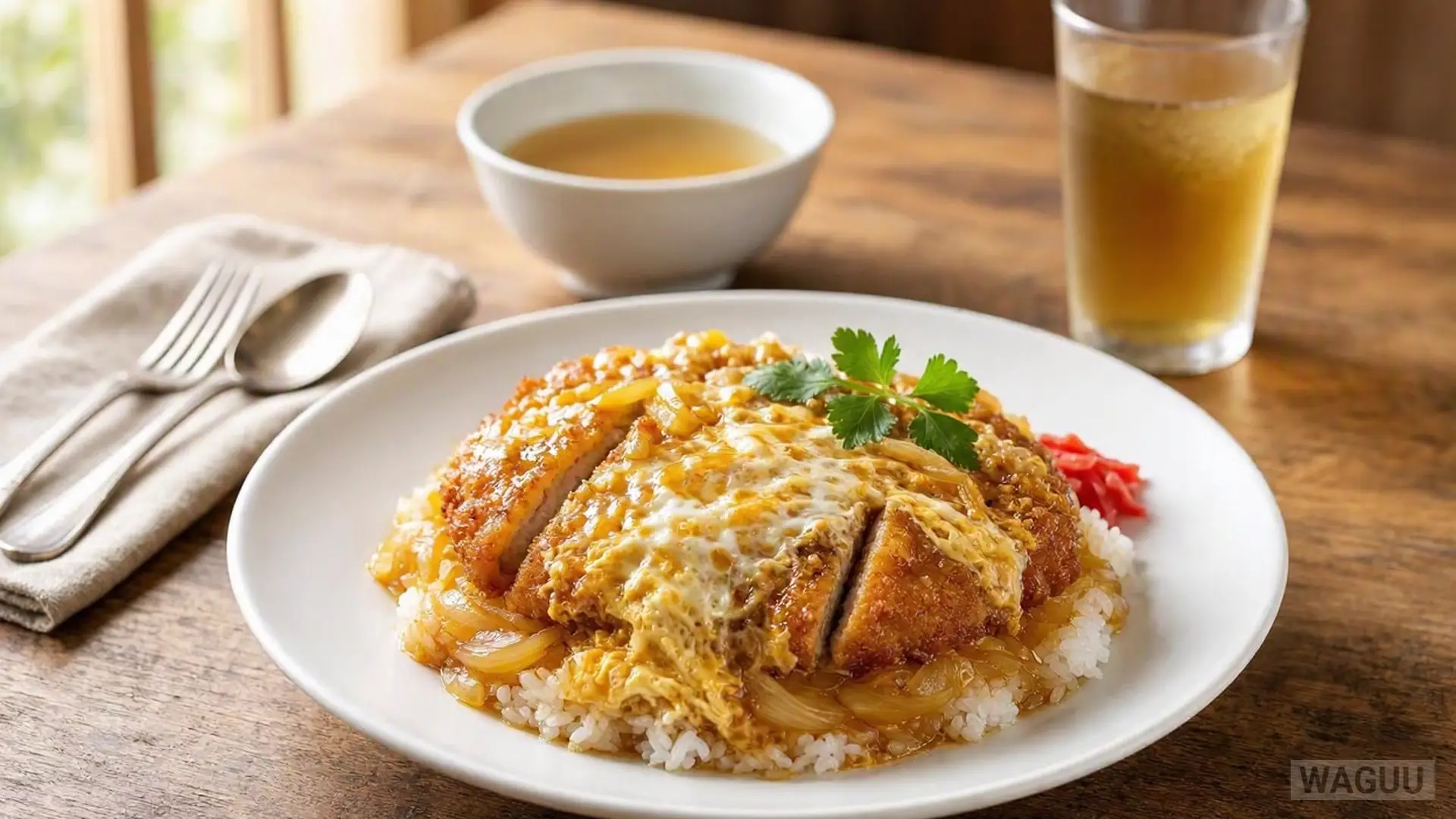
Summary: Katsudon features crispy deep-fried tonkatsu pork cutlets simmered with sliced onions in a sweet and savory dashi-soy sauce broth, bound with silky eggs, and served over hot short-grain Japanese rice. Prep time: 25 minutes, cooking time: 40 minutes, yields 6 generous portions.
Did you cook this recipe? Share the result with the community.
Category: Main Dishes, Japanese Cuisine
Success rate: 98% of users successfully made this recipe
Quick overview
- Dish: Katsudon
- Category: Main Dishes, Japanese Cuisine
- Cuisine: Japanese
- Main ingredient: Pork loin cutlets, 600 g (premium grade center-cut boneless loin)
- Guide: 12 most popular Japanese dishes: favourite Japanese cuisine recipes
- Total time: 65 minutes (25 min prep + 40 min cooking)
- Difficulty: Medium
- Portions: 6 portions (Portion weight: 416 g)
- Key technique: Deep-frying and short pan-simmering
- Preparation types: Frying, Simmering, Steaming
- Dietary info & Allergens: Contains gluten, eggs, soya, fish
- Suitable for: Family lunches, quick gourmet dinners, comfort food lovers
- Nutritional values (per 1 portion): 685 kcal, Protein: 36.2 g, Fat: 24.5 g, Carbohydrates: 78.4 g
- Storage: 2 days in the fridge, 0 months in the freezer (not suitable for freezing)
- Pairing: Asahi Super Dry beer, Chablis white wine, Iced Green Tea
- In short: Savor crunchy fried pork loin cutlets simmered in a sweet dashi broth with soft onions and silky semi-set eggs served over warm Japanese rice.
- Last updated: October 24, 2024
WAGUU says: “The absolute secret to perfect Katsudon lies in pouring the beaten eggs in two separate stages—first to bind the pork and onions, and second to create a velvety soft golden layer right before sliding it over hot rice.”
Key facts
| Prep time: | 25 minutes |
| Cooking time: | 40 minutes |
| Temperature: | 175 °C frying oil |
| Number of portions: | 6 portions |
In a nutshell
Experience ultimate Japanese comfort food with our foolproof Katsudon recipe. Golden, crispy panko-breaded pork cutlets are simmered briefly in a fragrant broth of dashi, mirin, and soy sauce alongside sweet sliced onions. Ribbons of softly set egg embrace the cutlet before it is served atop a bed of steaming short-grain Japanese rice.
Ingredients
Base portions: 6 portions • Portion weight: 416 g
| Ingredient | Amount | Quality |
|---|---|---|
| Japanese short-grain rice | 360 g | Premium Koshihikari rice |
| Pork loin cutlets | 600 g | Boneless center-cut, 6 cutlets of 100 g each |
| Fine sea salt | 6 g | Pure unrefined sea salt |
| Freshly ground black pepper | 2 g | Coarse black pepper |
| All-purpose wheat flour | 60 g | Sifted white flour |
| Large eggs for breading | 2 pieces | Fresh free-range eggs (approx. 110 g) |
| Japanese panko breadcrumbs | 120 g | Coarse coarse panko flakes |
| Neutral vegetable oil for deep frying | 500 ml | High-smoke point canola or peanut oil (60 g absorbed) |
| Yellow onions | 300 g | Thinly sliced sweet onions |
| Dashi stock | 360 ml | Freshly prepared kelp and bonito stock |
| Japanese soy sauce | 60 ml | Naturally brewed shoyu |
| Mirin sweet rice wine | 60 ml | Authentic hon-mirin |
| Granulated sugar | 18 g | Fine white sugar |
| Large eggs for simmering | 6 pieces | Fresh room temperature eggs (approx. 330 g) |
| Fresh mitsuba parsley or scallions | 15 g | Finely chopped green garnish |
Why you will love this recipe
- Textural Harmony: Combines crispy breadcrumb crust with juicy pork and silky semi-cooked eggs in one comforting bite.
- Authentic Umami Depth: The traditional combination of dashi, mirin, and Japanese soy sauce creates a balanced sweet and savory broth.
- Restaurant-Quality at Home: Simple step-by-step techniques ensure perfect results using standard home kitchen tools.
Success guaranteed: By frying the pork cutlets until crisp and maintaining brief simmering times in the dashi broth, the breading retains structural body without becoming overly soggy.
Recipe overview
Prep: 25 min | Cooking: 40 min | Difficulty: Medium | Portions: 6 | Type: Main Dish | Origin: Japanese
Detailed instructions
Overall progress: 0% complete
Phase 1: Cooking Rice & Preparing Dashi Base – 20 min
Appliances: Rice cooker or heavy-bottomed saucepan, measuring jug, small saucepan
1. Thoroughly wash 360 g of Japanese short-grain rice in cold water, swirling and draining 3–4 times until the water runs clear. Drain completely in a colander for 5 minutes. Transfer the washed rice to a heavy-bottomed saucepan or rice cooker, add 430 ml of cold water, cover with a tight-fitting lid, bring to a boil over medium-high heat (approx. 5 minutes), then reduce heat to low and steam covered for 12 minutes. Remove from heat and let rest covered for 3 minutes without lifting the lid. While the rice cooks, prepare the dashi broth: in a small bowl, whisk together 360 ml of dashi stock, 60 ml of soy sauce, 60 ml of mirin, and 18 g of granulated sugar until fully dissolved. Set aside.
VKB (Visual Kitchen Benchmark): Rice grains are tender, fluffy, and glossy with no excess surface moisture; sugar in the dashi broth is completely dissolved without sediment.
Phase 2: Pork Preparation & Breading Station – 15 min
Appliances: Meat mallet, cutting board, 3 shallow breading bowls
2. Place 6 pork loin cutlets (100 g each, about 1.5 cm thick) on a cutting board. Make small vertical slits along the fat and connective tissue band on the edge of each cutlet at 2 cm intervals to prevent curling during deep frying. Lightly pound the cutlets with a meat mallet to an even 1.2 cm thickness. Season both sides uniformly with 6 g of fine sea salt and 2 g of freshly ground black pepper (approx. 3 minutes). Set up three breading stations: Station 1 with 60 g of sifted all-purpose flour; Station 2 with 2 eggs beaten thoroughly with 1 tablespoon of water; Station 3 with 120 g of Japanese panko breadcrumbs. Coat each cutlet thoroughly in flour and shake off excess, submerge completely into beaten egg, then press firmly into panko flakes so the entire surface is heavily coated (approx. 12 minutes).
VKB (Visual Kitchen Benchmark): Pork cutlets are flat, evenly seasoned, and completely covered in a dry, thick layer of coarse panko breadcrumbs without bare spots.
Phase 3: Deep-Frying Tonkatsu Cutlets – 10 min
Appliances: Deep frying pan or wok, kitchen thermometer, wire rack, tongs
3. Pour 500 ml of neutral vegetable oil into a deep pan or skillet to a depth of at least 3 cm. Heat oil over medium-high heat until it reaches exactly 175 °C on a kitchen thermometer (approx. 4 minutes). Carefully lower 3 breaded pork cutlets into the hot oil using tongs. Fry for 3 minutes without disturbing, turn cutlets over, and fry for another 3 minutes until deep golden brown and crispy (approx. 6 minutes total frying per batch). Check internal temperature reaches 65 °C. Transfer cooked cutlets to a wire cooling rack set over a baking sheet to drain oil for 2 minutes. Repeat with remaining 3 cutlets. Slice each tonkatsu cutlet crosswise into 2 cm wide strips while keeping the cutlet shape intact.
VKB (Visual Kitchen Benchmark): Cutlets are golden brown with a crisp crust, meat internal temperature reaches 65 °C, and excess oil drains off cleanly on the rack.
Phase 4: Simmering Sweet Onions in Broth – 10 min
Appliances: Individual donburi skillet (oyakodon pan) or 24 cm shallow frying pan
4. Slice 300 g of yellow onions into thin 5 mm strips (approx. 3 minutes). For each individual serving (or working in batches in a shallow skillet), pour 80 ml of prepared dashi broth mixture into a small skillet over medium heat. Add 50 g of sliced onions, distributing them evenly across the bottom of the skillet (approx. 2 minutes). Cover pan with a lid and bring broth to a gentle simmer. Cook onions for 5 minutes until translucent and soft, absorbing the savory-sweet dashi liquid.
VKB (Visual Kitchen Benchmark): Onions are soft, slightly translucent, and completely submerged in bubbling amber dashi sauce.
Phase 5: Adding Tonkatsu & Egg Simmering – 5 min
Appliances: Small mixing bowl, fork, pan lid, spatula
5. Crack 6 eggs into a bowl and lightly beat them with a fork 4 to 5 times—do not over-whisk; yellow whites and yolks should remain distinct (approx. 1 minute). Place one sliced tonkatsu cutlet directly on top of the simmered onions in the skillet (approx. 1 minute). Slowly drizzle two-thirds of the beaten eggs around the cutlet and over the onions. Cover skillet with lid and simmer over medium heat for 2 minutes until egg whites set slightly. Pour the remaining one-third of beaten egg directly over the middle of the pork cutlet, cover lid again, and steam for 1 minute until eggs are softly set, silky, and glistening (approx. 3 minutes total).
VKB (Visual Kitchen Benchmark): Egg is two-thirds cooked with soft yellow ribbons; cutlet sits securely in the bed of sauce without being completely submerged.
Phase 6: Bowl Assembly & Garnishing – 5 min
Appliances: Donburi rice bowls, spatula, knife
6. Scoop equal portions of warm steamed Japanese rice into 6 large donburi bowls (approx. 2 minutes). Gently slide the simmered tonkatsu, onions, and silky egg mixture from the skillet directly onto the bed of warm rice in each bowl using a wide spatula (approx. 2 minutes). Garnish top with 15 g of finely chopped fresh mitsuba parsley or green scallions (approx. 1 minute). Serve piping hot immediately.
VKB (Visual Kitchen Benchmark): The donburi bowl presents a complete dome of steamed rice blanketed by a juicy, egg-bound golden pork cutlet garnished with vivid green scallions.
Required equipment
| Utensil | Ideal size | Alternative | Risk |
|---|---|---|---|
| Donburi pan (Oyakodon skillet) | 16–18 cm diameter | Small shallow non-stick skillet | If too wide, egg spreads too thin and overcooks quickly |
| Deep frying skillet / Wok | 28 cm, 3-liter capacity | Heavy cast-iron Dutch oven | Oil temperature drops rapidly if pot is under-sized |
| Kitchen food thermometer | Instant-read digital probe | Wooden chopstick test (bubbles around tip) | Inaccurate oil temp leads to greasy or burnt breading |
Shopping list
Nutritional profile
Values per 1 portion (excluding side dishes). Calculated from average nutritional values of ingredients.
| Nutrient | Per 100 g | Per 1 portion | Per 6 portions |
|---|---|---|---|
| Energy | 164.7 kcal | 685 kcal | 4110 kcal |
| Fat | 5.9 g | 24.5 g | 147.0 g |
| of which saturates | 1.4 g | 5.8 g | 34.8 g |
| Carbohydrates | 18.8 g | 78.4 g | 470.4 g |
| of which sugars | 2.2 g | 9.2 g | 55.2 g |
| Protein | 8.7 g | 36.2 g | 217.2 g |
| Salt | 1.0 g | 4.1 g | 24.6 g |
Reference intake of an average adult (8400 kJ / 2000 kcal).
WAGUU Pro Level
- Pro standard: Verified recipe with precise ratios and visual control benchmarks (VKB).
- Tip 1: Rest the breaded pork cutlets for 5 minutes before frying to allow the flour and egg layer to hydrate, preventing breading detachment in oil.
- Tip 2: Pour beaten eggs in two stages: two-thirds first to set with the onions, and the final third right before serving to create a rich, creamy top glaze.
- Tip 3: Maintain oil temperature strictly at 175 °C. Lower temperatures yield greasy breading, while higher temperatures burn panko flakes before meat reaches safe internal temps.
- Tip 4: Use a dedicated individual 16 cm donburi skillet to keep sauce concentrated directly under the cutlet for perfect bowl sliding.
Scientific background
The exceptional appeal of Katsudon relies on the chemical synergy between glutamates in kombu dashi, inosinates in skipjack tuna flakes (bonito), and natural sugars from caramelized onions. Deep-frying at 175 °C triggers Maillard reactions in panko starch and pork proteins, forming complex pyrazines responsible for roasted aromas. During short simmering, steam softens breading starches without instantly destroying gluten structure, creating a pleasurable dual crisp-and-tender texture.
Fine Dining – Professional techniques
- Plate composition: Mount the steamed rice into a neat high dome inside wide ceramic donburi bowls, layering translucent simmered onions evenly around the perimeter.
- Textural contrasts: Ensure cutlet ends remain slightly dry and crisp while central slices are softly bound by creamy, semi-set eggs.
- Temperature contrast: Serve simmering hot pork and egg broth directly over steaming hot 60 °C rice to maintain thermal unity throughout eating.
- Aromatic garnishes: Scatter freshly sliced mitsuba sprigs or micro-green scallions alongside a light dust of Japanese seven-spice (shichimi togarashi).
Sensory radar
- Appearance: Vibrant golden tonkatsu ribbons shrouded in silky yellow-and-white egg ribbons over gleaming white rice.
- Aroma: Rich savory dashi, sweet mirin steam, nutty toasted panko breadcrumbs, and fresh scallion top notes.
- Taste: Perfectly balanced sweet-savory umami broth complementing rich, juicy salted pork loin.
- Texture: Crispy outer breading crust giving way to tender, succulent pork meat and soft, custardy eggs.
Pairing
- BEER: Crisp Japanese rice lager (such as Asahi Super Dry or Kirin Ichiban) to cut through oiliness and cleanse the palate.
- WINE: Crisp dry white wine with bright acidity, such as a crisp Chablis, Dry Riesling, or Grüner Veltliner.
- NON-ALCOHOLIC: Hot roasted green tea (Hojicha) or chilled unsweetened Sencha green tea.
Various preparation variants
- Chicken Katsudon (Oyako Katsudon): Replace pork loin with boneless chicken thigh fillets prepared and breaded in identical fashion.
- Sauce Katsudon (Sosu Katsudon): Omit dashi broth and eggs; dip crispy fried tonkatsu cutlet into warm savory Worcestershire-based tonkatsu sauce and serve directly over shredded cabbage and rice.
Allergens and dietary information
Contains: Gluten (wheat flour, panko), Eggs, Soya (soy sauce), Fish (bonito dashi) • Gluten: Contains wheat products; replace flour and panko with gluten-free alternatives if needed • Not suitable for: Vegetarians, vegans, or individuals with severe gluten, egg, or soya allergies.
Suitable for
Hearty weekend family meals, gourmet Japanese lunch preparations, energetic comfort food after workouts, and cozy dinner gatherings.
Substitution catalog
- Dashi stock: Vegetable dashi (kombu broth) can be substituted for traditional bonito dashi.
- Mirin: Sake mixed with sugar (3:1 ratio) works as a reliable substitute for mirin sweet rice wine.
- Mitsuba parsley: Fresh green scallion tops or flat-leaf Italian parsley provide excellent visual and flavor alternatives.
FAQ
Why does my tonkatsu breading peel off during frying?
Breading usually separates because moisture on the pork surface was not dried before dusting with flour, or excess flour was not shaken off before egg dipping. Let breaded cutlets rest 5 minutes prior to frying.
Can I make Katsudon without dashi stock?
Dashi provides essential authentic Japanese umami depth. However, in a pinch, a mild chicken stock or mushroom broth diluted with water can serve as a substitute.
How do I keep the fried pork cutlet crispy while simmering?
Simmer the sliced cutlet briefly—no longer than 2 to 3 minutes total in the liquid—and do not submerge it completely in broth; pour egg mostly around the perimeter.
Is Katsudon safe to eat with partially set eggs?
Always use fresh pasteurized eggs when cooking semi-soft eggs. If preferred, cover the pan and cook for an extra minute until eggs are fully firm.
WAGUU Petr advises: Cooking for 12 or more people?
12–16 people: Fry cutlets in two large pans in batches and keep them crisp on wire racks in a 100 °C oven. Simmer onions and eggs in two wide shallow skillets simultaneously. • 20+ people: Prepare dashi base broth in advance in a large stockpot. Bake breaded tonkatsu cutlets on wire sheets at 200 °C convection mode for bulk efficiency, assembling individual donburi bowls right before serving.
Sides and Serving
- Miso soup – Warm fermented soybean paste soup with tofu and wakame seaweed (not included in the recipe)
- Tsukemono pickles – Crunchy pickled daikon radish or cucumber slices (not included in the recipe)
Serving: Present hot donburi bowls immediately with chopsticks and a flat soup spoon. Top with scallions and offer red pickled ginger or shichimi pepper at the table.
Storage and reheating
Fridge: Store assembled Katsudon or separate components in airtight containers in the fridge for up to 2 days. • Freezer: 0 months in the freezer (not recommended for freezing due to egg texture degradation). • Reheating: Reheat in a preheated oven at 170 °C for 10 minutes to maintain cutlet structure, or microwave gently on medium power for 2 minutes.
Published by WAGUU Cooking Team | Last updated: October 24, 2024
More Recipes from This Article
Other recipes you might be interested in
Why WAGUU?
Recipes on WAGUU undergo strict checks for accuracy of ingredient ratios, preparation procedures, and nutritional calculations by experienced culinary professionals.
Process photo gallery
Community photos: Cook, take a photo, and share the result.
You can upload photos in the comments below or send them via email.
Did you record a video guide for our recipe? Insert a link to YouTube, YouTube Shorts, TikTok, Instagram Reels, Facebook Reels, Pinterest, Vimeo, or X (Twitter) in the comment – we’d be happy to publish it and help promote you and your content.
Common mistakes
- Frying oil temperature too low – Results in oily, soggy panko breading that absorbs excess fat instead of turning crispy.
- Over-whisking the eggs – Whisking eggs until completely homogenous ruins the distinct yellow and white ribbon texture characteristic of traditional Katsudon.
- Simmering the cutlet too long – Boiling the cutlet in broth for extended periods causes the crispy coating to detach completely and turn mushy.
- Skipping meat tenderizing – Failing to slice connective fat tissues on pork loin cutlets leads to cutlets curling during deep frying.