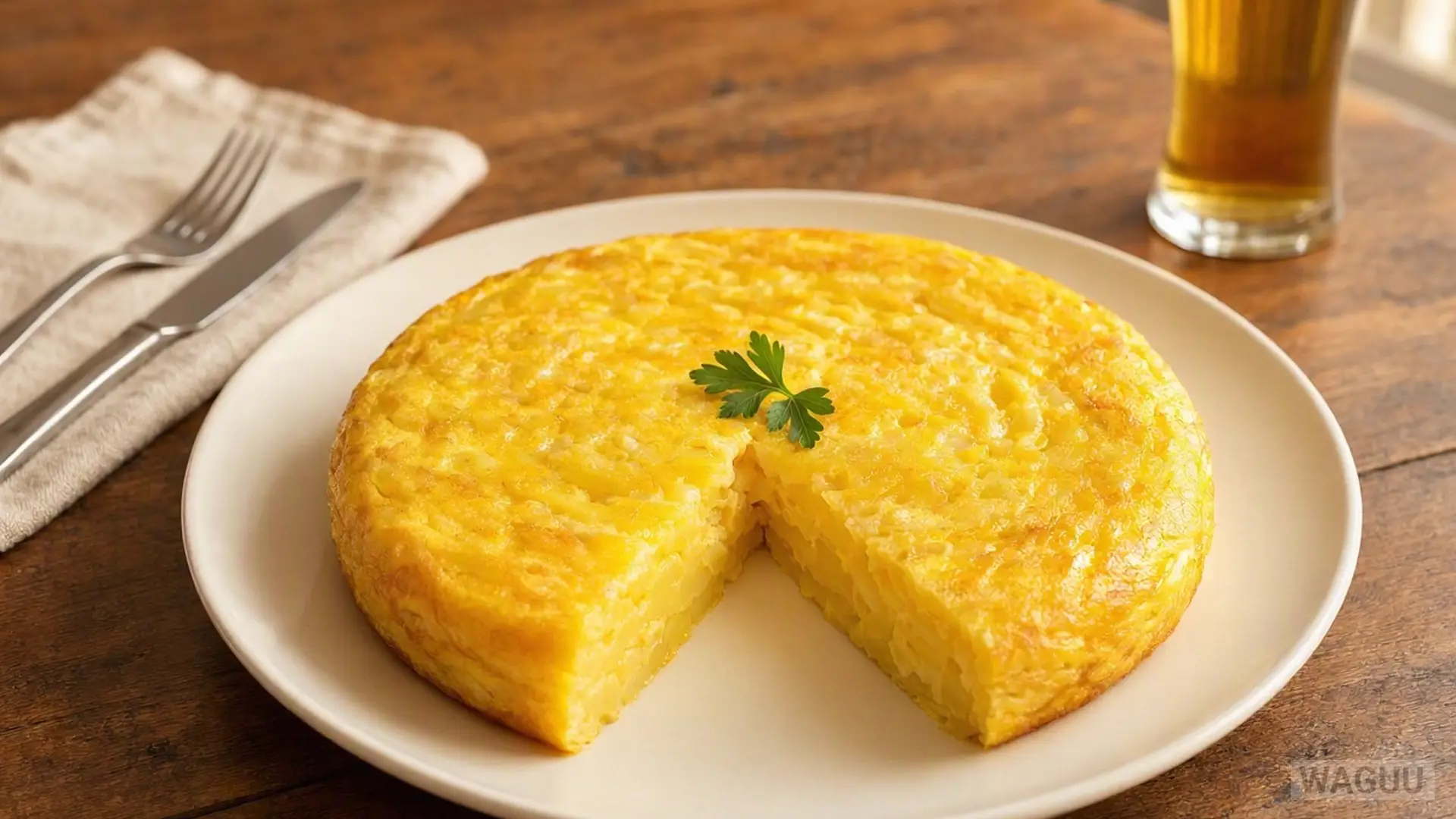
Summary: Tortilla Española is the quintessential Spanish potato omelette made of eggs, potatoes and often also onion, served warm or cold as a main dish or tapas. This golden masterpiece relies on gentle confiting of potatoes in quality olive oil, which creates an unbeatably tender texture, before binding them with farm-fresh eggs into a cohesive, perfectly shaped round cake. Preparation takes around 45 minutes of active and passive time, resulting in six hearty portions of authentic Iberian comfort food.
Did you cook this recipe? Share the result with the community.
Category: Main Dishes, Spanish Cuisine
Success rate: 96% of users successfully made this recipe
Quick overview
- Dish: Tortilla Española
- Category: Main Dishes, Spanish Cuisine
- Cuisine: Spanish
- Main ingredient: Maris Piper potatoes, 1.0 kg (waxy-textured, ideal for frying)
- Guide: 12 most popular Spanish dishes: favourite recipes of Spanish cuisine
- Total time: 45 minutes (15 min prep + 30 min cooking)
- Difficulty: Medium
- Portions: 6 portions (Portion weight: 210.0 g)
- Key technique: Potato confiting and pan-flipping
- Preparation types: Frying, slow cooking, setting
- Dietary info & Allergens: Contains eggs, vegetarian, gluten-free, lactose-free
- Suitable for: Lunch, dinner, tapas parties, picnics
- Nutritional values (per 1 portion): 373.6 kcal, Protein: 11.2 g, Fat: 22.5 g, Carbohydrates: 31.8 g
- Storage: 3 days in the fridge, 2 months in the freezer
- Pairing: Spanish beer, Rioja red wine, sparkling water with lemon
- In short: The ultimate Spanish potato omelette combining tender slow-cooked potatoes, sweet onions, and rich farm eggs into a golden masterpiece.
- Last updated: 21 September 2026
WAGUU says: “The secret to a transcendent Tortilla Española lies in patience. Never rush the potato confit stage; letting the potato slices soften gently in olive oil builds the luxurious, melt-in-the-mouth texture that defines an authentic Spanish bar classic.”
How to take it further: Add a pinch of smoked paprika during egg mixing, or incorporate a handful of finely diced jamón serrano for an extra savoury depth.
Key facts
| Prep time: | 15 minutes |
| Cooking time: | 30 minutes |
| Temperature: | 140–160 °C (confit), medium heat (setting) |
| Number of portions: | 6 portions |
In a nutshell
Tortilla Española is a timeless pillar of Spanish gastronomy. By slowly cooking sliced potatoes and sweet onions in extra virgin olive oil until tender rather than crispy, then marrying them with beaten eggs, you create a thick, golden omelette that is juicy in the center and beautifully set on the outside. Enjoy it warm, at room temperature, or cold.
Ingredients
Base portions: 6 portions • Portion weight: 210.0 g
| Ingredient | Amount | Quality |
|---|---|---|
| Maris Piper potatoes | 1.0 kg | peeled and thinly sliced |
| Brown onions | 300.0 g | finely julienned |
| Free-range eggs | 6.0 pieces | large, fresh |
| Extra virgin olive oil | 250.0 ml | for confiting and frying |
| Fine sea salt | 12.0 g | pure salt |
| Black pepper | 2.0 g | freshly ground |
Why you will love this recipe
- Authentic Spanish texture: Slow confiting in olive oil guarantees melt-in-the-mouth potato slices without any hard edges.
- Incredible versatility: Serve it warm for dinner, at room temperature for a buffet, or cold for a picnic.
- Simple ingredients: Made with everyday pantry staples transformed by technique into a gourmet delicacy.
Why it works: Gently poaching potatoes in oil at a moderate temperature breaks down starches evenly, while resting the hot potatoes in beaten eggs allows the eggs to absorb rich flavors and set into a creamy, cohesive interior.
Recipe overview
Prep: 15 min | Cooking: 30 min | Difficulty: Medium | Portions: 6 | Type: Main dish | Origin: Spanish
Detailed instructions
Overall progress: 0% complete
Phase 1: Potato and Onion Preparation – 10 min
Appliances: Hob
1. Peel 1.0 kg of Maris Piper potatoes and rinse them thoroughly in cold water. Cut the potatoes in half lengthwise, then slice them crosswise into uniform half-moon pieces approximately 4 mm thick. Peel 300.0 g of brown onions and cut them into thin julienne strips. Combine the sliced potatoes and onions in a large bowl, sprinkling 8.0 g of fine sea salt evenly over them, and toss well to coat.
Visual check point (VKB): Potato slices are evenly cut to about 4 mm thickness and thoroughly seasoned with salt.
Before moving to the next step:
Ensure the potatoes are uniformly sliced so they cook at an equal rate during the confit stage.
Phase 2: Confit Cooking – 15 min
Appliances: Hob
2. Place a wide non-stick frying pan over medium heat and pour in 250.0 ml of extra virgin olive oil, heating it to around 150 °C. Add the prepared potato and onion mixture to the pan. The oil should almost submerge the vegetables. Reduce the heat to medium-low and gently confit the mixture for 15 minutes, stirring occasionally with a wooden spatula, until the potatoes are completely tender and easily break apart when pressed, without turning brown or crispy.
VKB: Potatoes are completely tender and soft when pierced with a fork, with no browning on the edges.
Before moving to the next step:
Drain excess oil thoroughly using a colander, reserving the fragrant oil for future cooking.
Phase 3: Egg Binding and Resting – 5 min
Appliances: None
3. Crack 6.0 free-range eggs into a large mixing bowl, add 4.0 g of fine sea salt and 2.0 g of freshly ground black pepper, and whisk vigorously until smooth and frothy. Transfer the drained, warm potatoes and onions directly into the beaten eggs. Gently fold the mixture together with a spatula, breaking up a few potato slices slightly to release starches, and let it rest for 5 minutes so the warm potatoes absorb the egg mixture.
VKB: Potato and onion mixture is fully coated in egg and has soaked for 5 minutes, creating a thick, cohesive batter.
Before moving to the next step:
Ensure the pan is lightly oiled and hot before pouring in the egg and potato mixture.
Phase 4: First Side Cooking – 10 min
Appliances: Hob
4. Heat the same frying pan over medium heat with 1 tbsp of the reserved olive oil. Pour the entire potato-egg mixture into the hot pan, shaking gently and smoothing the surface with a spatula to form a neat disc with rounded edges. Cook over medium-low heat for 10 minutes, running a spatula around the edges to shape the omelette as the bottom sets and turns a rich golden brown.
VKB: The bottom of the tortilla is golden brown and the edges are firm, while the center remains slightly soft and jiggly.
Before moving to the next step:
Place a flat plate larger than the frying pan firmly over the top before flipping.
Phase 5: Flipping and Second Side Cooking – 5 min
Appliances: Hob
5. Place a flat plate firmly over the frying pan. With a swift, confident motion, invert the pan and plate together so the tortilla drops onto the plate cooked-side up. Slide the uncooked side back into the frying pan from the plate. Cook over medium-low heat for 5 minutes, tucking the edges in with a spatula to create a neat, rounded cushion shape.
VKB: Tortilla is successfully flipped onto the plate and slid back into the pan without breaking, cooking evenly on the second side.
Before moving to the next step:
Allow the cooked tortilla to rest before slicing for optimal texture retention.
Phase 6: Resting and Slicing – 5 min
Appliances: None
6. Slide the finished Tortilla Española onto a clean wooden serving board. Let it rest undisturbed for 5 minutes to allow the internal juices and eggs to settle. Cut the tortilla into wedges using a sharp chef’s knife and serve warm or at room temperature.
VKB: The resting period is complete and the wedges hold their shape perfectly when sliced.
Required equipment
| Utensil | Ideal size | Alternative | Risk |
|---|---|---|---|
| Non-stick frying pan | 24 cm diameter | Cast iron skillet | Stickiness if pan is worn |
| Mixing bowl | 2 l capacity | Large ceramic bowl | Splashing when whisking eggs |
| Flipping plate | 26 cm flat plate | Large chopping board | Spilling oil during inversion |
Shopping list
Nutritional profile
Values per 1 portion (excluding side dishes). Calculated from average nutritional values of ingredients.
| Nutrient | Per 100 g | Per 1 portion | Per 6 portions |
|---|---|---|---|
| Energy | 177.9 kcal | 373.6 kcal | 2,241.6 kcal |
| Fat | 10.7 g | 22.5 g | 135.0 g |
| of which saturates | 2.1 g | 4.4 g | 26.4 g |
| Carbohydrates | 15.1 g | 31.8 g | 190.8 g |
| of which sugars | 1.8 g | 3.8 g | 22.8 g |
| Protein | 5.3 g | 11.2 g | 67.2 g |
| Salt | 0.95 g | 2.0 g | 12.0 g |
Reference intake of an average adult (8400 kJ / 2000 kcal).
WAGUU Pro Level
- Pro standard: Verified recipe with precise ratios and visual control points.
- Tip 1: Always use waxy or floury-waxy potatoes like Maris Piper to achieve the soft, confited interior.
- Tip 2: Let the warm potatoes rest in the beaten eggs for at least 5 minutes before cooking so the starches thicken the egg batter.
- Tip 3: Use a high-quality non-stick pan to ensure the tortilla slides out effortlessly during the flip.
- Tip 4: Adjust cooking time on the second side depending on whether you prefer a runny center or a fully set omelette.
Scientific background
The culinary success of Tortilla Española relies on lipid heat transfer and protein coagulation. Submerging potato slices in olive oil at around 140–160 °C cooks them through confit-like immersion: water inside the potato cells vaporises slowly, softening cell walls and gelatinising starches without browning the sugars. When the warm potatoes are combined with raw eggs, the residual heat begins gentle thermal denaturation of egg proteins (ovalbumin), creating an emulsion where lipid-coated potato fragments are suspended in a tender protein matrix.
Fine Dining – Professional techniques
- Plate composition: Serve a precise wedge on a warmed white ceramic plate garnished with micro chervil and a drizzle of premium extra virgin olive oil.
- Textural contrasts: Contrast the creamy, velvety interior of the omelette with a delicate crust formed on the outer surfaces.
- Temperature contrast: Serve the tortilla warm or at room temperature alongside a chilled, crisp accompaniment.
- Aromatic garnishes: Finish with flaky Maldon sea salt and a subtle dusting of pimentón de la Vera.
Sensory radar
- Appearance: Thick, round golden disc with smooth rounded edges and a moist, glistening interior when cut.
- Aroma: Rich fragrance of extra virgin olive oil, sweet caramelized onions, and comforting cooked egg.
- Taste: Savory, buttery potato flavor balanced with natural sweetness from onions and clean seasoning.
- Texture: Supremely tender, melting potato pieces bound by a creamy, soft egg custard.
Pairing
- BEER: Crisp Spanish lager (Estrella Galicia)
- WINE: Medium-bodied Rioja Crianza red wine
- NON-ALCOHOLIC: Sparkling water with a fresh slice of lemon
Various preparation variants
- Tortilla con Chorizo: Incorporate 100 g of diced cured chorizo sausage into the potato mixture during the egg-binding stage for a smoky, spicy kick.
- Tortilla con Espinacas: Fold 150 g of blanched, squeezed baby spinach into the potato and egg batter to add vibrant color and earthy green vegetable notes.
Allergens and dietary information
Contains: Eggs • Gluten: Gluten-free • Not suitable for: Vegan diets
Suitable for
Lunch, dinner, tapas parties, picnics, and vegetarian gatherings
Substitution catalog
- Maris Piper potatoes: King Edward potatoes
- Extra virgin olive oil: Pure sunflower oil
- Brown onions: Shallots
FAQ
Should a Tortilla Española be runny in the middle?
Traditional Spanish preference varies. Many tapas bars in Spain serve tortillas with a slightly runny, creamy center (jugosa), while others prefer it fully set. Adjust your cooking time on the second side to suit your personal preference.
Can I make the tortilla without onion?
Yes, the debate between con cebolla (with onion) and sin cebolla (without onion) is a famous culinary debate in Spain. Both are authentic; you can omit the onion entirely if desired.
What is the best way to flip the tortilla safely?
Use a flat plate that is slightly wider than your frying pan. Place it firmly over the pan, and with one swift, confident movement, invert them together. Slide the tortilla back into the pan from the plate.
Can I reuse the leftover olive oil from confiting?
Absolutely. Strain the oil through a fine mesh sieve after cooling and store it in a glass jar. It is infused with potato and onion flavor and can be reused for cooking or roasting vegetables.
WAGUU Petr advises: Cooking for 12 or more people?
12–16 people: Prepare two separate 24 cm tortillas using doubled ingredient quantities, as cooking one oversized tortilla makes flipping difficult and uneven. • 20+ people: Bake three tortillas in advance, slice them into bite-sized tapas squares, and serve them at room temperature on large platters with toothpicks.
Sides and Serving
- Pan con tomate – toasted crusty bread rubbed with fresh garlic and ripe tomatoes (not included in the recipe) Mixed green salad with a bright vinaigrette – crisp lettuce leaves dressed in extra virgin olive oil and sherry vinegar (not included in the recipe)
Serving: Cut into wedges or bite-sized cubes for tapas. Serve warm, at room temperature, or cold alongside crusty artisan bread and olives.
Storage and reheating
Fridge: 3 days • Freezer: 2 months • Reheating: Reheat gently in a low oven at 140 °C for 10 minutes or enjoy at room temperature.
Author: WAGUU Petr & Team • Published: 21 Sep 2026 • Updated: 30 Oct 2026
More Recipes from This Article
Other recipes you might be interested in
Why WAGUU?
Recipes on WAGUU undergo checks for the accuracy of ingredients, procedures, and nutritional values.
Process photo gallery
Community photos: Cook, take a photo, and share the result.
You can upload photos in the comments below or send them via email.
Did you record a video guide for our recipe? Insert a link to YouTube, YouTube Shorts, TikTok, Instagram Reels, Facebook Reels, Pinterest, Vimeo, or X (Twitter) in the comment – we’d be happy to publish it and help promote you and your content.
Common mistakes
- Frying potatoes on high heat – Causes potatoes to brown and turn crispy on the outside while remaining hard and raw in the center instead of achieving a tender confit texture.
- Skipping the resting stage – Failing to let hot potatoes rest in the beaten eggs prevents starches from binding properly, leading to a broken or crumbly tortilla.
- Flipping without a secure plate – Using a plate smaller than the pan or unstable handling during the inversion step can result in spills and broken omelettes.
- Overcooking the eggs – Cooking the tortilla at too high a temperature dries out the eggs, destroying the signature creamy interior texture.