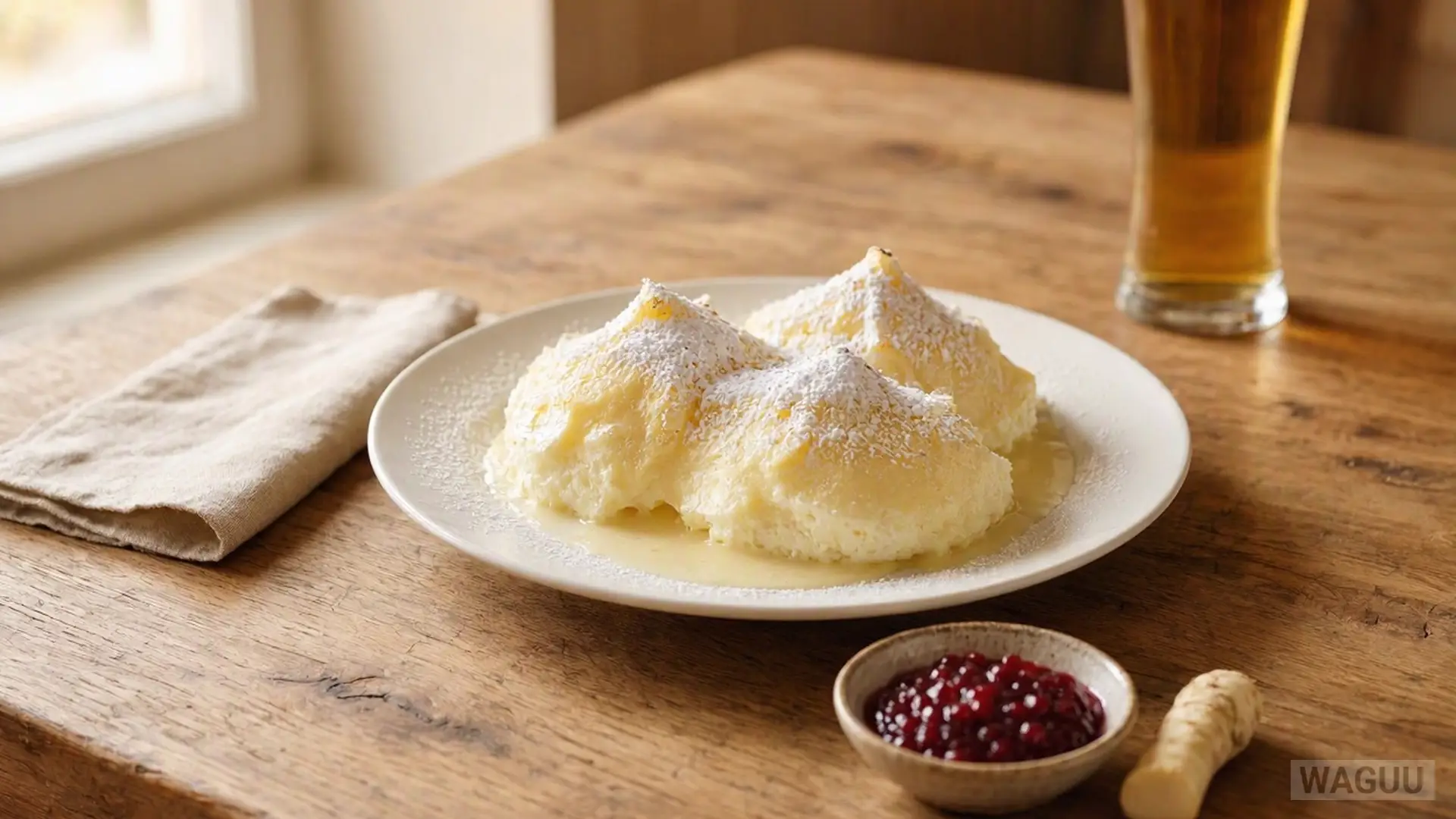
Summary: Salzburger Nockerl is a legendary Austrian soufflé representing the three snow-capped peaks of Salzburg. This ethereal dessert relies on perfectly aerated egg whites folded with sugar and a minimal amount of flour, baked until golden and served immediately. Preparation takes 20 minutes with 15 minutes of baking for 6 portions.
Did you cook this recipe? Share the result with the community.
Category: Desserts, Austrian Cuisine
Success rate: 98% of users successfully made this recipe
Quick overview
- Dish: Salzburger Nockerl
- Category: Desserts, Austrian Cuisine
- Cuisine: Austrian
- Main ingredient: Eggs, 6 pieces (large, free-range)
- Guide: 12 Most Popular Austrian Dishes: Favourite Recipes of Austrian Cuisine
- Total time: 35 minutes (20 min prep + 15 min cooking)
- Difficulty: Advanced
- Portions: 6 (Portion weight: 180 g)
- Key technique: Folding egg whites
- Preparation types: Baking
- Dietary info & Allergens: Contains eggs, milk, gluten
- Suitable for: Vegetarians
- Nutritional values (per 1 portion): 285 kcal, Protein: 9.2 g, Fat: 12.4 g, Carbohydrates: 34.6 g
- Storage: 0 days in the fridge, 0 months in the freezer
- Pairing: Riesling, coffee, black tea
- In short: A cloud-like soufflé that celebrates the simplicity of eggs and sugar.
- Last updated: 21 September 2026
WAGUU says: “The secret to this dish is the temperature of the egg whites and the speed with which you serve it once it leaves the oven.”
How to take it further: Infuse the milk with a vanilla bean or add a tablespoon of high-quality cranberry jam to the bottom of the dish.
Key facts
| Prep time: | 20 minutes |
| Cooking time: | 15 minutes |
| Temperature: | 200 °C |
| Number of portions: | 6 |
In a nutshell
Salzburger Nockerl is an iconic Austrian dessert consisting of three mounds of sweetened, whipped egg whites baked until golden brown. It is light, airy, and served warm, often accompanied by a fruit compote.
Ingredients
Base portions: 6 portions • Portion weight: 180 g
| Ingredient | Amount | Quality |
|---|---|---|
| Eggs | 6 pieces | Large, cold |
| Caster sugar | 150 g | Fine |
| Plain flour | 30 g | Sifted |
| Whole milk | 250 ml | Full fat |
| Butter | 20 g | Unsalted |
| Salt | 2 g | Fine sea salt |
Why you will love this recipe
- Artistic presentation: The three peaks mimic the mountains of Salzburg.
- Unmatched texture: A perfect balance between a crisp exterior and a molten, cloud-like center.
- Historical significance: A true piece of Austrian heritage that impresses every guest.
Why it works: The precise balance of protein structure in the egg whites and the minimal addition of starch ensures the soufflé retains its shape while remaining light.
Recipe overview
Prep: 20 min | Cooking: 15 min | Difficulty: Advanced | Portions: 6 | Type: Dessert | Origin: Austria
Detailed instructions
Overall progress: 0% complete
Phase 1: Preparation of the base – 5 min
Appliances: Oven, hob
1. Preheat the oven to 200 °C. Grease a large baking dish with the butter and pour in the milk. Heat the milk in the baking dish inside the oven until it just begins to simmer.
VKB: Visual check point (VKB): The milk should be steaming and show small bubbles at the edges of the dish.
Before moving to the next step: Ensure the oven has reached 200 °C.
Phase 2: Whipping the meringue – 10 min
Appliances: Electric mixer
2. Separate the eggs. In a clean bowl, whisk the egg whites with the salt until soft peaks form. Gradually add the caster sugar while continuing to whisk until a stiff, glossy meringue is achieved. Finally, gently fold in the sifted flour using a spatula.
VKB: The meringue should hold its shape firmly on the whisk.
Before moving to the next step: The folding must be very delicate to preserve the air bubbles.
Phase 3: Shaping and baking – 20 min
Appliances: Oven
3. Remove the baking dish with hot milk from the oven. Using a large spoon, form three generous mounds of the meringue mixture and place them into the hot milk. Return to the oven and bake for 12–15 minutes until golden brown.
VKB: The peaks should be firm to the touch and golden on the surface.
Required equipment
| Utensil | Ideal size | Alternative | Risk |
|---|---|---|---|
| Baking dish | 30 cm | Roasting tin | Overflow |
| Electric mixer | Handheld | Stand mixer | Over-whipping |
| Spatula | Silicone | Wooden spoon | Losing air |
Shopping list
Nutritional profile
Values per 1 portion (excluding side dishes). Calculated from average nutritional values of ingredients.
| Nutrient | Per 100 g | Per 1 portion | Per 6 portions |
|---|---|---|---|
| Energy | 158.3 kcal | 285.0 kcal | 1710.0 kcal |
| Fat | 6.9 g | 12.4 g | 74.4 g |
| of which saturates | 2.8 g | 5.0 g | 30.0 g |
| Carbohydrates | 19.2 g | 34.6 g | 207.6 g |
| of which sugars | 15.5 g | 27.9 g | 167.4 g |
| Protein | 5.1 g | 9.2 g | 55.2 g |
| Salt | 0.2 g | 0.4 g | 2.4 g |
Reference intake of an average adult (8400 kJ / 2000 kcal).
WAGUU Pro Level
- Pro standard: Verified recipe with precise ratios and visual control points.
- Tip 1: Use room temperature eggs for better volume.
- Tip 2: Ensure the bowl is completely free of grease.
- Tip 3: Serve immediately as it collapses quickly.
- Tip 4: Use a high-sided dish to support the rise.
Scientific background
The structure of Salzburger Nockerl is based on the denaturation and coagulation of egg proteins. When whisking egg whites, proteins unfold and trap air bubbles, creating a foam. The sugar stabilises this structure by increasing the viscosity of the liquid phase, while the small amount of flour provides a scaffold that prevents the soufflé from collapsing during the initial stages of heat exposure.
Fine Dining – Professional techniques
- Plate composition: Place the three peaks in a uniform row to reflect the mountain peaks.
- Textural contrasts: Dust with icing sugar (not part of the recipe) just before serving to add a silky mouthfeel.
- Temperature contrast: Serve with a chilled berry coulis (not part of the recipe).
- Aromatic garnishes: Use a touch of fresh mint (not part of the recipe) for a clean finish.
Sensory radar
- Appearance: Golden, peaked, and rising high.
- Aroma: Sweet, creamy, and eggy.
- Taste: Delicately sweet with a rich milk undertone.
- Texture: Extremely airy, light, and melting on the tongue.
Pairing
- BEER: A light wheat beer.
- WINE: A sweet Riesling Auslese.
- NON-ALCOHOLIC: Sparkling elderflower cordial.
Various preparation variants
- Vanilla variant: Infuse the milk with a split vanilla pod to enhance the aromatic profile.
- Citrus variant: Fold in a teaspoon of fresh lemon zest to provide a bright contrast to the richness.
Allergens and dietary information
Contains: Eggs, Milk, Gluten • Gluten: Contains plain flour • Not suitable for: Vegans, Lactose-intolerant individuals
Suitable for
Vegetarians and those seeking a refined, light dessert finish to a meal.
Substitution catalog
- Plain flour: Cornflour (reduces gluten content).
FAQ
Can I make this ahead?
No, it must be served immediately from the oven.
Why did it collapse?
Usually due to over-whipping the whites or waiting too long to serve.
Can I use a different sugar?
Caster sugar is best for its fine texture.
What if I don’t have a large dish?
Use individual ramekins for a unique presentation.
WAGUU Petr advises: Cooking for 12 or more people?
12–16 people: Prepare two separate batches to ensure the meringue doesn’t lose volume before baking. 20+ people: It is recommended to use multiple ovens and coordinate timing with a team, as the dish requires immediate serving.
Sides and Serving
- Cranberry compote – Adds a tart balance to the sweet soufflé (not included in the recipe).
- Vanilla sauce – A classic pairing for Austrian egg desserts (not included in the recipe).
Serving: Serve directly in the baking dish while still puffed and warm.
Storage and reheating
Fridge: 0 days • Freezer: 0 months • Reheating: Not recommended.
Author: WAGUU Petr & Team • Published: 21 Sep 2026 • Updated: 30 Oct 2026
Other recipes you might be interested in
Why WAGUU?
Recipes on WAGUU undergo checks for the accuracy of ingredients, procedures, and nutritional values.
Process photo gallery
Community photos: Cook, take a photo, and share the result.
You can upload photos in the comments below or send them via email.
Did you record a video guide for our recipe? Insert a link to YouTube, YouTube Shorts, TikTok, Instagram Reels, Facebook Reels, Pinterest, Vimeo, or X (Twitter) in the comment – we’d be happy to publish it and help promote you and your content.
Common mistakes
- Over-whipping: The meringue becomes dry and loses its ability to rise.
- Delaying service: The soufflé loses its height within minutes of leaving the oven.
- Improper folding: Deflating the egg whites leads to a dense result.
- Low oven temperature: The soufflé will not set properly in the middle.