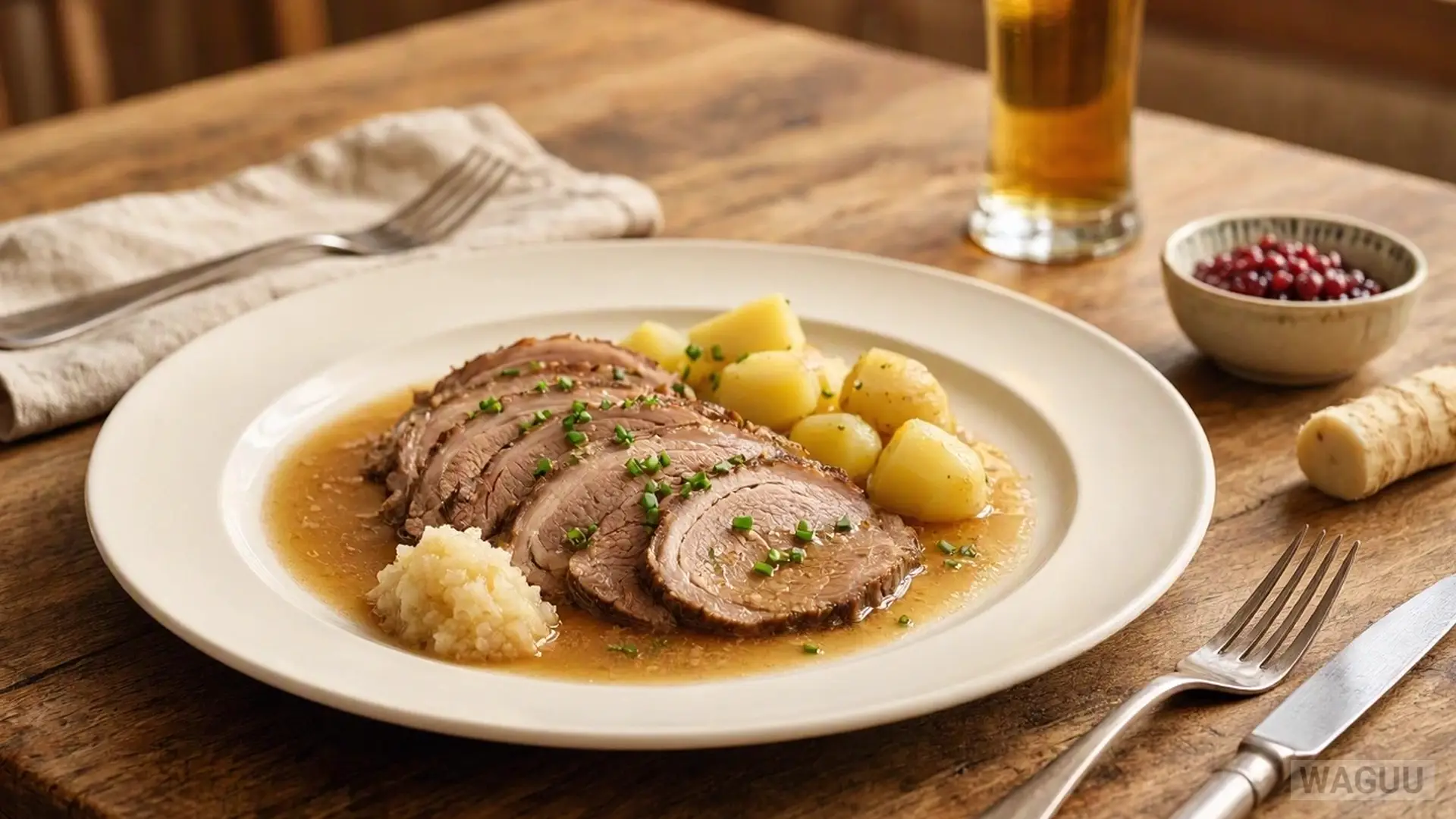
Summary: Tafelspitz is the pinnacle of Austrian boiled beef tradition. This recipe uses premium beef tri-tip, slow-simmered in a fragrant vegetable broth until fork-tender, served with classic apple horseradish and chive sauce.
Did you make this recipe? Share the result with the community.
Category: Main Dishes, Austrian Cuisine
Success rate: 98% of users successfully made this recipe
Quick overview
- Dish: Tafelspitz
- Category: Main Dishes, Austrian Cuisine
- Cuisine: Austrian
- Main ingredient: Beef tri-tip, 3 lb
- Guide: 12 Most Popular Austrian Dishes
- Total time: 180 minutes (30 min prep + 150 min cooking)
- Difficulty: Medium
- Servings: 6 (Serving weight: 600 g)
- Key technique: Gentle simmering (poaching)
- Preparation types: Boiling, Braising
- Dietary info & Allergens: Contains: Milk, Eggs, Celery. Gluten-free.
- Suitable for: Family dinners, Sunday lunch
- Nutritional values (per 1 serving): 620 kcal, Protein: 42 g, Fat: 38 g, Carbs: 28 g
- Storage: 3 days in the fridge, 3 months in the freezer
- Pairing: Lager, Grüner Veltliner, Sparkling water
- In a nutshell: The ultimate comfort food: tender beef, flavorful broth, and tangy sides.
- Last updated: September 21, 2026
WAGUU says: “Tafelspitz is about patience. Never boil the beef; keep it at a gentle simmer to ensure the meat stays succulent and the broth remains crystal clear.”
Key facts
| Prep time: | 30 min |
| Cooking time: | 150 min |
| Temperature: | 190–200 °F (simmering) |
| Number of servings: | 6 |
In a nutshell
Tafelspitz is a legendary dish consisting of beef tri-tip boiled in a rich, aromatic broth filled with root vegetables. Served with horseradish and a chive sauce, it is a masterpiece of simplicity and flavor.
Ingredients
Base servings: 6 servings • Serving weight: 600 g
| Ingredient | Quantity | Quality |
|---|---|---|
| Beef tri-tip | 3 lb | High-quality, trimmed |
| Root vegetables (carrots, celery, parsnip) | 1.5 lb | Fresh, cleaned |
| Beef bones | 1 lb | Marrow bones |
| Fresh horseradish | 4 oz | Freshly grated |
| Apples | 2 units | Tart variety |
| Fresh chives | 2 oz | Finely chopped |
| Sour cream | 1 cup | Full fat |
| Salt | 1.2 oz | Sea salt |
Why you’ll love this recipe
- Flavor depth: The combination of beef bones and root vegetables creates a broth that is incredibly rich and complex.
- Tender meat: Slow poaching preserves the structural integrity of the beef, resulting in a melt-in-your-mouth texture.
- Classic sides: The apple horseradish and chive sauce offer a perfect balance of heat, acidity, and creaminess.
Success guaranteed: By maintaining a gentle simmer and skimming the surface frequently, you ensure a clear, flavorful broth every time.
Recipe overview
Prep: 30 min | Cooking: 150 min | Difficulty: Medium | Servings: 6 | Type: Main Dish | Origin: Austrian
Detailed instructions
Overall progress: 0% completed
Phase 1: Preparing the broth – 30 min
Appliances: Stove, Large stockpot
1. Place the beef bones and 3 quarts of cold water in a large stockpot. Bring to a slow boil, skim off the foam, and add the beef tri-tip. Reduce to a gentle simmer.
CP: VKB: The liquid should never reach a rolling boil to prevent cloudiness.
Phase 2: Adding vegetables – 90 min
Appliances: Stove
2. After 1 hour of simmering, add the cleaned root vegetables, salt, and peppercorns. Continue to simmer gently for another 90 minutes until the beef is tender.
CP: VKB: The beef is ready when a fork slides into the center with no resistance.
Phase 3: Preparing the sauces – 30 min
Appliances: Grater, Mixing bowl
3. Grate the apples and mix with the grated horseradish. Separately, whisk the sour cream with the finely chopped fresh chives and a pinch of salt.
CP: VKB: The chive sauce should be thick and creamy.
Phase 4: Serving – 0 min
Appliances: Knife, Serving platter
4. Remove the beef, slice against the grain into 1/2-inch thick slices. Serve warm with the broth, vegetables, and the prepared sauces.
CP: VKB: Slicing against the grain ensures maximum tenderness.
Required equipment
| Utensil | Ideal size | Alternative | Risk |
|---|---|---|---|
| Stockpot | 8 quarts | Large Dutch oven | Boiling over |
| Grater | Fine | Food processor | Uneven texture |
| Chef’s knife | 10 inches | Carving knife | Tearing meat |
Shopping list
Nutrition profile
Values per 1 serving (excluding side dishes). Calculated from average ingredient nutrition values.
| Nutrient | Per 100 g | Per 1 serving | Per 6 servings |
|---|---|---|---|
| Energy | 103.3 kcal | 620 kcal | 3720 kcal |
| Fat | 6.3 g | 38 g | 228 g |
| of which saturates | 2.1 g | 12.6 g | 75.6 g |
| Carbohydrates | 4.7 g | 28 g | 168 g |
| of which sugars | 1.2 g | 7.2 g | 43.2 g |
| Protein | 7 g | 42 g | 252 g |
| Salt | 0.2 g | 1.2 g | 7.2 g |
Reference intake of an average adult (8400 kJ / 2000 kcal).
WAGUU Pro level
- Pro standard: Verified recipe with precise ratios and visual checkpoints.
- Tip 1: Use high-quality beef tri-tip for the best tenderness.
- Tip 2: Skim the foam continuously to keep the broth clear.
- Tip 3: Serve the broth first as a soup, followed by the beef.
- Tip 4: Freshly grated horseradish provides the most vibrant flavor.
Scientific background
Tafelspitz utilizes collagen hydrolysis. By maintaining a temperature below boiling, collagen in the beef connective tissue slowly converts to gelatin, resulting in tender meat without the toughening effects of rapid heat.
Fine Dining – Professional techniques
- Plate composition: Fan the beef slices on a warmed plate.
- Texture contrasts: Combine soft, slow-cooked beef with crunchy fresh horseradish.
- Temperature contrast: Serve the hot beef with cool chive sauce.
- Aromatic garnishes: Use micro-chives for an elegant finish.
Sensory radar
- Appearance: Clear, golden broth with tender, succulent beef slices.
- Aroma: Deep, savory beef notes with earthy root vegetables.
- Taste: Balanced, savory, and slightly tangy from the horseradish.
- Texture: Velvety, tender meat contrasting with the bite of fresh horseradish.
Pairing
- BEER: A light, crisp Austrian lager.
- WINE: A dry, mineral-rich Grüner Veltliner.
- NON-ALCOHOLIC: Sparkling mineral water with a lemon slice.
Various preparation methods
- Slow Cooker: Cook on low for 8 hours for maximum tenderness.
- Pressure Cooker: Reduces cooking time to 60 minutes while maintaining moisture.
Allergens and dietary information
Contains: Milk, Eggs, Celery • Gluten: None • Not suitable for: Dairy-free diets
Suitable for
Sunday family meals, traditional dinners, and special occasions.
Substitution guide
- Beef tri-tip: Beef brisket or rump roast.
- Sour cream: Crème fraîche for a richer, less acidic finish.
FAQ
Can I prepare Tafelspitz in advance?
Yes, the broth and meat improve in flavor when reheated gently the next day.
Is the broth meant to be served?
Traditionally, the broth is served as a first course with sliced vegetables.
WAGUU Petr advises: Cooking for 12 or more people?
12–16 people: Use two separate pots to maintain consistent temperature. • 20+ people: Consider using a large catering-grade stockpot.
Sides and serving
- Boiled potatoes – with parsley (not included in the recipe)
- Creamed spinach – a classic accompaniment (not included in the recipe)
Serving: Serve the beef slices warm with a generous amount of broth and the two sauces on the side.
Storage and reheating
Fridge: 3 days • Freezer: 3 months • Reheating: Gently heat in the broth on the stove.
Author: WAGUU Petr & Team • Published: 21 Sep 2026 • Updated: 30 Oct 2026
More Recipes in This Article
Guide: 12 Most Popular Austrian Dishes
Schweinsbraten mit Knödeln
Salzburger Nockerl
Apfelstrudel
Kaiserschmarrn
Other recipes you might enjoy
Why WAGUU?
Recipes on WAGUU undergo checks for ingredient accuracy, procedures, and nutritional values.
Process photo gallery
Community photos: Cook, take a picture, and share your results.
You can upload photos in the comments below or send them via email.
Common mistakes
- Boiling the meat: Hard boiling ruins the texture; always keep a gentle simmer.
- Cloudy broth: Failing to skim the foam results in a cloudy liquid.
- Tough meat: Slicing with the grain instead of against it makes the beef tough.
- Overcooking vegetables: Root vegetables should be tender but still hold their shape.