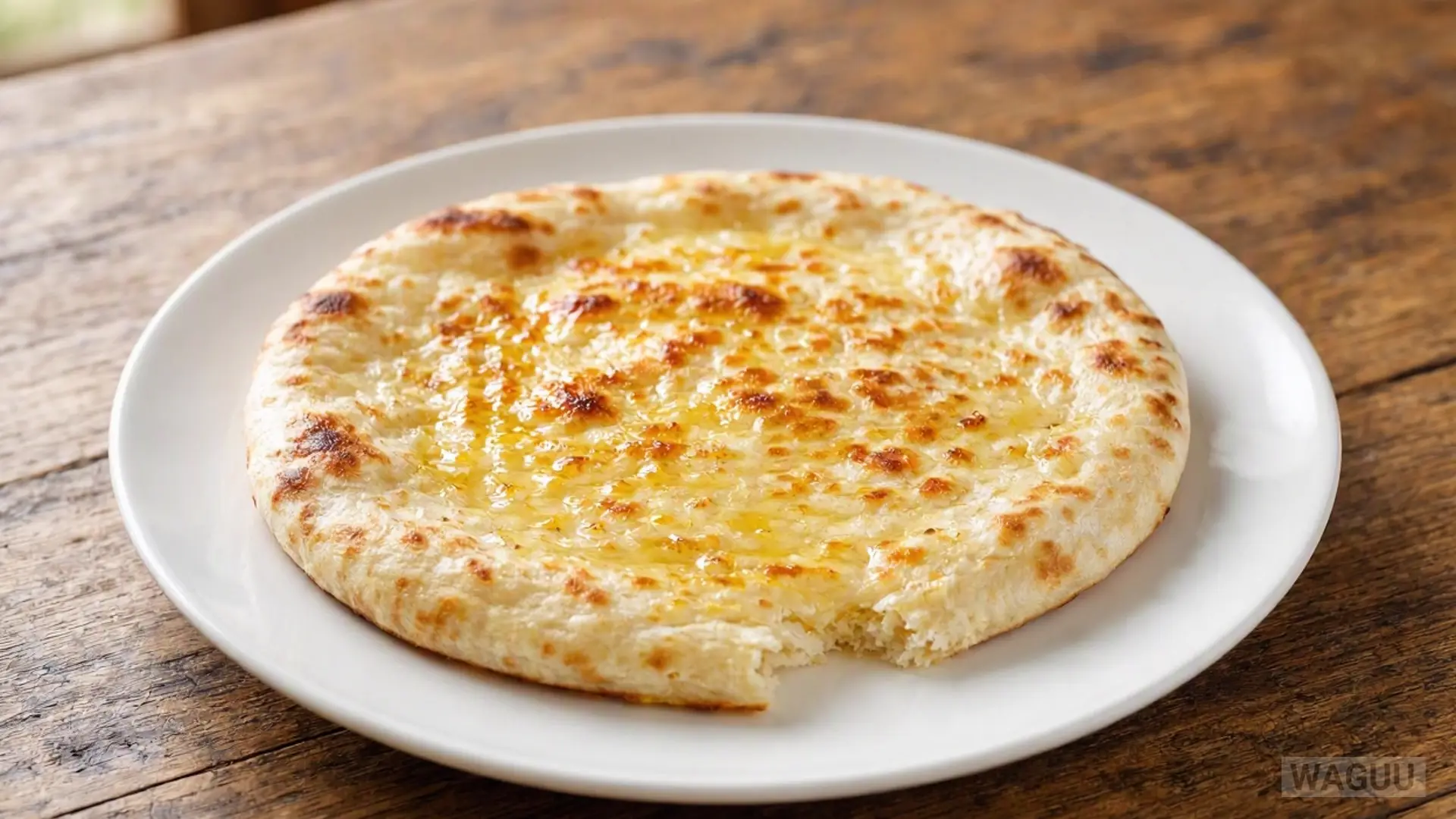
Summary: Naan – a soft Indian bread made from leavened dough, traditionally baked in a tandoor oven; served as an accompaniment to curry, often brushed with butter or ghee. Prepared using traditional yeast fermentation and high-temperature skillet baking, total preparation time 90 minutes, yielding 6 portions.
Did you cook this recipe? Share the result with the community.
Category: Bread and Pastry, Indian Cuisine
Success rate: not rated yet% of users successfully made this recipe
Quick overview
- Dish: Naan
- Category: Bread and Pastry, Indian Cuisine
- Cuisine: Indian
- Main ingredient: Wheat flour, 500 g (high-protein bread flour)
- Guide: 12 most popular Indian dishes: favourite recipes of Indian cuisine
- Total time: 90 minutes (60 min prep + 30 min cooking)
- Difficulty: Medium
- Portions: 6 portions (Portion weight: 120 g)
- Key technique: Yeast dough fermentation and high-heat skillet baking
- Preparation types: Kneading, proofing, rolling, pan-searing
- Dietary info & Allergens: Contains gluten, dairy
- Suitable for: Vegetarians, dinner parties, Indian feast nights
- Nutritional values (per 1 portion): 320 kcal, Protein: 9.2 g, Fat: 8.5 g, Carbohydrates: 51.0 g
- Storage: 2 days in the fridge, 3 months in the freezer
- Pairing: Mango lassi, Indian pale ale, sparkling water with lime
- In short: Authentic soft leavened flatbread brushed with ghee and garlic butter.
- Last updated: October 2023
WAGUU says: “Achieving restaurant-quality bubbles and char marks on your naan at home requires a blazing hot cast-iron skillet and properly relaxed dough.”
Key facts
| Prep time: | 60 minutes |
| Cooking time: | 30 minutes |
| Temperature: | 250 °C skillet surface |
| Number of portions: | 6 portions |
In a nutshell
Naan is the ultimate crown jewel of Indian bread baskets. Soft, pillowy, and lightly charred, this leavened flatbread pairs harmoniously with rich curries, gravies, and tandoori specialties. Making it at home without a commercial clay tandoor is surprisingly achievable using a heavy cast-iron skillet and a simple stovetop technique that recreates authentic texture and smoky flavor profiles.
Ingredients
Base portions: 6 portions • Portion weight: 120 g
| Ingredient | Amount | Quality |
|---|---|---|
| Wheat flour | 500 g | High protein bread flour |
| Yeast | 7 g | Active dry yeast |
| Sugar | 10 g | White granulated sugar |
| Warm water | 200 ml | Lukewarm (37 °C) |
| Yogurt | 100 g | Plain whole milk yogurt |
| Salt | 8 g | Fine sea salt |
| Ghee | 30 g | Clarified butter |
| Garlic | 15 g | Freshly minced cloves |
| Coriander | 10 g | Fresh chopped leaves |
Why you will love this recipe
- Authentic Texture: Yields a wonderfully soft interior with characteristic blistered spots on the surface.
- Easy Stovetop Method: No professional clay oven needed; works perfectly with a standard cast-iron skillet.
- Versatile Pairing: Complements virtually any Indian curry, stew, or grilled meat dish.
Success guaranteed: Following the exact resting times and maintaining high skillet temperature ensures perfect puffing every single time.
Recipe overview
Prep: 60 min | Cooking: 30 min | Difficulty: Medium | Portions: 6 portions | Type: Bread / Side Dish | Origin: Indian
Detailed instructions
Overall progress: 0% complete
Phase 1: Dough Preparation and Activation – 15 min
Appliances: Mixing bowl, digital kitchen scale
1. Combine 200 ml of lukewarm water (37 °C) with 10 g of sugar and 7 g of active dry yeast in a small bowl. Stir gently and let sit for 10 minutes until a frothy layer forms on the surface, indicating the yeast is active and viable.
VKB: Visual control: frothy yeast foam at least 1 cm thick.
Before moving to the next step:
Ensure water is not too hot, otherwise it will kill the yeast culture.
Phase 2: Mixing and Kneading – 15 min
Appliances: Stand mixer with dough hook or large mixing bowl
2. In a large bowl, mix 500 g of wheat flour and 8 g of salt. Create a well in the center and pour in the activated yeast mixture along with 100 g of plain yogurt and 15 g of melted ghee. Knead vigorously for 10 minutes by hand or 6 minutes in a stand mixer until a smooth, pliable, and slightly tacky dough forms.
VKB: Dough should pull away cleanly from the sides of the bowl while remaining soft to the touch.
Before moving to the next step:
Do not add too much extra flour during kneading; stickiness is normal for naan dough.
Phase 3: Bulk Fermentation – 45 min
Appliances: Bowl, damp kitchen towel or plastic wrap
3. Lightly oil the dough ball and place it back into the bowl. Cover securely with a damp towel or plastic wrap. Allow to proof in a warm, draft-free spot (24 °C) for 45 minutes until doubled in volume.
VKB: Dough volume doubled; impression left by a finger stays indented softly.
Before moving to the next step:
Keep the dough protected from cold drafts to ensure proper yeast activity.
Phase 4: Portioning and Shaping – 10 min
Appliances: Bench scraper, kitchen scale
4. Punch down the risen dough to release excess gas. Transfer to a lightly floured work surface and divide into 6 equal portions (approx. 120 g each). Roll each portion into a tight smooth ball, cover with a towel, and let rest for 10 minutes to relax the gluten strands.
VKB: Dough balls are smooth and relaxed, yielding easily when pressed.
Before moving to the next step:
Do not skip the 10-minute rest, otherwise the dough will shrink back when rolled.
Phase 5: Rolling and Topping Preparation – 10 min
Appliances: Rolling pin, small bowl, pastry brush
5. Roll each dough ball out into an elongated teardrop shape roughly 25 cm long and 5 mm thick. In a small bowl, mix 15 g of minced garlic and 10 g of chopped fresh coriander leaves together for finishing.
VKB: Uniform thickness across the entire flatbread shape without thin tearing spots.
Before moving to the next step:
Ensure the skillet is heating up properly before starting to cook the rolled pieces.
Phase 6: Skillet Baking and Finishing – 20 min
Appliances: Heavy cast-iron skillet, tongs
6. Heat a cast-iron skillet over high heat until smoking hot (250 °C). Lightly dampen one side of the rolled dough with water and place it wet-side down onto the hot dry skillet. Cook for 60-90 seconds until large bubbles puff up and the bottom shows dark charred spots. Flip the naan over briefly or invert the skillet over an open flame for 15 seconds to char the top. Brush immediately with remaining melted ghee, garlic, and coriander.
VKB: Golden-brown blisters on bottom and smoky charred spots across the surface.
Required equipment
| Utensil | Ideal size | Alternative | Risk |
|---|---|---|---|
| Cast-iron skillet | 28 cm diameter | Heavy stainless steel pan | Thin pans won’t retain enough heat for proper charring |
| Rolling pin | Standard wooden pin | Glass bottle | Uneven rolling thickness |
| Mixing bowl | 3-litre capacity | Any large ceramic bowl | Overflow during proofing if too small |
Shopping list
Nutritional profile
Values per 1 portion (excluding side dishes). Calculated from average nutritional values of ingredients.
| Nutrient | Per 100 g | Per 1 portion | Per 6 portions |
|---|---|---|---|
| Energy | 266.6 kcal | 320 kcal | 1920 kcal |
| Fat | 7.1 g | 8.5 g | 51.0 g |
| of which saturates | 4.2 g | 5.0 g | 30.0 g |
| Carbohydrates | 42.5 g | 51.0 g | 306.0 g |
| of which sugars | 2.1 g | 2.5 g | 15.0 g |
| Protein | 7.7 g | 9.2 g | 55.2 g |
| Salt | 1.1 g | 1.3 g | 7.8 g |
Reference intake of an average adult (8400 kJ / 2000 kcal).
WAGUU Pro Level
- Pro standard: Verified recipe with precise ratios and visual control points.
- Tip 1: Use high-protein bread flour (above 12% protein) to achieve better elasticity and larger air pockets during baking.
- Tip 2: Pre-heat your cast-iron skillet for at least 10 minutes on high heat before placing the first piece of dough.
- Tip 3: Lightly dampening one side of the dough ensures it adheres properly to the hot skillet surface without slipping.
- Tip 4: Brush the cooked naan with clarified butter (ghee) immediately while piping hot to lock in moisture and softness.
Scientific background
The exceptional softness and chewiness of naan stem from the combination of yeast fermentation and dairy lactic acid from yogurt. Yogurt proteins tenderize the gluten network while yeast produces carbon dioxide gas bubbles. When the wet dough hits the scorching 250 °C skillet, trapped moisture instantly vaporizes, creating explosive steam pockets that expand the dough and produce the signature charred blisters characteristic of tandoor baking.
Fine Dining – Professional techniques
- Plate composition: Serve stacked inside a warm linen-lined traditional bread basket, garnished with micro herbs and black sesame seeds.
- Textural contrasts: Crispy charred exterior surfaces contrasting with an exceptionally soft, pillowy interior crumb.
- Temperature contrast: Served piping hot immediately upon finishing, contrasting with cool raita or yogurt dips.
- Aromatic garnishes: Infused with garlic ghee, crushed toasted cumin, and fresh cilantro leaves.
Sensory radar
- Appearance: Teardrop shaped flatbread with golden-brown blisters and smoky dark char marks.
- Aroma: Rich buttery fragrance accompanied by roasted garlic and yeasty fermented wheat notes.
- Taste: Savory, buttery, with a subtle yeast sweetness and pleasant smoky undertones.
- Texture: Tender, chewy, and elastic with an airy interior crumb structure.
Pairing
- BEER: Crisp Indian Pale Ale (IPA) with citrus hop notes to balance the rich butter.
- WINE: Off-dry Riesling or Gewürztraminer with floral aromas and balanced acidity.
- NON-ALCOHOLIC: Traditional sweet or salted mango lassi, or iced mint limeade.
Various preparation variants
- Butter Garlic Naan: Brushed heavily with minced garlic, melted ghee, and finely chopped cilantro right after cooking.
- Cheese Stuffed Naan (Kulcha): Filled with spiced grated paneer or cheddar cheese before rolling and cooking.
Allergens and dietary information
Contains: Gluten, dairy (yogurt, ghee) • Gluten: Contains wheat gluten • Not suitable for: Vegan, lactose intolerant, celiac disease
Suitable for
Vegetarians, dinner parties, Indian theme nights, family weekend cooking
Substitution catalog
- Yogurt: Can be substituted with buttermilk or vegan yogurt alternative.
- Ghee: Can be replaced with melted unsalted butter or plant-based oil.
FAQ
Can I make naan without yeast?
Yes, you can use baking powder and baking soda as leavening agents, though yeast provides a superior authentic texture and flavor.
Why didn’t my naan puff up on the skillet?
Your skillet might not have been hot enough, or the dough was rolled too thinly or lacked sufficient moisture.
Can I freeze baked naan?
Yes, let them cool completely, wrap individually in parchment paper, freeze for up to 3 months, and reheat in a hot oven.
Do I need a tandoor oven?
No, a heavy cast-iron skillet heated on a standard stovetop replicates tandoor conditions remarkably well.
WAGUU Petr advises: Cooking for 12 or more people?
12–16 people: Scale ingredients by 2x and prepare dough in two separate mixing bowls to ensure proper kneading. Cook in batches and keep warm wrapped in a clean kitchen towel inside a preheated 80 °C oven • 20+ people: Divide dough preparation across the morning, shape all pieces in advance, and use two cast-iron skillets simultaneously on dual burners.
Sides and Serving
- Butter Chicken (Murgh Makhani) – Rich creamy tomato chicken curry (not included in the recipe)
- Chana Masala – Spiced chickpea curry (not included in the recipe)
Serving: Serve piping hot stacked in a bread basket, brushed generously with garlic ghee and sprinkled with fresh cilantro.
Storage and reheating
Fridge: 2 days • Freezer: 3 months • Reheating: Warm in a hot dry skillet or preheated oven at 180 °C for 3 minutes.
Author: WAGUU Petr & Team • Published: 25 Aug 2026 • Updated: 31 Oct 2026
More Recipes from This Article
Guide: 12 most popular Indian dishes: favourite recipes of Indian cuisine
Other recipes you might be interested in
Why WAGUU?
Recipes on WAGUU undergo checks for the accuracy of ingredients, procedures, and nutritional values.
Process photo gallery
Community photos: Cook, take a photo, and share the result.
You can upload photos in the comments below or send them via email.
Did you record a video guide for our recipe? Insert a link to YouTube, YouTube Shorts, TikTok, Instagram Reels, Facebook Reels, Pinterest, Vimeo, or X (Twitter) in the comment – we’d be happy to publish it and help promote you and your content.
Common mistakes
- Insufficient Skillet Heat – Using a lukewarm pan prevents the dough from bubbling and charring correctly.
- Skipping Gluten Relaxation – Forcing unrelaxed dough balls leads to excessive shrinkage during rolling.
- Overkneading Dry Dough – Adding too much flour makes the naan dense instead of pillowy and soft.
- Skipping the Ghee Finish – Failing to brush with fat immediately causes the surface to dry out quickly.