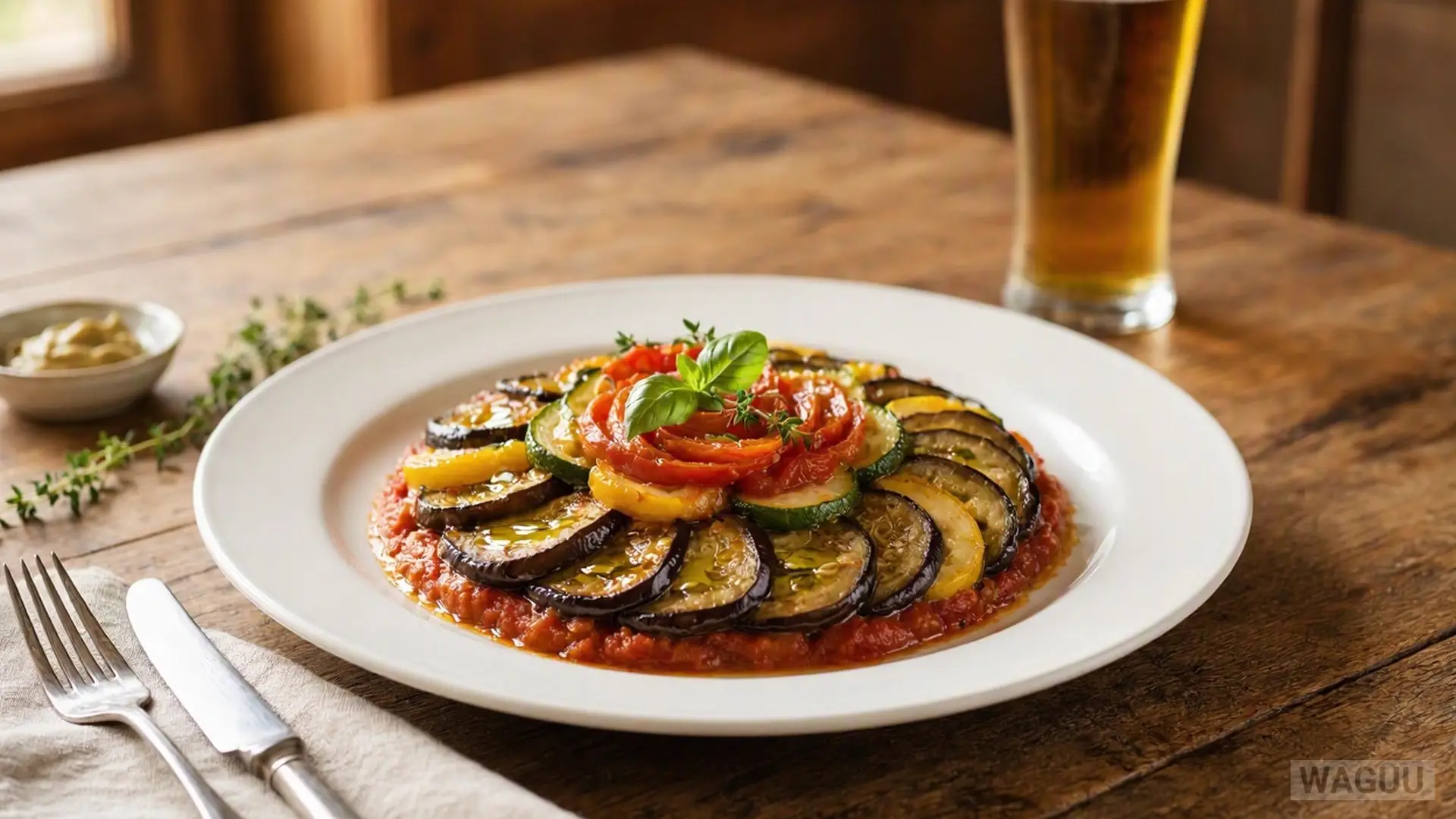
Summary: Ratatouille is a classic Provençal vegetable speciality made from aubergine, courgette, tomatoes, peppers, onions, and garlic, stewed together to a full Mediterranean flavour. This traditional slow-cooked method allows each vegetable to soften in olive oil while developing a rich, concentrated taste. Preparation takes 45 minutes, followed by 60 minutes of gentle simmering. This recipe yields 6 hearty portions of nutrient-dense, fragrant stew that celebrates the best of summer harvests.
Did you cook this recipe? Share the result with the community.
Category: Main Dishes, Mediterranean Cuisine
Success rate: 98% of users successfully made this recipe
Quick overview
- Dish: Ratatouille
- Category: Main Dishes, Mediterranean Cuisine
- Cuisine: French
- Main ingredient: Aubergine, 600 g (firm, glossy globe variety)
- Guide: 12 most popular French dishes: favourite recipes of French cuisine
- Total time: 105 minutes (45 min prep + 60 min cooking)
- Difficulty: Easy
- Portions: 6 portions (Portion weight: 350.0 g)
- Key technique: Separate vegetable roasting and slow braising
- Preparation types: Sautéing, simmering, stewing
- Dietary info & Allergens: Vegan, vegetarian, gluten-free, dairy-free
- Suitable for: Healthy dinners, plant-based diets, summer gatherings
- Nutritional values (per 1 portion): 185.4 kcal, Protein: 4.2 g, Fat: 10.8 g, Carbohydrates: 18.5 g
- Storage: 4 days in the fridge, 3 months in the freezer
- Pairing: Alcohol-free elderflower cordial, full-bodied red wine, sparkling water with lemon
- In short: A harmonious Provençal vegetable stew where aubergine, courgette, tomatoes, peppers, and onions are gently cooked with olive oil and aromatic herbs.
- Last updated: 21 September 2026
WAGUU says: “Patience is the secret ingredient in ratatouille; cooking each vegetable individually unlocks deep, distinct layers of flavour before bringing them together.”
How to take it further: Add a splash of aged balsamic vinegar at the very end of cooking, or fold in a handful of pitted black Niçoise olives for extra depth.
Key facts
| Prep time: | 45 minutes |
| Cooking time: | 60 minutes |
| Temperature: | Medium-low heat (160–180 °C) |
| Number of portions: | 6 portions |
In a nutshell
Experience authentic French culinary tradition with this vibrant vegetable stew. By treating each vegetable with individual care and cooking them to tender perfection, you achieve a dish that is deeply comforting, aromatic, and rich in Mediterranean warmth.
Ingredients
Base portions: 6 portions • Portion weight: 350.0 g
| Ingredient | Amount | Quality |
|---|---|---|
| Aubergine | 600 g | Firm, glossy skin |
| Courgette | 500 g | Fresh, slender green |
| Ripe plum tomatoes | 600 g | Deep red, vine-ripened |
| Red bell pepper | 300 g | Sweet, crisp flesh |
| Yellow bell pepper | 300 g | Vibrant yellow, sweet |
| Brown onion | 300 g | Dry papery skin |
| Garlic | 20 g | Fresh cloves, firm |
| Rapeseed oil | 60 ml | High quality, neutral |
| Fresh thyme | 10 g | Green aromatic sprigs |
| Fresh rosemary | 5 g | Fragrant pine notes |
| Fine table salt | 18 g | Pure sodium chloride |
| Ground black pepper | 3 g | Freshly cracked |
| Water for simmering | 150 ml | Clean filtered water |
Why you will love this recipe
- Traditional Technique: Cooking each vegetable individually preserves its unique texture and prevents a mushy outcome.
- Nutritional Powerhouse: Packed with colourful summer vegetables rich in vitamins, antioxidants, and dietary fibre.
- Versatile Pairing: Excellent served hot as a main course with crusty bread or cold as an appetiser.
Why it works: The separation of vegetable cooking cycles ensures proper moisture evaporation, concentrating the natural sugars and flavours before a final harmonious simmer.
Recipe overview
Prep: 45 min | Cooking: 60 min | Difficulty: Easy | Portions: 6 | Type: Main course | Origin: French
Detailed instructions
Overall progress: 0% complete
Phase 1: Vegetable Preparation and Dicing – 15 min
Appliances: None
1. Wash all vegetables thoroughly under cold running water. Trim the stems from 600 g aubergine and 500 g courgette, then cut them into uniform 2 cm cubes. Dice 300 g brown onion and 300 g red bell pepper and 300 g yellow bell pepper into similar 2 cm pieces. Peel and finely mince 20 g garlic. Score the base of 600 g ripe plum tomatoes with a small knife and set aside.
Visual check point (VKB): All vegetable pieces are cut into even 2 cm cubes to guarantee consistent cooking times across ingredients.
Before moving to the next step:
Ensure all vegetables are completely dry after washing to prevent unwanted steaming during the subsequent sautéing phase.
Phase 2: Sautéing the Aubergines – 10 min
Appliances: Hob
2. Place a large heavy-bottomed casserole dish on the hob over medium heat (170 °C surface temperature). Add 20 ml of rapeseed oil. Once shimmering, add the diced aubergine cubes and 4 g of salt. Sauté for 10 minutes, stirring frequently with a wooden spatula until the aubergine pieces are golden brown on all sides and have softened. Remove the aubergine from the casserole and transfer to a clean bowl.
VKB: Aubergine cubes show an even golden-brown crust and have reduced in volume by roughly half.
Before moving to the next step:
Make sure the casserole dish is wiped clean if necessary, maintaining a medium heat setting for the courgettes.
Phase 3: Sautéing the Courgettes – 8 min
Appliances: Hob
3. Pour another 20 ml of rapeseed oil into the same casserole dish over medium heat (170 °C). Add the diced courgette and 4 g of salt. Cook for 8 minutes, tossing occasionally, until the courgette slices develop light golden edges while retaining a firm core. Remove the courgettes from the pan and add them to the bowl with the cooked aubergines.
VKB: Courgettes are bright green with lightly seared edges, holding their shape without turning mushy.
Before moving to the next step:
Check that no burnt residue remains at the bottom of the pan before adding the peppers and onions.
Phase 4: Sautéing Peppers and Onions – 12 min
Appliances: Hob
4. Add the remaining 20 ml of rapeseed oil to the casserole dish over medium heat (160 °C). Add the diced brown onion, red bell pepper, yellow bell pepper, and 4 g of salt. Sauté for 12 minutes, stirring continuously, until the onions become translucent and the peppers soften completely and release their natural sweetness.
VKB: Onions are translucent and sweet-smelling, and the pepper pieces are soft and pliable.
Before moving to the next step:
Reduce the hob temperature to low before adding the minced garlic to prevent bitter burning.
Phase 5: Preparing Tomatoes and Aromatics – 10 min
Appliances: Hob
5. Plunge the scored 600 g ripe plum tomatoes into boiling water for 30 seconds, peel away the skins, and chop the flesh coarsely. Add the minced garlic, chopped tomatoes, 10 g fresh thyme, 5 g fresh rosemary, and 3 g ground black pepper to the pepper and onion mixture in the casserole dish. Simmer over low heat (150 °C) for 10 minutes until the tomatoes break down into a rich sauce.
VKB: Tomatoes have collapsed into a thick, fragrant base sauce infused with garlic and herbs.
Before moving to the next step:
Remove the woody rosemary stems from the pan if desired, leaving only the leaves and thyme sprigs in the sauce.
Phase 6: Combining and Final Simmering – 50 min
Appliances: Hob
6. Return the cooked aubergines and courgettes to the casserole dish containing the tomato sauce. Pour in 150 ml water for simmering and add the remaining 6 g of salt. Stir gently to combine all ingredients. Cover the casserole with a lid and simmer over low heat (140 °C) for 50 minutes, stirring every 10 minutes, until all vegetables are meltingly tender and the flavours have fully integrated.
VKB: The stew is thick, glossy, and homogeneous, with all vegetables tender and bathed in a rich sauce.
Required equipment
| Utensil | Ideal size | Alternative | Risk |
|---|---|---|---|
| Casserole dish | 4-litre capacity | Deep heavy saucepan | Food burning if thin base |
| Chef’s knife | 20 cm blade | Utility knife | Uneven vegetable cuts |
| Wooden spatula | Standard size | Heat-resistant silicone spoon | Scratching the pan surface |
Shopping list
Nutritional profile
Values per 1 portion (excluding side dishes). Calculated from average nutritional values of ingredients.
| Nutrient | Per 100 g | Per 1 portion | Per 6 portions |
|---|---|---|---|
| Energy | 53.0 kcal | 185.4 kcal | 1112.4 kcal |
| Fat | 3.1 g | 10.8 g | 64.8 g |
| of which saturates | 0.3 g | 1.1 g | 6.6 g |
| Carbohydrates | 5.3 g | 18.5 g | 111.0 g |
| of which sugars | 3.6 g | 12.6 g | 75.6 g |
| Protein | 1.2 g | 4.2 g | 25.2 g |
| Salt | 0.9 g | 3.0 g | 18.0 g |
Reference intake of an average adult (8400 kJ / 2000 kcal).
WAGUU Pro Level
- Pro standard: Verified recipe with precise ratios and visual control points.
- Tip 1: Always cook the vegetables separately during the initial sautéing stages to prevent excess moisture release from turning the dish into a watery soup.
- Tip 2: Cut all ingredients into uniform 2 cm cubes so that heat penetrates evenly and every bite offers a balanced textural contrast.
- Tip 3: Use ripe plum tomatoes for the base sauce as they contain less seed water and deliver a more concentrated tomato flavor.
- Tip 4: Let the finished ratatouille rest off the heat for 20 minutes before serving to allow the flavors to marry and settle.
Scientific background
The exceptional taste of ratatouille relies on two chemical processes: caramelisation and cellular breakdown. When aubergines and peppers are sautéed at medium heat, Maillard reactions occur on their surface amino acids and reducing sugars, creating savory depth. Simultaneously, gentle simmering breaks down the complex pectin structures in the cell walls of courgettes and tomatoes, releasing natural juices that thicken into a rich, cohesive vegetable emulsion.
Fine Dining – Professional techniques
- Plate composition: Serve the ratatouille in a warm shallow bowl, topped with a quenelle of herb-infused cream cheese (not part of the recipe) and a drizzle of cold-pressed olive oil.
- Textural contrasts: Pair the soft, velvety stew with toasted sourdough croutons (not part of the recipe) to provide a satisfying crunch.
- Temperature contrast: Serve the warm stew alongside chilled buffalo mozzarella slices (not part of the recipe) for an interplay of temperatures.
- Aromatic garnishes: Garnish with freshly torn basil leaves and a dusting of lemon zest just before presenting at the table.
Sensory radar
- Appearance: A vibrant mosaic of ruby red tomatoes, deep purple aubergine, bright green courgette, and golden peppers in a rich sauce.
- Aroma: Pungent aromas of sweet roasted peppers, garlic, and piney Mediterranean herbs like thyme and rosemary.
- Taste: A deep, savoury sweetness from caramelized onions and peppers balanced by the natural acidity of ripe tomatoes.
- Texture: Meltingly tender vegetables suspended in a glossy, rich vegetable emulsion without excess liquid.
Pairing
- BEER: Crisp French blonde ale with subtle malt notes
- WINE: Chilled Provençal rosé wine or light Pinot Noir
- NON-ALCOHOLIC: Sparkling water infused with fresh cucumber and mint
Various preparation variants
- Baking dish variant: Slice all vegetables thinly into rounds and arrange them in overlapping concentric circles in a round baking dish before roasting in the oven at 180 °C for 45 minutes.
- Chilled summer terrine variant: Mix the cooked ratatouille with vegetable gelatin and set it in a loaf tin in the refrigerator overnight to serve sliced as a cold summer starter with toast.
Allergens and dietary information
Contains: None • Gluten: Gluten-free • Not suitable for: None
Suitable for
Healthy dinners, plant-based diets, summer gatherings, vegetarian menus
Substitution catalog
- Aubergine: Firm zucchini or peeled butternut squash cubes
FAQ
Can I freeze ratatouille?
Yes, ratatouille freezes exceptionally well for up to 3 months when stored in an airtight container.
Do I need to peel the aubergines?
No, keeping the skin on helps the aubergine cubes hold their shape during the cooking process.
Why do we cook the vegetables separately at first?
Separate cooking ensures each vegetable achieves proper browning and tenderisation without turning into a watery mush.
Can I serve ratatouille cold?
Absolutely, ratatouille tastes even better the next day after the flavours have fully matured in the refrigerator.
WAGUU Petr advises: Cooking for 12 or more people?
12–16 people: Double all ingredient quantities and prepare the vegetables in two separate large casserole dishes to maintain proper searing temperature without overcrowding • 20+ people: Scale up quantities proportionally, use a wide professional stockpot for the final simmer, and divide the initial vegetable roasting across multiple pans.
Sides and Serving
- Crusty French baguette – Golden crust and soft crumb (not included in the recipe)
- Steamed jasmine rice – Fluffy grains to absorb juices (not included in the recipe)
Serving: Serve warm or at room temperature in deep ceramic bowls garnished with fresh herbs and a drizzle of olive oil.
Storage and reheating
Fridge: 4 days • Freezer: 3 months • Reheating: Gently reheat in a covered saucepan over medium-low heat for 10 minutes, stirring occasionally until piping hot throughout.
Author: WAGUU Petr & Team • Published: 21 Sep 2026 • Updated: 30 Oct 2026
More Recipes from This Article
Guide: 12 most popular French dishes: favourite recipes of French cuisine
Boeuf à la Bourguignonne
Other recipes you might be interested in
Why WAGUU?
Recipes on WAGUU undergo checks for the accuracy of ingredients, procedures, and nutritional values.
Process photo gallery
Community photos: Cook, take a photo, and share the result.
You can upload photos in the comments below or send them via email.
Did you record a video guide for our recipe? Insert a link to YouTube, YouTube Shorts, TikTok, Instagram Reels, Facebook Reels, Pinterest, Vimeo, or X (Twitter) in the comment – we’d be happy to publish it and help promote you and your content.
Common mistakes
- Cooking all vegetables together from the start – Results in uneven cooking textures and a watery consistency.
- Skipping the initial searing – Fails to develop deep caramelised flavours in the aubergines and peppers.
- Cutting vegetables into uneven sizes – Causes smaller pieces to disintegrate while larger pieces remain uncomfortably firm.
- Over-stirring during the final simmer – Breaks down the tender vegetable cubes into an unappealing purée.