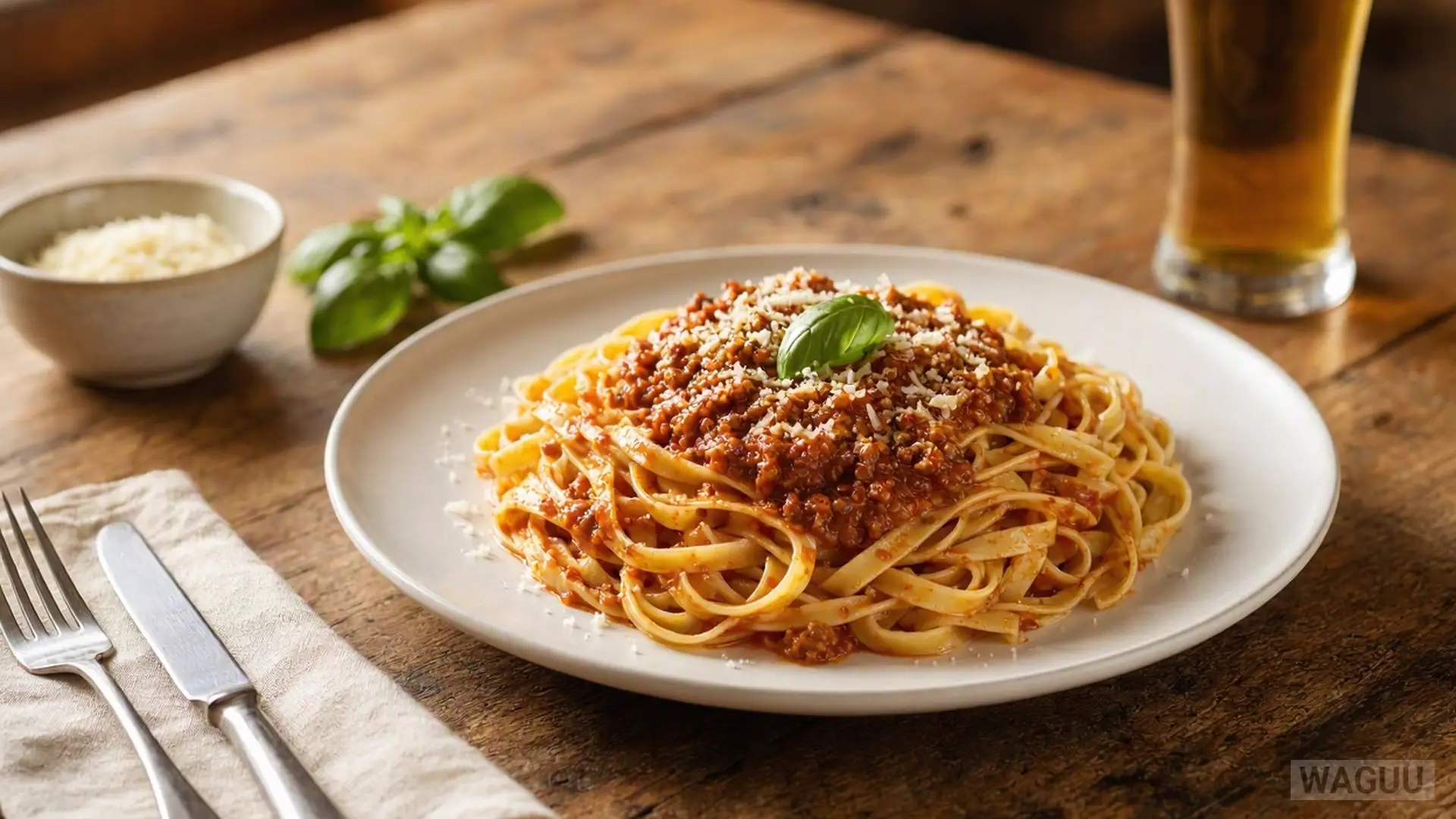
Summary: Tagliatelle al Ragù is a quintessential Italian classic featuring wide ribbons of fresh egg pasta coated in a rich, slow-cooked Bolognese meat ragù made with finely diced vegetables, minced meats, red wine, and tomatoes. This authentic preparation requires patience and traditional braising techniques over 3 hours to achieve a meltingly tender texture and deep, layered savory profile designed for 6 portions.
Did you cook this recipe? Share the result with the community.
Category: Pasta, Italian Cuisine
Success rate: 98% of users successfully made this recipe
Quick overview
- Dish: Tagliatelle al Ragù
- Category: Pasta, Italian Cuisine
- Cuisine: Italian
- Main ingredient: Minced beef and pancetta, 700 g (premium quality)
- Guide: 12 most popular Italian dishes: favourite recipes of Italian cuisine
- Total time: 210 minutes (30 min prep + 180 min cooking)
- Difficulty: Intermediate
- Portions: 6 portions (Portion weight: 450 g)
- Key technique: Slow braising and milk reduction
- Preparation types: Sautéing, simmering, boiling
- Dietary info & Allergens: Contains gluten, milk, eggs, sulphites
- Suitable for: Lunch, dinner, festive gatherings
- Nutritional values (per 1 portion): 712.5 kcal, Protein: 32.4 g, Fat: 28.6 g, Carbohydrates: 81.2 g
- Storage: 3 days in the fridge, 3 months in the freezer
- Pairing: Craft amber lager, Chianti Classico, sparkling water with lemon
- In short: Silky egg ribbons enveloped in a robust, slow-cooked meat sauce.
- Last updated: 21 September 2026
WAGUU says: “True Bolognese ragù is built on patience; simmering the meat gently in milk before adding wine and tomatoes breaks down connective tissue and creates an incomparable velvety texture.”
How to take it further: Finish the ragù with a pat of cold butter just before tossing, and grate aged Parmigiano Reggiano directly into the pasta water emulsion.
Key facts
| Prep time: | 30 minutes |
| Cooking time: | 180 minutes |
| Temperature: | 95–100 °C |
| Number of portions: | 6 portions |
In a nutshell
Experience the authentic taste of Emilia-Romagna with this masterclass in ragù preparation. Wide strands of fresh egg pasta cling perfectly to the thick, aromatic meat sauce, offering a deeply comforting and sophisticated dining experience.
Ingredients
Base portions: 6 portions • Portion weight: 450 g
| Ingredient | Amount | Quality |
|---|---|---|
| Minced beef chuck | 500 g | Freshly minced, 15% fat |
| Pancetta | 150 g | Cured pork belly, finely diced |
| Yellow onion | 120 g | Finely minced |
| Carrot | 100 g | Finely diced |
| Celery stalks | 80 g | Finely diced |
| Tomato paste | 60 g | Double concentrated |
| Dry white wine | 250 ml | Crisp and dry |
| Whole milk | 250 ml | Full fat, 3.5% |
| Beef stock | 300 ml | Rich homemade stock |
| Extra virgin olive oil | 30 ml | Cold pressed |
| Fresh tagliatelle pasta | 600 g | Wide egg ribbons |
| Parmigiano Reggiano | 100 g | Aged 24 months, freshly grated |
| Fine sea salt | 15 g | Pure sea salt |
| Ground black pepper | 3 g | Freshly ground |
Why you will love this recipe
- Unmatched depth of flavour: The traditional slow-simmering process builds layers of savory complexity that quick meat sauces simply cannot match.
- Perfect pasta pairing: Porous, wide egg tagliatelle holds the rich meat ragù impeccably, ensuring every bite is balanced.
- Culinary satisfaction: Master a timeless Italian technique that transforms humble ingredients into a magnificent feast.
Why it works: Simmering minced meat in milk before adding acidic wine and tomatoes tenderizes the proteins and mellows harsh acidity, resulting in a harmonious sauce.
Recipe overview
Prep: 30 min | Cooking: 180 min | Difficulty: Intermediate | Portions: 6 portions | Type: Main course | Origin: Italian
Detailed instructions
Overall progress: 0% complete
Phase 1: Preparing the soffritto and pancetta – 20 min
Appliances: Hob
1. Place a heavy-bottomed Dutch oven over medium heat. Add 30 ml of extra virgin olive oil along with 150 g of finely diced pancetta. Sauté for 8 minutes until the pancetta fat renders and becomes lightly golden. Add 120 g of finely minced yellow onion, 100 g of finely diced carrot, and 80 g of finely diced celery stalks. Cook the vegetables stirring frequently for 12 minutes at 110 °C until thoroughly softened and translucent without browning.
Visual check point (VKB): Vegetables are uniformly soft and sweet-smelling, and the fat is clear.
Before moving to the next step:
Ensure the soffritto is completely soft so it melts into the meat sauce rather than remaining crunchy.
Phase 2: Browning the meat and wine reduction – 25 min
Appliances: Hob
2. Add 500 g of minced beef chuck to the vegetable base. Increase the heat to medium-high and cook for 15 minutes, breaking up any lumps with a wooden spoon, until the meat is fully browned and its juices evaporate. Pour in 250 ml of dry white wine and simmer uncovered for 10 minutes at 95 °C until the alcohol aroma dissipates and the liquid is nearly absorbed.
VKB: Meat is browned evenly and no raw wine alcohol smell remains in the pan.
Before moving to the next step:
Cook off all the wine until dry to prevent a sharp, acidic taste in the finished ragù.
Phase 3: Milk simmer and protein tenderisation – 60 min
Appliances: Hob
3. Stir in 60 g of double concentrated tomato paste until well incorporated. Pour in 250 ml of whole milk. Reduce the heat to low and simmer gently uncovered for 60 minutes at 90 °C, stirring occasionally, until the milk has completely evaporated and coated the meat.
VKB: Milk is fully absorbed and the meat mixture appears glossy and pale before adding stock.
Before moving to the next step:
Ensure the milk is fully reduced so the dairy fats bond with the meat proteins properly.
Phase 4: Long slow braising with stock – 95 min
Appliances: Hob
4. Pour in 300 ml of rich beef stock, add 15 g of fine sea salt and 3 g of freshly ground black pepper. Cover the pot with a tight-fitting lid, leaving it slightly cracked. Simmer on the lowest heat setting for 95 minutes at 85–90 °C, stirring every 20 minutes and adding a small splash of water if the sauce thickens too quickly.
VKB: Ragù is thick, unctuous, deep red-brown in colour, and the meat is exceptionally tender.
Before moving to the next step:
Check seasoning and adjust salt if necessary before cooking the pasta.
Phase 5: Boiling the fresh tagliatelle – 5 min
Appliances: Hob
5. Bring a large pot filled with 5 litres of water to a rolling boil and add 35 g of salt (not part of the recipe). Drop in 600 g of fresh tagliatelle pasta. Cook for 3 to 4 minutes at 100 °C until al dente. Reserve 150 ml of starchy pasta cooking water before draining the pasta thoroughly.
VKB: Fresh pasta floats to the surface and offers a slight bite in the center when tested.
Before moving to the next step:
Do not overcook the fresh pasta, as it will continue cooking slightly when tossed with the hot ragù.
Phase 6: Tossing and final assembly – 5 min
Appliances: Hob
6. Transfer the drained fresh tagliatelle directly into the warm Dutch oven containing the ragù. Add 100 ml of the reserved pasta cooking water and 50 g of freshly grated Parmigiano Reggiano. Toss vigorously over medium heat for 2 minutes until the sauce emulsifies and coats every strand of pasta.
VKB: Sauce clings to the ribbons without pooling at the bottom of the pan.
Required equipment
| Utensil | Ideal size | Alternative | Risk |
|---|---|---|---|
| Dutch oven | 5 litre capacity | Heavy saucepan | Scorching if heat is too high |
| Chef’s knife | 20 cm blade | Utility knife | Uneven vegetable dice |
| Pasta pot | 8 litre capacity | Large stockpot | Boiling over if lid is left on |
Shopping list
Nutritional profile
Values per 1 portion (excluding side dishes). Calculated from average nutritional values of ingredients.
| Nutrient | Per 100 g | Per 1 portion | Per 6 portions |
|---|---|---|---|
| Energy | 158.3 kcal | 712.5 kcal | 4275.0 kcal |
| Fat | 6.4 g | 28.6 g | 171.6 g |
| of which saturates | 2.8 g | 12.4 g | 74.4 g |
| Carbohydrates | 18.0 g | 81.2 g | 487.2 g |
| of which sugars | 2.1 g | 9.5 g | 57.0 g |
| Protein | 7.2 g | 32.4 g | 194.4 g |
| Salt | 0.6 g | 2.7 g | 16.2 g |
Reference intake of an average adult (8400 kJ / 2000 kcal).
WAGUU Pro Level
- Pro standard: Verified recipe with precise ratios and visual control points.
- Tip 1: Mince the soffritto vegetables by hand rather than using a food processor to prevent them from releasing too much water and turning mushy.
- Tip 2: Use a combination of beef chuck and pancetta to ensure sufficient natural gelatin and fat content for a glossy sauce.
- Tip 3: Never rush the milk reduction phase; simmering milk slowly neutralizes the acidity of the tomatoes and tenderizes the meat fibres.
- Tip 4: Always toss the freshly boiled tagliatelle directly in the hot ragù with a splash of starchy pasta water to bind everything together into a cohesive emulsion.
Scientific background
The prolonged simmering process induces collagen hydrolysis in the beef chuck and pancetta, converting tough connective tissues into gelatin that thickens the sauce naturally. The casein proteins in the whole milk bind with meat fats during the milk reduction phase, smoothing out the acidity of the wine and tomatoes while creating a silky mouthfeel.
Fine Dining – Professional techniques
- Plate composition: Twirl the tagliatelle into a neat nest using a large carving fork and ladle a generous spoonful of glossy ragù over the top.
- Textural contrasts: Pair the tender egg pasta and unctuous ragù with the delicate crunch of freshly grated aged Parmigiano Reggiano.
- Temperature contrast: Serve the dish on pre-warmed ceramic plates to maintain an optimal serving temperature.
- Aromatic garnishes: Garnish with freshly cracked black pepper and a drizzle of raw extra virgin olive oil just before serving.
Sensory radar
- Appearance: Deep red-brown glossy sauce clinging to vibrant yellow egg pasta ribbons.
- Aroma: Rich aromas of braised beef, sweet soffritto vegetables, and aged cheese.
- Taste: Deeply savoury, balanced with mild natural sweetness from carrots and rich umami notes.
- Texture: Silky, velvety sauce coating tender yet resilient egg pasta.
Pairing
- BEER: Craft amber lager with caramel malt undertones.
- WINE: Chianti Classico or Sangiovese with bright acidity and cherry fruit.
- NON-ALCOHOLIC: Sparkling mineral water with a fresh lemon slice.
Various preparation variants
- Rustic Country Style: Incorporate finely diced chicken livers during the meat-browning phase for an authentic regional depth of flavour.
- Herb-Infused Variant: Add a single sprig of fresh rosemary during the long braising phase for an aromatic herbal note.
Allergens and dietary information
Contains: Gluten, milk, eggs, sulphites • Gluten: Contains wheat flour in pasta • Not suitable for: Vegans, vegetarians, lactose-intolerant individuals
Suitable for
Sunday family dinners, celebratory meals, and lovers of traditional Italian comfort food.
Substitution catalog
- Pancetta: Substitute with finely diced unsmoked dry-cured guanciale or high-quality thick-cut bacon.
- Dry white wine: Substitute with dry red wine such as Sangiovese or a splash of water mixed with a teaspoon of red wine vinegar.
FAQ
Can I use dried pasta instead of fresh tagliatelle?
While fresh egg tagliatelle is traditional, high-quality bronze-die dried tagliatelle can be used. Adjust cooking time according to package instructions.
Why is milk added to the meat sauce?
Milk tenderizes the meat proteins and neutralizes the acidity of the tomatoes and wine, creating a smooth and velvety sauce.
Can I freeze the cooked ragù?
Yes, the ragù freezes exceptionally well for up to 3 months. Thaw overnight in the fridge before reheating.
How long should the ragù simmer?
At least 3 hours total cooking time is recommended to allow the flavours to develop and the meat to become meltingly tender.
WAGUU Petr advises: Cooking for 12 or more people?
12–16 people: Double all ingredient quantities and prepare the ragù in a large 10-litre heavy-bottomed stockpot. Cook the pasta in two separate batches to prevent overcrowding.
20+ people: Divide the ragù preparation across two separate large Dutch ovens. Ensure precise temperature control and recruit an assistant for tossing the pasta.
Sides and Serving
- Crispy garlic ciabatta – toasted bread rubbed with garlic and olive oil (not included in the recipe)
- Simple rocket salad – fresh rocket dressed with lemon juice and extra virgin olive oil (not included in the recipe)
Serving: Serve immediately in warm bowls garnished with freshly grated Parmigiano Reggiano and freshly cracked black pepper.
Storage and reheating
Fridge: 3 days • Freezer: 3 months • Reheating: Reheat the ragù gently in a saucepan over medium-low heat, adding a splash of water or stock to restore consistency before tossing with freshly cooked pasta.
Author: WAGUU Petr & Team • Published: 21 Sep 2026 • Updated: 30 Oct 2026
More Recipes from This Article
Other recipes you might be interested in
Why WAGUU?
Recipes on WAGUU undergo checks for the accuracy of ingredients, procedures, and nutritional values.
Process photo gallery
Community photos: Cook, take a photo, and share the result.
You can upload photos in the comments below or send them via email.
Did you record a video guide for our recipe? Insert a link to YouTube, YouTube Shorts, TikTok, Instagram Reels, Facebook Reels, Pinterest, Vimeo, or X (Twitter) in the comment – we’d be happy to publish it and help promote you and your content.
Common mistakes
- Skipping the milk reduction phase – Adding tomatoes too early prevents the meat proteins from tenderizing and creates an overly acidic sauce.
- Using pre-ground lean minced beef – Lean beef lacks sufficient fat and gelatin, resulting in a dry, stringy ragù.
- Boiling fresh pasta incorrectly – Overcooking fresh egg tagliatelle makes it mushy and unable to hold the heavy sauce.
- Rinsing the cooked pasta – Rinsing washes away essential surface starches required for binding the sauce to the pasta ribbons.