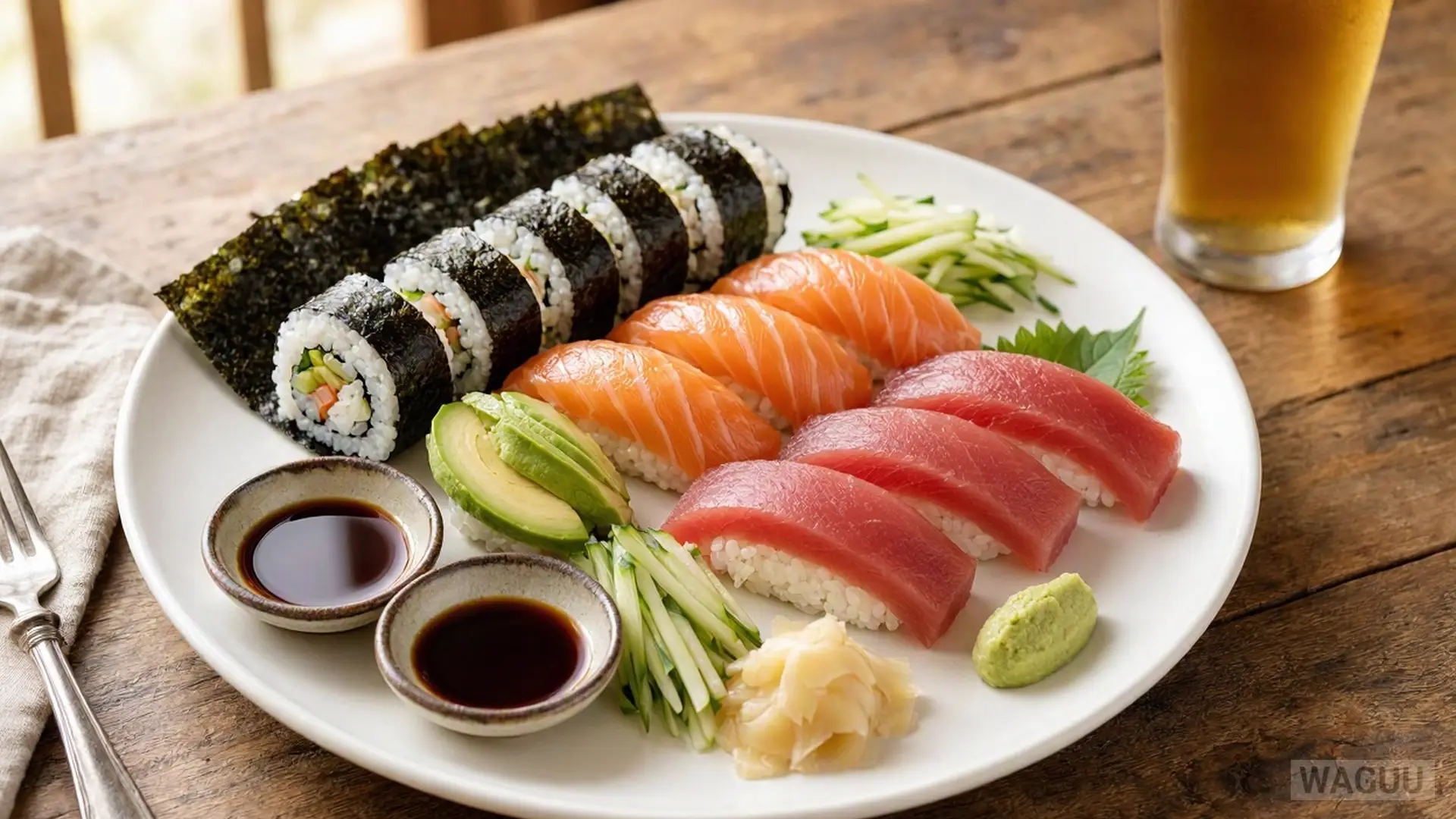
Summary: Traditional Japanese Sushi crafted with perfectly seasoned vinegared short-grain rice, buttery sushi-grade salmon and tuna, crisp English cucumber, creamy avocado, and toasted nori seaweed sheets. Prepared using authentic cutting and rolling techniques, requiring 40 minutes of hands-on prep and 20 minutes of rice cooking time, yielding 6 generous portions.
Did you make this recipe? Share the result with the community.
Category: Fish and Seafood, Japanese Cuisine
Success rate: 94% of users successfully made this recipe
Quick overview
- Dish: Sushi
- Category: Fish and Seafood, Japanese Cuisine
- Cuisine: Japanese
- Main ingredient: Japanese short-grain sushi rice, 3 cups (Koshihikari premium short-grain variety)
- Guide: 12 Most Popular Japanese Dishes: Favorite Recipes of Japanese Cuisine
- Total time: 60 minutes (40 min prep + 20 min cooking)
- Difficulty: Medium
- Servings: 6 (Serving weight: 10 oz / 280 g)
- Key technique: Vinegar seasoning, sushi rice fan cooling, precision fish slicing, and bamboo mat rolling (Makisu)
- Preparation types: Boiling, seasoning, slicing, rolling
- Dietary info & Allergens: Contains Fish, Soy, Sesame. Gluten-free if using tamari or gluten-free soy sauce. Dairy-free.
- Suitable for: Seafood lovers, dinner parties, healthy high-protein diets, cultural cooking experiences
- Nutritional values (per 1 serving): 420 kcal, Protein: 24 g, Fat: 9 g, Carbs: 61 g
- Storage: 1 day in the fridge (fresh raw fish must be consumed promptly), not suitable for the freezer
- Pairing: Japanese Asahi or Sapporo lager, chilled Junmai Ginjo sake, or hot Sencha green tea
- In a nutshell: Master authentic Japanese sushi at home with perfectly seasoned sticky rice, fresh fish, and crisp vegetables wrapped in toasted seaweed.
- Last updated: October 24, 2024
WAGUU says: “Great sushi relies 80 percent on the quality and seasoning of the rice (Shari). Take your time washing the rice until the water runs completely clear, season it while warm, and cool it rapidly with a gentle fanning motion to achieve that iconic glossy shine and tender chew.”
Key facts
| Prep time: | 40 minutes |
| Cooking time: | 20 minutes |
| Temperature: | Simmer at 212 °F (100 °C), serve rice warm/room temp at 98 °F (37 °C) |
| Number of servings: | 6 servings |
In a nutshell
Experience the elegant art of Japanese culinary tradition right in your kitchen. This comprehensive sushi recipe guides you through creating delicate salmon and tuna Nigiri alongside crisp, flavorful Hosomaki and Futomaki rolls. By pairing seasoned short-grain rice with pristine raw fish, avocado, cucumber, and spicy wasabi, you will produce restaurant-quality sushi that balances subtle sweet, sour, salty, and umami notes in every single bite.
Ingredients
Base servings: 6 servings • Serving weight: 10 oz / 280 g
| Ingredient | Quantity | Quality |
|---|---|---|
| Japanese short-grain sushi rice | 3 cups | Koshihikari or Shinmai premium grade |
| Filtered water | 3 cups | Cold, pure spring water |
| Unseasoned rice vinegar | 6 tbsp | 100% natural fermented grain vinegar |
| Granulated white sugar | 3 tbsp | Fine baker’s sugar |
| Fine kosher salt | 1½ tsp | Non-iodized pure sea salt |
| Sushi-grade Atlantic salmon fillet | 12 oz | Super-frozen grade, skinless, center-cut |
| Sushi-grade Yellowfin tuna fillet | 12 oz | Bright crimson loin piece, sashimi quality |
| Toasted nori seaweed sheets | 6 sheets | Gold quality grade, dark green and crisp |
| English seedless cucumber | 1 piece | Firm skin, seedless core, julienned |
| Ripe Hass avocado | 1 piece | Creamy texture, cut into thin strips |
| Wasabi paste | 2 tbsp | Grated horseradish or authentic Hon-wasabi |
| Pickled sushi ginger (Gari) | 4 oz | Thinly sliced sweet pickled ginger side |
| Japanese brewed soy sauce (Shoyu) | 6 fl oz | Naturally fermented soy sauce side |
Why you’ll love this recipe
- Authentic taste and texture: By mastering the precise rice seasoning ratio (Awasu-zu), every grain stays distinct, glossy, and light rather than mushy or overly heavy.
- High protein and clean eating: Packed with healthy omega-3 fatty acids from fresh salmon and lean protein from tuna, offering a nutrient-dense feast without heavy cooking oils.
- Fun interactive cooking: Rolling your own sushi at home turns dinner into an engaging, artistic culinary activity perfect for family gatherings or date nights.
Success guaranteed: Following our multi-stage rice washing method and using damp hands during assembly prevents sticky rice mess and guarantees firmly structured rolls every single time.
Recipe overview
Prep: 40 min | Cooking: 20 min | Difficulty: Medium | Servings: 6 | Type: Main Dish | Origin: Japanese
Detailed instructions
Overall progress: 0% completed
Phase 1: Washing and Soaking Japanese Rice – 15 min
Appliances: Fine-mesh sieve, large mixing bowl
1. Measure 3 cups of Japanese short-grain sushi rice into a large bowl. Fill with cold filtered water and swirl gently using your fingertips in a circular motion for 10 seconds. Immediately pour off the cloudy water. Repeat this washing rinse 4 to 5 times until the water remains almost completely translucent. Drain the rice thoroughly in a fine-mesh sieve and let it rest undisturbed for 15 minutes to allow uniform surface hydration.
CP: The rice grains transition from translucent off-white to uniform opaque bright white after soaking, and rinsing water drains nearly crystal clear.
Before moving to the next step:
Ensure the rice is thoroughly drained in the mesh strainer before adding cooking water. Excess trapped water from washing will throw off the precise 1:1 rice-to-water ratio, resulting in soggy sushi rice.
Phase 2: Cooking and Steaming Rice – 20 min
Appliances: Heavy-bottomed saucepan with tight lid or electric rice cooker
2. Transfer the soaked rice to a heavy-bottomed saucepan and add exactly 3 cups of cold filtered water. Cover tightly with the lid. Bring to a rapid boil over medium-high heat (about 5 minutes). Once steam plumes vigorously from under the lid, reduce heat to the lowest setting and simmer undisturbed for 12 minutes. Turn off the heat entirely and leave the saucepan tightly covered to steam on the residual heat for an additional 10 minutes. Never open the lid during cooking or steaming.
CP: All liquid is fully absorbed into the plump grains, leaving small steam holes across the surface of the rice bed without any scorching on the pot bottom.
Before moving to the next step:
Resist the urge to lift the lid during the 10-minute steam rest. Escaping steam causes top-layer rice grains to harden and dry out rapidly.
Phase 3: Vinegar Seasoning and Cooling Rice – 15 min
Appliances: Hangiri (wooden sushi tub) or wide non-metallic bowl, Shamoji (wooden rice paddle), hand fan
3. While the rice steams, whisk together 6 tbsp unseasoned rice vinegar, 3 tbsp white sugar, and 1½ tsp fine kosher salt in a small bowl until completely dissolved. Gently transfer hot steamed rice into a wide, non-metallic shallow bowl or wooden Hangiri tub. Drizzle the vinegar seasoning evenly over a wooden paddle held above the rice. Using slicing and cutting strokes with the paddle (never mashing), slice through the rice mass at a 45-degree angle while turning it over gently. Simultaneously fan the rice with a paper fan to cool it down rapidly to body temperature (around 98 °F / 37 °C). Cover with a damp cloth.
CP: The rice absorbs the seasoning completely, acquiring a glossy sheen, distinct sticky individual grains, and a pleasant aromatic, subtle acidic scent.
Before moving to the next step:
Do not place the vinegared rice in the refrigerator to cool. Refrigeration crystallizes the rice starches, turning smooth sticky grains hard, chalky, and unpalatable.
Phase 4: Prepping Fish, Vegetables, and Nori – 20 min
Appliances: Yanagiba (sushi knife) or razor-sharp chef’s knife, cutting board
4. Using a sharp Yanagiba or chef’s knife, slice the 12 oz salmon and 12 oz yellowfin tuna fillets into two styles: thin 1/4-inch slice slabs for Nigiri toppings (cut at a 45-degree angle across the grain) and long 1/2-inch square strips for sushi rolls. Cut 1 English cucumber into long, 4-inch fine matchsticks (discarding the watery center seeds). Halve, pit, and slice 1 ripe Hass avocado into thin longitudinal strips. Cut 3 sheets of nori seaweed in half crosswise for Hosomaki rolls, keeping 3 full sheets whole for larger Futomaki rolls.
CP: Clean, smooth cuts on the fish without shredded edges or tears. Vegetables are crisp, uniformly cut, and dry.
Before moving to the next step:
Keep raw fish chilled on an ice pack or in the refrigerator right up until the assembly moment to preserve absolute freshness and food safety.
Phase 5: Assembling and Rolling Nigiri and Maki – 25 min
Appliances: Makisu (bamboo rolling mat) wrapped in plastic wrap, hand-dipping water bowl (Tezu)
5. Prepare vinegared hand water (Tezu) by mixing 1 cup water with 2 tbsp rice vinegar in a small bowl. Wet your hands thoroughly.
Nigiri: Take about 0.7 oz (20 g) of warm sushi rice and gently press it with your palm and fingers into a oblong oval mound. Smear a speck of wasabi on the underside of a fish slice (salmon or tuna), place it over the rice mound, and press gently with two fingers to adhere.
Maki Rolls: Lay a halved nori sheet (rough side up) on your bamboo mat. Spread about 3/4 cup of rice evenly over the nori, leaving a 1/2-inch border at the top edge. Lay strips of fish, cucumber, or avocado across the lower third of the rice bed. Using the bamboo mat, lift the lower edge over the filling and roll forward tightly into a cylinder. Seal the top seam using a drop of water.
CP: Compact, tightly sealed rolls that hold their shape firmly without crushing the rice grains inside.
Before moving to the next step:
Do not overfill maki rolls with excessive ingredients, or the nori seam will fail to close, resulting in bursting rolls when sliced.
Phase 6: Slicing, Plating, and Serving – 10 min
Appliances: Sharp slicing knife, damp dish towel, ceramic sushi platter
6. Wipe the blade of your sharpest knife with a damp towel before each cut. Slice each maki roll into 6 to 8 equal round pieces using a single smooth, pulling draw stroke (never saw back and forth). Arrange the sliced maki rolls and prepared Nigiri neatly on a clean ceramic platter. Serve immediately alongside 2 tbsp wasabi paste, 4 oz pickled sushi ginger (Gari), and 6 fl oz Japanese soy sauce split into dipping dishes.
CP: Clean, circular cross-sections showing vivid contrast between dark nori, glistening white rice, bright green avocado/cucumber, and deep orange/red fish.
Required equipment
| Utensil | Ideal size | Alternative | Risk |
|---|---|---|---|
| Bamboo sushi mat (Makisu) | 9.5 × 9.5 inches | Thick clean kitchen towel wrapped in plastic wrap | Rolls will loose structure or become uneven |
| Sashimi knife (Yanagiba) | 9.5 to 10.5 inch blade | Extremely sharp chef’s knife | Dull blades crush rice and shred delicate fish fiber |
| Wooden sushi tub (Hangiri) | 12 to 14 inch diameter | Wide, shallow wooden or glass baking dish | Metal bowls alter delicate vinegar taste and hold excess moisture |
Shopping list
Nutrition profile
Values per 1 serving (excluding side dipping sauce). Calculated from average ingredient nutrition values.
| Nutrient | Per 100 g | Per 1 serving | Per 6 servings |
|---|---|---|---|
| Energy | 150 kcal | 420 kcal | 2520 kcal |
| Fat | 3.2 g | 9.0 g | 54.0 g |
| of which saturates | 0.6 g | 1.8 g | 10.8 g |
| Carbohydrates | 21.8 g | 61.0 g | 366.0 g |
| of which sugars | 2.5 g | 7.0 g | 42.0 g |
| Protein | 8.6 g | 24.0 g | 144.0 g |
| Salt | 0.95 g | 2.66 g | 15.96 g |
Reference intake of an average adult (8400 kJ / 2000 kcal).
WAGUU Pro level
- Pro standard: Verified authentic ratio recipe requiring Koshihikari short-grain rice, strict temperature controls, and razor-sharp single-bevel knife blade mechanics.
- Tip 1: Vinegared Hand Water (Tezu): Keep a bowl with 1 cup water mixed with 2 tbsp rice vinegar at your assembly station. Dipping your hands briefly prevents sticky rice starches from adhering to your skin while forming Nigiri or spreading rice over nori.
- Tip 2: Single-Draw Knife Stroke: Never slice sushi using a back-and-forth sawing movement. Place the heel of the blade against the top of the roll and draw backward smoothly in one continuous stroke down to the tip for razor-clean cuts.
- Tip 3: Season Rice While Hot: Always add vinegar liquid (Awasu-zu) while the rice is steaming hot directly out of the pot. Warm rice starches instantly absorb liquid, locking in flavor while evaporating excess moisture.
- Tip 4: Wrap the Bamboo Mat: Wrap your Makisu bamboo rolling mat tightly in double-layered plastic wrap before rolling. This prevents rice grains from wedging into the bamboo slats and makes cleanup effortless.
Scientific background
The chemistry of perfect sushi rice hinges on starch gelatinization and pH control. Japanese short-grain rice contains a high concentration of amylopectin, a branched starch molecule responsible for the signature sticky, cohesive texture required for sushi holding. Rinsing raw rice removes surface free amylose powders that otherwise create a slimy coating. When hot cooked rice is dressed with acidic rice vinegar (acetic acid), the drop in pH lowers starch retrogradation rates, preserving a tender yet resilient bite. Rapid cooling with a fan evaporates excess surface water, creating a translucent, glossy outer sheen on each grain while locking moisture inside.
Fine Dining – Professional techniques
- Plate composition: Serve on dark slate or handmade black stoneware dishes to highlight the vivid color contrast between pristine white rice, bright pink salmon, rich red tuna, and deep green nori. Arrange Nigiri pieces in an odd-numbered, diagonal sequence.
- Texture contrasts: Pair soft, silky raw fish loin with crisp julienned cucumber matchsticks and soft, rich, buttery avocado slices inside the same roll.
- Temperature contrast: Keep fish chilled at 40 °F (4 °C) while serving it over slightly warm, body-temperature rice (98 °F / 37 °C). This subtle heat contrast enhances aromatic volatility and fat melt on the palate.
- Aromatic garnishes: Garnish plates with finely microplaned fresh authentic wasabi root, micro shiso leaves, and delicately folded pink pickled ginger roses.
Sensory radar
- Appearance: Glossy, distinct rice grains, vibrant coral-pink salmon, crimson red tuna, dark green toasted nori with clean geometrical cross-section cuts.
- Aroma: Clean marine fresh scent, subtle sweet rice steam, tangy rice vinegar mist, toasted seaweed notes, and pungent earthy wasabi.
- Taste: Perfectly balanced sweet and sour rice base, rich savory umami from raw fish, sharp nasal heat from wasabi, and salty depth from natural soy sauce.
- Texture: Tender, slightly firm chewed rice grains, meltingly soft fish, crisp crunchy cucumber, and smooth creamy avocado.
Pairing
- BEER: Crisp Japanese rice lagers such as Asahi Super Dry or Sapporo Premium. The clean carbonation wipes away fat coated on the tongue by salmon and tuna.
- WINE: Premium dry Junmai Ginjo Sake served chilled, or a crisp dry German Riesling with high acidity to complement the vinegared rice and fatty fish.
- NON-ALCOHOLIC: Hot Japanese Sencha or Genmaicha (roasted brown rice green tea), offering earthy herbal notes that cleanse the palate between bites.
Various preparation methods
- Uramaki (Inside-Out Roll): Rice is spread on the nori sheet, then flipped over so rice faces outward. Topped with toasted sesame seeds or flying fish roe (Tobiko) before rolling around salmon and avocado fillings.
- Chirashi Bowl (Deconstructed Sushi): For a quick dinner, lay warm seasoned sushi rice in a shallow bowl and top artfully with sliced raw fish, cucumber, avocado, strips of nori, and ginger slices without rolling.
Allergens and dietary information
Contains: Fish (salmon, yellowfin tuna), Soy (soy sauce side). • Gluten: Gluten-free if traditional brewed soy sauce is replaced with certified gluten-free Tamari. • Not suitable for: Pregnant women, immune-compromised individuals, or young children due to raw fish consumption.
Suitable for
Ideal for healthy seafood enthusiasts, weekend family cooking workshops, date-night menus, dinner party starters, and high-protein athletic meal plans.
Substitution guide
- Sushi-grade Salmon / Tuna: Replace with cooked shrimp (Ebi), smoked salmon, imitation crab stick (Surimi), or pan-seared extra firm tofu strips.
- Rice Vinegar: Substitute with apple cider vinegar mixed with a drop of lemon juice, adjusting sugar content slightly.
- Nori Seaweed: Use thin soy paper sheets or blanched collard green sheets if avoiding seaweed flavor.
FAQ
What does ‘sushi-grade’ fish actually mean?
‘Sushi-grade’ or ‘sashimi-grade’ is a commercial term indicating that the fish was caught quickly, bled immediately, and commercially flash-frozen at extremely low temperatures (-31 °F / -35 °C or lower) to eliminate potential parasites, making it completely safe for raw consumption.
Why is my sushi rice falling apart or too sticky?
Rice falls apart if long-grain rice is used instead of short-grain rice, or if it was not seasoned while warm. It becomes mushy and gluey if stirred aggressively instead of sliced gently with a paddle, or if too much water was used during cooking.
Can I make sushi rice in advance?
Sushi rice is best enjoyed within 2 to 4 hours of preparation when stored at room temperature under a damp towel. Do not refrigerate cooked sushi rice, as cold air causes starches to harden into dry, gritty grains.
How do I stop rice from sticking to my hands?
Always keep a small bowl of hand water (Tezu) containing 1 cup cold water and 2 tbsp rice vinegar at your workspace. Moisten your palms and fingers before touching vinegared rice.
WAGUU Petr advises: Cooking for 12 or more people?
12–16 people: Cook rice in two separate pot batches (6 cups dry rice per batch) rather than overcrowding a single pot, which leads to uneven steam distribution. Set up an assembly line with bowls of pre-sliced fish and vegetables. • 20+ people: Prepare a Chirashi sushi station where guests build their own bowls over seasoned warm rice, saving hours of manual rolling time.
Sides and serving
- Miso Soup – Traditional hot soybean paste broth with tofu and wakame seaweed (not included in the recipe)
- Steamed Edamame – Warm salted soybean pods sprinkled with coarse sea salt (not included in the recipe)
Serving: Serve sushi rolls freshly made on dark ceramic plates alongside small dipping dishes filled with natural soy sauce, pickled ginger slices, and wasabi paste.
Storage and reheating
Fridge: 1 day maximum in an airtight container lined with paper towels (consume raw fish promptly for peak safety). • Freezer: Not suitable for freezing (freezing ruins raw fish texture and turns vinegared rice mushy). • Reheating: Do not reheat raw sushi. If rolls were refrigerated and rice hardened, let them sit at room temperature for 20 minutes before consuming.
Author: WAGUU Petr & Team • Published: 30 Oct 2026
More Recipes in This Article
Other recipes you might enjoy
Why WAGUU?
Recipes on WAGUU undergo checks for ingredient accuracy, procedures, and nutritional values.
Process photo gallery
Community photos: Cook, take a picture, and share your results.
You can upload photos in the comments below or send them via email.
Did you record a video of your process for our recipe? Paste a link to YouTube, YouTube Shorts, TikTok, Instagram Reels, Facebook Reels, Pinterest, Vimeo, or X (Twitter) in the comments – we’d love to share it and help give you and your content more visibility.
Common mistakes
- Using long-grain or jasmine rice – Long-grain rice varieties lack the amylopectin starches necessary to create sticky, cohesive sushi rolls, resulting in pieces that fall apart instantly.
- Seasoning cold rice – Drizzling vinegar seasoning onto cooled rice prevents proper absorption, creating wet pools at the bottom of the bowl and dull rice texture.
- Refrigerating sushi rice – Placing vinegared sushi rice in the fridge causes starch crystallization, making the grains dry, hard, and chalky.
- Cutting rolls with a dull knife – Using a dull or dry knife crushes the soft rice rolls and shreds delicate fish instead of making razor-clean circular cuts.