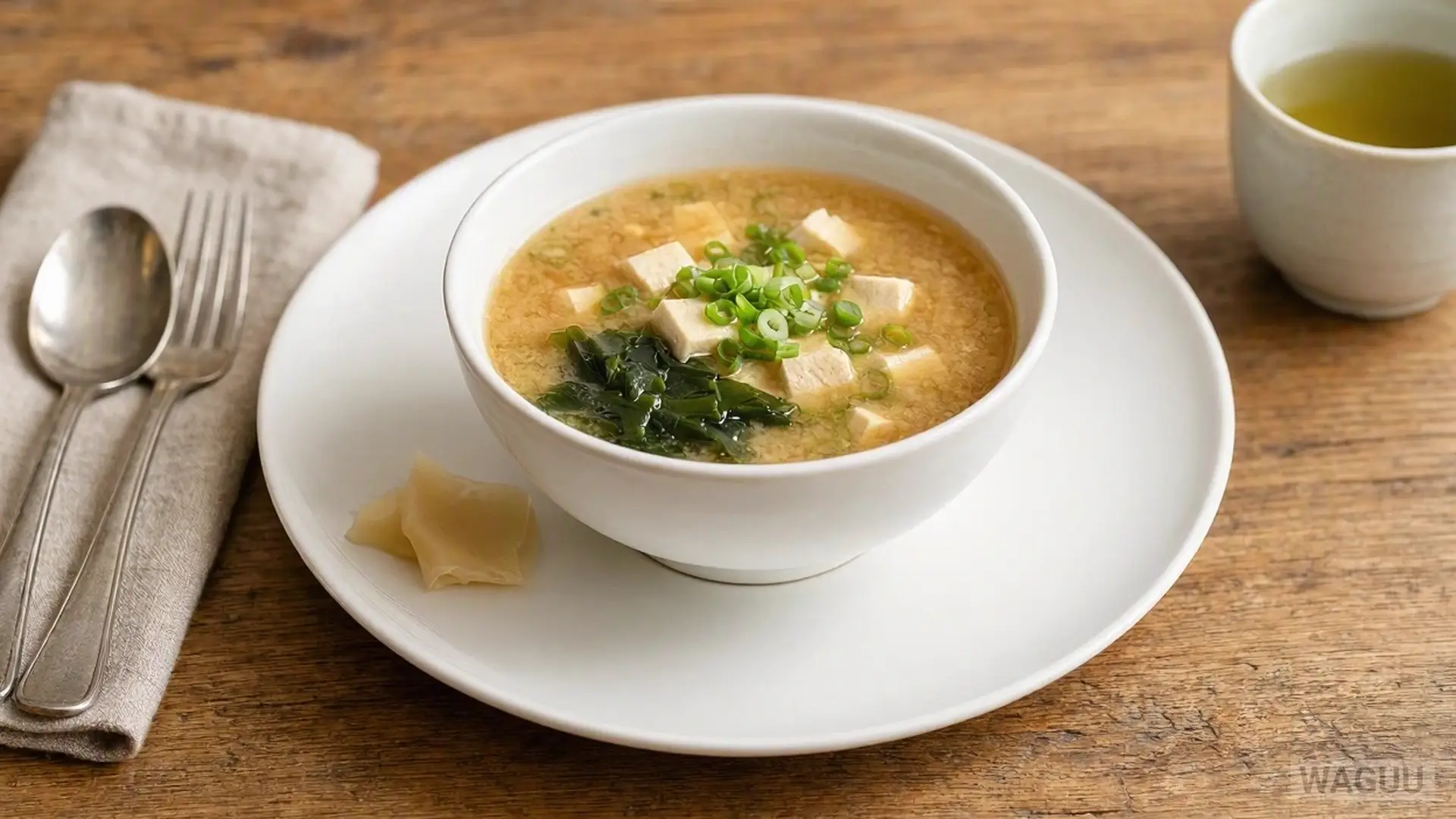
Summary: Traditional Japanese Miso Shiru made with aromatic dashi broth, fermented miso paste, silky firm tofu, rehydrated wakame seaweed, and fresh green onions, prepared in 15 minutes for 4 servings.
Did you make this recipe? Share the result with the community.
Category: Main Dishes, Soups
Success rate: 98% of users successfully made this recipe
Quick overview
- Dish: Miso Shiru
- Category: Main Dishes, Soups
- Cuisine: Japanese
- Main ingredient: Miso paste, 4 tbsp (premium fermented soybean paste)
- Guide: 12 Most Popular Japanese Dishes: Favorite Recipes of Japanese Cuisine
- Total time: 15 minutes (5 min prep + 10 min cooking)
- Difficulty: Easy
- Servings: 4 servings (Serving weight: 250 g)
- Key technique: Gentle simmering and delicate dissolving of miso
- Preparation types: Boiling, rehydrating
- Dietary info & Allergens: Soy, gluten-free (optional with certified dashi/miso)
- Suitable for: Everyday dining, Asian cuisine lovers, light lunch
- Nutritional values (per 1 serving): 65 kcal, Protein: 5.2 g, Fat: 2.1 g, Carbs: 6.8 g
- Storage: 2 days in the fridge, 0 months in the freezer
- Pairing: Green tea, Japanese lager, water with lemon
- In a nutshell: A delicate, savory, and comforting traditional Japanese soup that combines umami-rich dashi broth with nutrient-packed miso, soft tofu cubes, and oceanic wakame.
- Last updated: 2026-03-30
WAGUU says: “Never boil the soup after adding the miso paste, as high heat destroys its delicate live cultures and fine aromatic notes.”
Key facts
| Prep time: | 5 minutes |
| Cooking time: | 10 minutes |
| Temperature: | 190 °F (gentle simmer, never boil) |
| Number of servings: | 4 servings |
In a nutshell
Experience the authentic taste of Japan with this classic Miso Shiru recipe. Featuring a deeply savory dashi base, protein-rich firm tofu, tender wakame seaweed, and fresh green onions, it offers a harmonious balance of umami flavors and soothing warmth.
Ingredients
Base servings: 4 servings • Serving weight: 250 g
| Ingredient | Quantity | Quality |
|---|---|---|
| Dashi broth | 4 cups | Traditional kombu and bonito stock |
| Miso paste | 4 tbsp | White or yellow fermented soybean paste |
| Firm tofu | ½ lb | Fresh, cut into small ½-inch cubes |
| Wakame seaweed | 2 tbsp | Dried, rehydrated |
| Green onions | 3 tbsp | Freshly chopped |
| Salt | ½ tsp | Fine sea salt (optional, adjust to taste) |
Why you’ll love this recipe
- Authentic Flavor: Perfectly balances traditional dashi umami with the earthy richness of fermented miso.
- Quick & Easy: Ready in just 15 minutes, making it ideal for busy weeknight dinners or quick lunches.
- Nutritious & Light: Packed with plant-based protein from tofu and essential minerals from wakame seaweed.
Success guaranteed: Follow the precise temperature guidelines—avoid boiling after adding miso—to achieve restaurant-quality flavor and texture every single time.
Recipe overview
Prep: 5 min | Cooking: 10 min | Difficulty: Easy | Servings: 4 | Type: Soup | Origin: Japanese
Detailed instructions
Overall progress: 0% completed
Phase 1: Preparing ingredients and rehydrating wakame – 3 min
Appliances: Medium bowl
1. Place 2 tbsp of dried wakame seaweed into a medium bowl filled with cold water. Let it soak for 3 minutes until fully rehydrated and softened. Drain thoroughly through a fine-mesh strainer and gently squeeze out excess moisture. Cut 0.5 lb of firm tofu into neat, uniform ½-inch cubes using a sharp chef’s knife. Finely chop 3 tbsp of fresh green onions and set them aside in a small prep bowl.
CP: Wakame is fully plumped and softened; tofu cubes are uniform in size.
Before moving to the next step:
Ensure the wakame is thoroughly drained so it does not dilute the dashi broth flavor.
Phase 2: Heating the dashi broth – 4 min
Appliances: Saucepan, stove
2. Pour 4 cups of dashi broth into a medium saucepan. Place the saucepan on the stove over medium-high heat and bring the liquid to a gentle simmer (reaching approximately 190 °F). Once simmering, reduce the heat to low to maintain a steady, quiet heat without letting the broth roll-boil aggressively.
CP: Dashi is steaming hot and simmering gently.
Before moving to the next step:
Control the heat so the broth does not boil vigorously before adding the tofu.
Phase 3: Adding tofu and wakame – 2 min
Appliances: Saucepan, slotted spoon
3. Carefully add the cubed firm tofu and rehydrated wakame seaweed into the simmering dashi broth. Let them cook together for 2 minutes on low heat, allowing the tofu cubes to warm through completely and absorb the savory dashi flavors.
CP: Tofu is heated through and floating gently.
Before moving to the next step:
Turn off the burner heat entirely before proceeding to dissolve the miso paste.
Phase 4: Dissolving the miso paste – 1 min
Appliances: Ladle, small whisk or chopsticks
4. Turn off the heat under the saucepan. Take a ladleful of the hot broth from the pot and pour it into a small bowl. Add 4 tbsp of miso paste into this warm broth in the bowl. Whisk vigorously with a small whisk or chopsticks until the miso paste is completely dissolved into a smooth, lump-free liquid paste.
CP: Miso paste is fully liquefied without any clumps or grains.
Before moving to the next step:
Ensure no raw lumps of miso remain in the bowl before pouring it back into the pot.
Phase 5: Incorporating miso into the soup – 1 min
Appliances: Wooden spoon
5. Pour the dissolved miso mixture back into the main saucepan containing the dashi, tofu, and wakame. Stir gently with a wooden spoon to distribute the miso evenly throughout the soup. Season with ½ tsp of fine sea salt if extra saltiness is desired. Do not allow the soup to return to a boil.
CP: Soup has a uniform opaque brown color and rich savory aroma.
Before moving to the next step:
Confirm the stove burner is turned completely off.
Phase 6: Garnishing and serving – 1 min
Appliances: Soup bowls, ladle
6. Ladle the hot Miso Shiru evenly into 4 individual serving bowls, ensuring each bowl receives an equal portion of tofu cubes and wakame seaweed. Sprinkle the freshly chopped green onions generously over the top of each bowl just before serving.
CP: Bowls are filled, garnished with green onions, and piping hot.
Required equipment
| Utensil | Ideal size | Alternative | Risk |
|---|---|---|---|
| Saucepan | 2-quart capacity | Small stockpot | Overboiling if pot is too small |
| Chef’s knife | 8-inch blade | Santoku knife | Uneven tofu cuts |
| Small whisk | 6-inch wire whisk | Chopsticks | Lumpy miso paste dissolution |
Shopping list
Nutrition profile
Values per 1 serving (excluding side dishes). Calculated from average ingredient nutrition values.
| Nutrient | Per 100 g | Per 1 serving | Per 4 servings |
|---|---|---|---|
| Energy | 26.0 kcal | 65.0 kcal | 260.0 kcal |
| Fat | 0.8 g | 2.1 g | 8.4 g |
| of which saturates | 0.1 g | 0.3 g | 1.2 g |
| Carbohydrates | 2.7 g | 6.8 g | 27.2 g |
| of which sugars | 0.9 g | 2.3 g | 9.2 g |
| Protein | 2.1 g | 5.2 g | 20.8 g |
| Salt | 0.7 g | 1.8 g | 7.2 g |
Reference intake of an average adult (8400 kJ / 2000 kcal).
WAGUU Pro level
- Pro standard: Verified recipe with precise ratios and visual checkpoints.
- Tip 1: Use high-quality homemade dashi with kombu and bonito flakes for an exceptionally deep umami profile.
- Tip 2: Dissolve the miso paste in a separate small bowl with warm broth before adding it back to prevent clumping.
- Tip 3: Choose white (shiro) miso for a lighter, sweeter soup or red (aka) miso for a bolder, more robust flavor.
- Tip 4: Cut tofu into bite-sized cubes so they warm through evenly without breaking apart in the broth.
Scientific background
Miso paste is produced through the fermentation of soybeans with salt and koji mold (Aspergillus oryzae). This fermentation breaks down complex proteins into savory glutamates, creating the signature umami taste that stimulates receptors on the tongue. Heating miso above boiling point denatures these delicate enzymes and volatile aromatic compounds, which is why traditional Japanese culinary technique dictates turning off the heat before incorporating the paste.
Fine Dining – Professional techniques
- Plate composition: Serve in traditional Japanese lacquer or matte ceramic bowls with clear visibility of suspended tofu and wakame.
- Texture contrasts: Combine velvety soft tofu cubes with tender, slightly chewy rehydrated wakame seaweed.
- Temperature contrast: Serve piping hot to release the volatile aromatics of green onions and dashi.
- Aromatic garnishes: Top with paper-thin rings of fresh green onions just before serving for visual pop and sharp contrast.
Sensory radar
- Appearance: Opaque golden-brown broth with floating white tofu cubes and dark green wakame flecks.
- Aroma: Oceanic dashi fragrance combined with earthy, fermented soybean notes.
- Taste: Savory, umami-rich, subtly sweet and salty with a clean finish.
- Texture: Smooth liquid broth contrasted by tender tofu and soft seaweed.
Pairing
- BEER: Crisp Japanese rice lager
- WINE: Dry, crisp Junmai sake or light-bodied Sauvignon Blanc
- NON-ALCOHOLIC: Steamed green tea (Sencha) or iced barley tea (Mugicha)
Various preparation methods
- Aka Miso Variation: Use red miso paste for a deeper, more robust flavor profile suited for colder weather.
- Vegetarian Dashi: Substitute bonito flakes with dried shiitake mushrooms and kombu for a 100% plant-based dashi broth.
Allergens and dietary information
Contains: Soy, fish (if using bonito dashi) • Gluten: Naturally gluten-free (check miso and dashi labels for barley additives) • Not suitable for: Soy allergy sufferers
Suitable for
Everyday dining, Asian cuisine lovers, light lunch, appetizer course
Substitution guide
- Firm tofu: Silken tofu or aburaage (fried tofu pouches)
FAQ
Can I boil the soup after adding the miso paste?
No, boiling miso destroys its delicate live enzymes, beneficial probiotics, and nuanced aromatic compounds, and can cause the soup to separate.
What is the difference between white and red miso?
White miso (shiro miso) is fermented for a shorter time, resulting in a mild, sweet flavor. Red miso (aka miso) ferments longer with more soybeans and salt, yielding a stronger, saltier taste.
How do I store leftover Miso Shiru?
Store leftovers in an airtight container in the refrigerator for up to 2 days. Reheat gently on the stove without letting it come to a boil.
Can I make my own dashi from scratch?
Yes, traditional dashi is easily made by simmering dried kombu kelp in water, removing it just before boiling, and steeping bonito flakes.
WAGUU Petr advises: Cooking for 12 or more people?
12–16 people: Scale ingredients proportionally and use a larger 6-quart stockpot; dissolve miso in multiple batches to ensure complete incorporation. • 20+ people: Prepare dashi base in a large commercial stockpot and whisk miso paste into portions in separate bowls before serving to maintain precise flavor control.
Sides and serving
- Steamed white rice – Plain short-grain Japanese rice (not included in the recipe)
- Pickled vegetables – Traditional Japanese tsukemono (not included in the recipe)
Serving: Serve piping hot in traditional bowls alongside a main meal or as a standalone light starter.
Storage and reheating
Fridge: 2 days • Freezer: 0 months • Reheating: Reheat gently in a saucepan over medium-low heat until hot, taking care never to let it reach a rolling boil.
Author: WAGUU Petr & Team • Published: 30 Oct 2026
More Recipes in This Article
Other recipes you might enjoy
Why WAGUU?
Recipes on WAGUU undergo checks for ingredient accuracy, procedures, and nutritional values.
Process photo gallery
Community photos: Cook, take a picture, and share your results.
You can upload photos in the comments below or send them via email.
Did you record a video of your process for our recipe? Paste a link to YouTube, YouTube Shorts, TikTok, Instagram Reels, Facebook Reels, Pinterest, Vimeo, or X (Twitter) in the comments – we’d love to share it and help give you and your content more visibility.
Common mistakes
- Boiling miso paste – Boiling the soup after incorporating the miso destroys its delicate live enzymes and alters its fine flavor profile.
- Adding unblended miso directly – Dropping solid miso paste straight into the pot without pre-dissolving creates stubborn lumps that do not disperse.
- Overcooking tofu – Boiling tofu too vigorously can cause it to become rubbery and lose its delicate, silky texture.
- Incorrect wakame rehydration – Failing to drain and squeeze rehydrated wakame can introduce excess water and dilute the dashi broth.