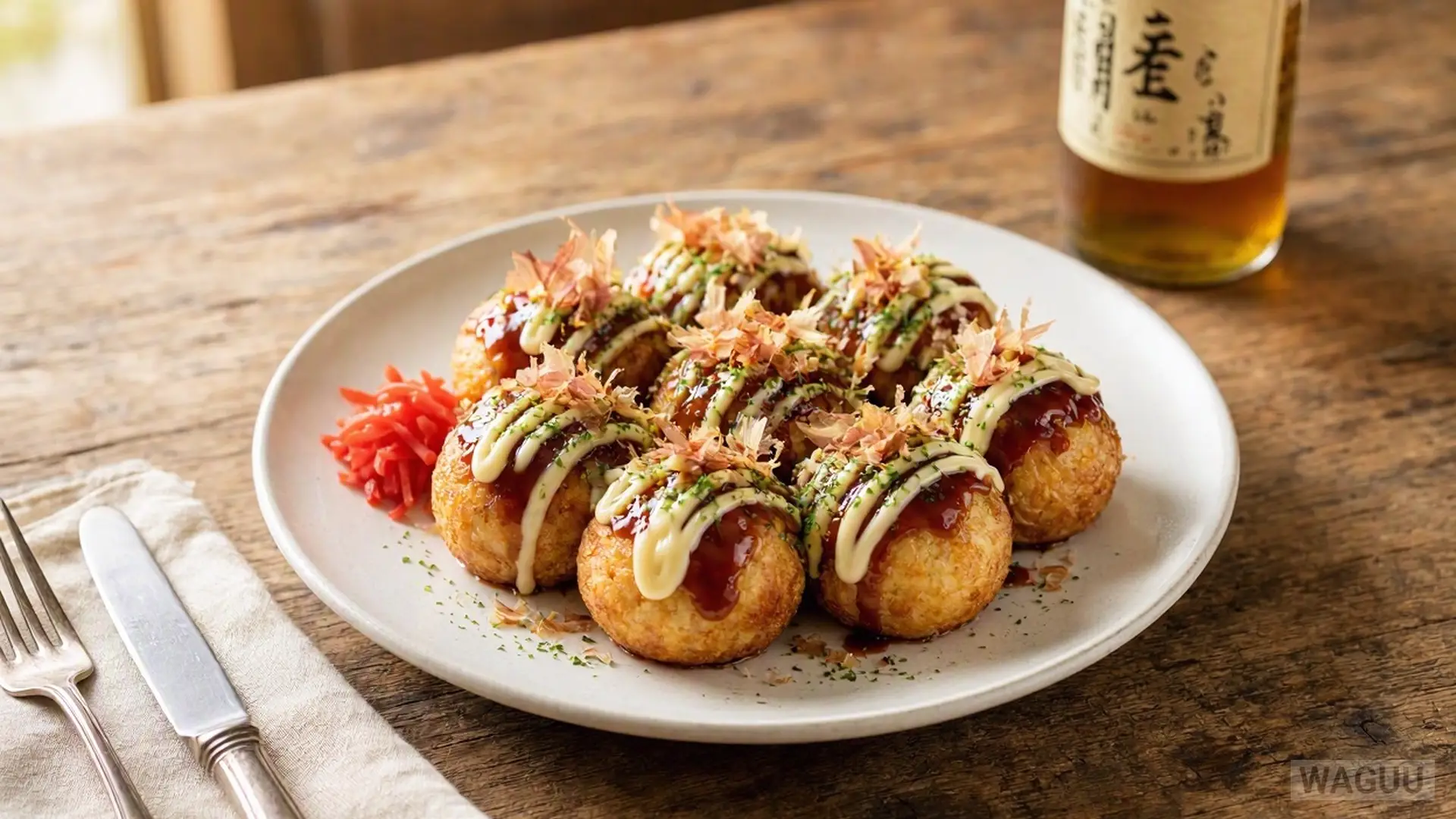
Summary: Authentic Japanese Takoyaki – small round batter balls filled with tender pieces of octopus, prepared in a special cast-iron takoyaki pan, brushed with savory takoyaki sauce, creamy Japanese mayonnaise, and topped with dancing dried bonito fish flakes and green seaweed powder, taking 45 minutes to prepare and yielding 6 servings of golden, crispy-exterior yet creamy-interior octopus balls.
Did you make this recipe? Share the result with the community.
Category: Main Dishes, Cuisines
Success rate: 96% of users successfully made this recipe
Quick overview
- Dish: Takoyaki
- Category: Main Dishes, Cuisines
- Cuisine: Japanese
- Main ingredient: Cooked octopus, 1 lb (tender and cleaned)
- Guide: 12 Most Popular Japanese Dishes: Favorite Recipes of Japanese Cuisine
- Total time: 45 minutes (15 min prep + 30 min cooking)
- Difficulty: Medium
- Servings: 6 servings (Serving weight: 220 g)
- Key technique: Batter filling, turning with bamboo picks in a hemispherical mold cast-iron pan
- Preparation types: Mixing, pouring, flipping, pan-griddling
- Dietary info & Allergens: Contains wheat, eggs, fish, soy, mollusks
- Suitable for: Seafood lovers, party snack enthusiasts, Asian street food fans
- Nutritional values (per 1 serving): 340 kcal, Protein: 18.0 g, Fat: 14.5 g, Carbs: 33.2 g
- Storage: 2 days in the fridge, 1 month in the freezer
- Pairing: Japanese Lager, Cold Junmai Sake, Ice-cold Green Tea
- In a nutshell: Crispy golden sphere outside, molten savory dough and tender octopus inside, topped with rich sauces and dancing bonito flakes.
- Last updated: June 6, 2026
WAGUU says: “Mastering takoyaki requires patience with the flip; rotate the balls incrementally to form a perfect spherical crust while keeping the interior lusciously soft.”
Key facts
| Prep time: | 15 minutes |
| Cooking time: | 30 minutes |
| Temperature: | 390 °F (200 °C) |
| Number of servings: | 6 servings |
In a nutshell
Takoyaki brings the electric energy of Osaka street stalls right into your kitchen. These savory, golf-ball-sized treats combine a dashi-infused wheat batter with chewy chunks of octopus, tempura crunchies, pickled ginger, and green onion. Dressed generously with sweet-savory takoyaki sauce, Japanese kewpie mayonnaise, aonori, and bonito flakes that flutter from the heat, every bite delivers an unforgettable contrast of textures and umami-rich flavors.
Ingredients
Base servings: 6 servings • Serving weight: 220 g
| Ingredient | Quantity | Quality |
|---|---|---|
| All-purpose flour | 1.5 cups | Unbleached |
| Dashi stock | 3 cups | Chilled and rich |
| Eggs | 2 large | Fresh |
| Soy sauce | 1.5 tbsp | Japanese shoyu |
| Salt | ¾ tsp | Fine sea salt |
| Cooked octopus | 1 lb | Tako, diced into ½-inch cubes |
| Pickled red ginger (beni shoga) | ⅓ cup | Finely chopped |
| Green onions | ½ cup | Finely minced scallions |
| Tempura scraps (tenkasu) | ½ cup | Crispy crunchy bits |
| Vegetable oil | 3 tbsp | Neutral cooking oil for greasing pan |
| Takoyaki sauce | ⅓ cup | Sweet savory fruit-based sauce |
| Japanese mayonnaise | ¼ cup | Kewpie brand |
| Dried bonito flakes (katsuobushi) | 1 cup | Thin smoked fish shavings |
| Dried green seaweed powder (aonori) | 1 tbsp | Fine flakes |
Why you’ll love this recipe
- Authentic taste: Delivers the genuine flavor profile of Osaka street food with traditional dashi batter and real octopus.
- Interactive cooking: Flipping the spheres in the specialized pan makes preparation an engaging and fun culinary activity.
- Textural harmony: Offers a delightful contrast between the crispy fried outer shell and the molten, creamy center.
Success guaranteed: Follow our precise temperature guidelines and use generous oil in every well to achieve perfectly round, non-stick takoyaki spheres every single time.
Recipe overview
Prep: 15 min | Cooking: 30 min | Difficulty: Medium | Servings: 6 | Type: Appetizer | Origin: Japanese
Detailed instructions
Overall progress: 0% completed
Phase 1: Preparing the Dashi Batter – 5 min
Appliances: Mixing bowl, whisk
1. In a large mixing bowl, whisk together 1.5 cups of all-purpose flour, 2 large eggs, 3 cups of chilled dashi stock, 1.5 tbsp of Japanese soy sauce, and ¾ tsp of fine sea salt until completely smooth and free of lumps. Strain the liquid batter through a fine-mesh sieve into a pitcher for easy pouring.
CP: Batter must be exceptionally thin and watery compared to pancake batter.
Before moving to the next step:
Ensure no flour lumps remain in the pitcher to guarantee an even cooking consistency.
Phase 2: Preparing Fillings and Preheating the Pan – 5 min
Appliances: Takoyaki pan, pastry brush
2. Dice 1 lb of cooked octopus into consistent ½-inch cubes. Finely chop ⅓ cup of pickled red ginger and ½ cup of green onions. Place all filling ingredients in small bowls near the stove. Place your takoyaki pan over medium-high heat, heat thoroughly, and generously brush every single well and the flat surface surrounding them with vegetable oil using a folded paper towel or oil brush.
CP: The pan is hot enough when oil starts to shimmer and slightly smoke.
Before moving to the next step:
Check that every mold is heavily coated with oil to prevent the batter from sticking.
Phase 3: Pouring Batter and Adding Octopus – 5 min
Appliances: Takoyaki pan, pouring pitcher
3. Pour the prepared dashi batter generously into every well of the heated takoyaki pan and over the top surface until the wells overflow completely. Drop 1 to 2 cubes of cooked octopus into each individual well. Immediately scatter ½ cup of finely chopped green onions, ⅓ cup of chopped pickled red ginger, and ½ cup of tempura scraps evenly across the entire pan surface over the batter and wells.
CP: Batter should immediately sizzle and start setting around the edges of the wells.
Before moving to the next step:
Ensure every well contains at least one solid piece of octopus before turning begins.
Phase 4: Flipping and Shaping the Spheres – 10 min
Appliances: Takoyaki pick or bamboo skewers
4. Once the bottom crust turns light golden brown after about 3 to 4 minutes, use takoyaki picks or bamboo skewers to cut the sheet of batter between the wells into individual squares. Poke each well and turn the dough balls 90 degrees. Tuck any overflowing batter and ingredients back into the mold using the picks to form rough spheres. Continue cooking and turning the balls every minute until they are evenly golden brown and crisp all around.
CP: Balls should rotate smoothly and hold their spherical shape without breaking open.
Before moving to the next step:
Rotate balls frequently to ensure uniform crispness and deep golden coloring across the entire surface.
Phase 5: Final Crisping and Plating – 5 min
Appliances: Takoyaki pan, serving plate
5. Drizzle remaining 1 tbsp of vegetable oil around the edges of the takoyaki balls in the pan to deep-fry the exterior surfaces for the last 2 minutes until extra crispy. Transfer the hot golden takoyaki spheres onto a clean serving plate or traditional boat-shaped serving tray.
CP: Exterior sounds crisp and hollow when lightly tapped with a pick.
Before moving to the next step:
Ensure all balls are transferred promptly so they do not overcook in the residual pan heat.
Phase 6: Dressing and Garnishing – 5 min
Appliances: Squeeze bottles
6. Generously brush ⅓ cup of takoyaki sauce over the warm takoyaki balls. Pipe fine zig-zag lines of ¼ cup of Japanese kewpie mayonnaise across the top. Sprinkle 1 tbsp of dried green seaweed powder and 1 cup of dried bonito flakes over the garnished takoyaki just before serving while they are piping hot.
CP: Bonito flakes should visibly flutter and wave from the steam rising off the hot dish.
Required equipment
| Utensil | Ideal size | Alternative | Risk |
|---|---|---|---|
| Takoyaki pan | 16 hemispherical wells, cast iron | Electric takoyaki maker | Uneven heating or sticking if unseasoned |
| Takoyaki pick | Metal pick with wooden handle | Wooden bamboo skewers | Scratching non-stick surfaces with metal tips |
| Mixing pitcher | 1 quart capacity | Measuring cup with spout | Spilling thin batter during pouring |
Shopping list
Nutrition profile
Values per 1 serving (excluding side dishes). Calculated from average ingredient nutrition values.
| Nutrient | Per 100 g | Per 1 serving | Per 6 servings |
|---|---|---|---|
| Energy | 154.5 kcal | 340.0 kcal | 2040.0 kcal |
| Fat | 6.6 g | 14.5 g | 87.0 g |
| of which saturates | 1.4 g | 3.1 g | 18.6 g |
| Carbohydrates | 15.1 g | 33.2 g | 199.2 g |
| of which sugars | 3.2 g | 7.0 g | 42.0 g |
| Protein | 8.2 g | 18.0 g | 108.0 g |
| Salt | 1.1 g | 2.4 g | 14.4 g |
Reference intake of an average adult (8400 kJ / 2000 kcal).
WAGUU Pro level
- Pro standard: Verified recipe with precise ratios and visual checkpoints.
- Tip 1: Always use very cold dashi stock in your batter to create a thermal shock when hitting the hot pan, resulting in a crisp exterior and custard-like interior.
- Tip 2: Generously oil the entire takoyaki pan surface, not just the wells, so that when you flip the batter sheet, the overflowing dough does not stick.
- Tip 3: Do not rush the first flip; wait until the bottom forms a firm golden crust so the sphere holds together when rotated.
- Tip 4: Use authentic Japanese Kewpie mayonnaise for its rich egg-yolk flavor and umami depth that standard western mayonnaise cannot replicate.
Scientific background
Takoyaki preparation is a masterclass in thermal conduction and protein coagulation. The specialized cast-iron or heavy aluminum pan delivers intense, concentrated heat directly to the hemisphere molds. When the thin dashi-and-egg batter contacts the 390 °F (200 °C) metal surface, moisture rapidly flashes to steam, creating micro-bubbles that puff the batter outward while starches gelatinize and proteins coagulate instantly. The Maillard reaction between wheat proteins, egg amino acids, and reducing sugars creates the savory golden crust, while the interior remains moist and molten due to trapped steam and high water activity in the dashi. Furthermore, the motion of turning the balls reshapes the semi-set dough into spheres, ensuring even heat distribution.
Fine Dining – Professional techniques
- Plate composition: Arrange six perfectly round takoyaki spheres on a rectangular ceramic slate or traditional bamboo takoyaki boat, drizzled with precise parallel lines of sauce and mayonnaise.
- Texture contrasts: Pair the crispy, crunchy exterior shell with the soft, molten interior custard and the chewy bite of tender octopus.
- Temperature contrast: Serve the steaming hot takoyaki immediately so the contrast with cool garnishes and chilled beverages creates a sensory peak.
- Aromatic garnishes: Finish with freshly shaved katsuobushi that flutters dramatically in rising thermal currents, complemented by vibrant green aonori dust.
Sensory radar
- Appearance: Golden-brown spherical dumplings adorned with glossy sauce zig-zags, white mayonnaise, green seaweed specks, and dancing fish flakes.
- Aroma: Rich oceanic aroma of smoked bonito and octopus combined with savory Worcestershire-based takoyaki sauce and toasted wheat.
- Taste: Deep umami savory flavor balanced by the natural sweetness of takoyaki sauce, briny octopus, and rich egg-infused batter.
- Texture: Crispy exterior shell encasing a piping hot, molten, custard-like interior with tender chunks of octopus.
Pairing
- BEER: Crisp Japanese rice lager or Asahi Super Dry
- WINE: Dry sparkling sake or chilled crisp Junmai Ginjo
- NON-ALCOHOLIC: Iced green tea (sencha) or Japanese plum soda (umeshu soda)
Various preparation methods
- Electric Takoyaki Maker: Uses an electric countertop appliance with precise temperature control, ideal for indoor dining parties.
- Pan-Free Oven Method: Baked in miniature muffin tins (though lacking the authentic spherical shape and direct bottom-crust crisping of traditional pans).
Allergens and dietary information
Contains: Wheat, eggs, fish, soy, mollusks • Gluten: Contains gluten from wheat flour • Not suitable for: Celiac disease, shellfish and mollusk allergies, vegetarian diets
Suitable for
Seafood lovers, Japanese street food enthusiasts, party appetizers, and interactive cooking nights
Substitution guide
- Octopus: Can be substituted with cooked shrimp, diced squid, or cooked cocktail frankfurter pieces for children.
- Dashi stock: Can be replaced with vegetable broth mixed with soy sauce and MSG for umami depth.
FAQ
Why are my takoyaki sticking to the pan?
The pan was either not hot enough or lacked sufficient oil. Ensure you generously oil every well and the surface between them before pouring the batter.
Can I make takoyaki without a special takoyaki pan?
A specialized hemispherical mold pan is essential for achieving the iconic round shape. Without it, the batter will spread out like a pancake.
How do I prevent the inside from remaining too runny?
Traditional takoyaki has a very creamy, molten interior. If you prefer a firmer texture, let them cook slightly longer while turning frequently.
Can I freeze leftover cooked takoyaki?
Yes, let them cool completely, freeze on a tray, and store in a freezer bag for up to 1 month. Reheat in an air fryer or toaster oven.
WAGUU Petr advises: Cooking for 12 or more people?
12–16 people: Use two electric takoyaki makers simultaneously and prep all ingredients in double batches ahead of time. • 20+ people: Set up a takoyaki grilling station where guests can participate in turning their own octopus balls.
Sides and serving
- Miso Shiru – traditional soybean paste soup with tofu and wakame (not included in the recipe)
- Edamame – steamed young soybeans sprinkled with sea salt (not included in the recipe)
Serving: Serve piping hot on a ceramic plate or wooden boat with bamboo picks for easy eating.
Storage and reheating
Fridge: 2 days • Freezer: 1 month • Reheating: Reheat in a preheated toaster oven or air fryer at 370 °F for 5 minutes until crispy.
More Recipes in This Article
Other recipes you might enjoy
Why WAGUU?
Recipes on WAGUU undergo checks for ingredient accuracy, procedures, and nutritional values.
Process photo gallery
Community photos: Cook, take a picture, and share your results.
You can upload photos in the comments below or send them via email.
Did you record a video of your process for our recipe? Paste a link to YouTube, YouTube Shorts, TikTok, Instagram Reels, Facebook Reels, Pinterest, Vimeo, or X (Twitter) in the comments – we’d love to share it and help give you and your content more visibility.
Common mistakes
- Not oiling the pan enough – Causes the batter to adhere firmly to the cast iron, preventing smooth rotation into spheres.
- Turning the balls too early – Attempting to flip before the bottom crust forms causes the ball to break apart and spill liquid batter.
- Using thick pancake batter – Takoyaki batter must be extremely watery so the interior remains molten and custard-like.
- Skipping the dashi stock – Water alone lacks the umami depth required for authentic street-style flavor.