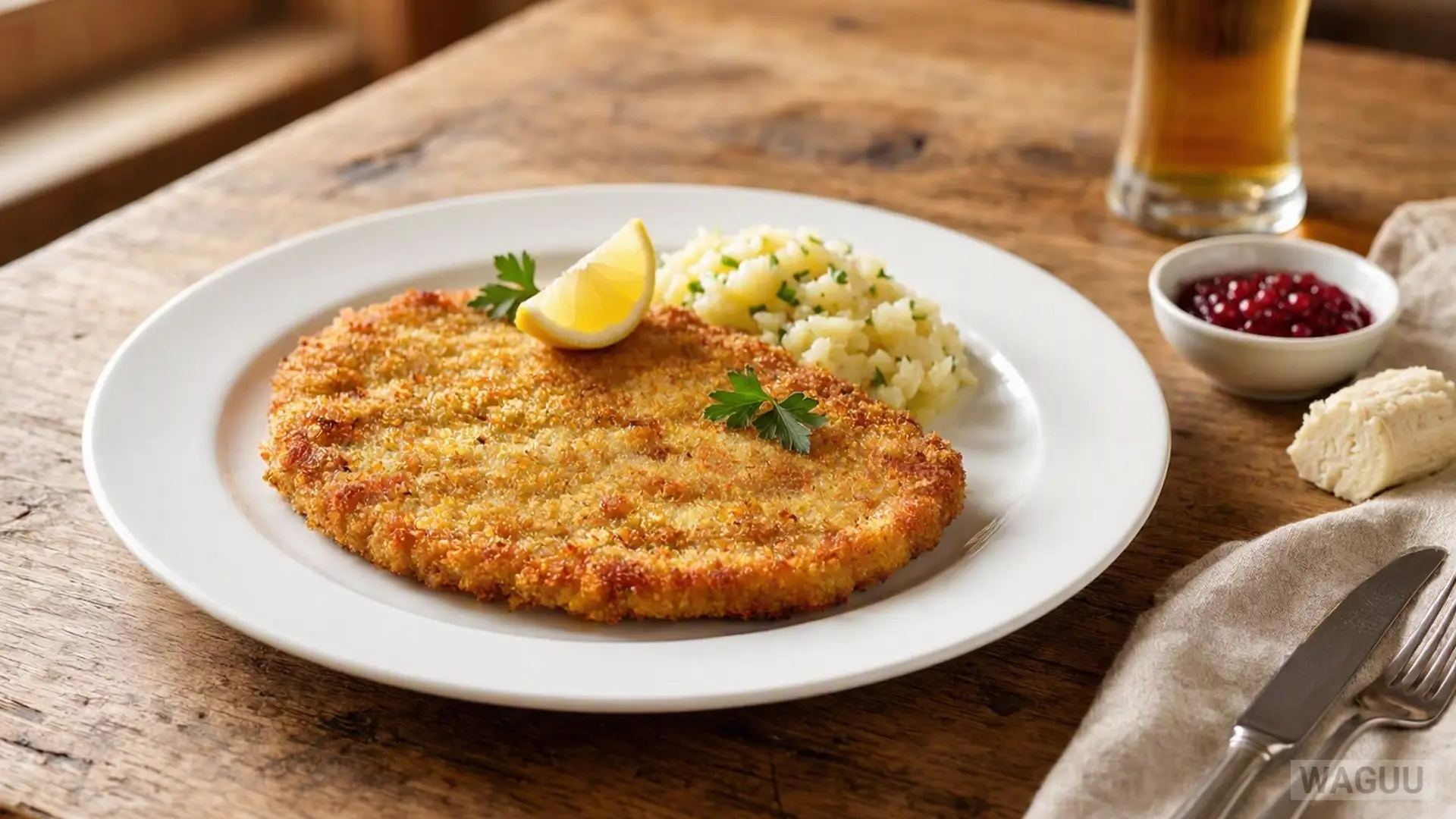
Summary: This classic Wiener Schnitzel features a premium veal cutlet, pounded thin, breaded in a light, airy crust, and pan-fried to a perfect golden brown. Served traditionally with a fresh slice of lemon and a side of creamy potato salad, this dish is a hallmark of Austrian culinary tradition, refined for the home kitchen in about 45 minutes.
Did you make this recipe? Share the result with the community.
Category: Main Dishes, Austrian Cuisine
Success rate: 98% of users successfully made this recipe
Quick overview
- Dish: Wiener Schnitzel
- Category: Main Dishes, Austrian Cuisine
- Cuisine: Austrian
- Main ingredient: Veal cutlets, 2 lb (premium quality)
- Guide: 12 Most Popular Austrian Dishes
- Total time: 45 minutes (15 min prep + 30 min cooking)
- Difficulty: Intermediate
- Servings: 6 (Serving weight: 12 oz g)
- Key technique: Shallow frying, breading
- Preparation types: Pan-frying
- Dietary info & Allergens: Contains: milk, eggs, gluten
- Suitable for: Meat lovers
- Nutritional values (per 1 serving): 580 kcal, Protein: 42 g, Fat: 34 g, Carbs: 28 g
- Storage: 2 days in the fridge, 1 month in the freezer
- Pairing: Lager beer, Grüner Veltliner, Sparkling water with lemon
- In a nutshell: Thinly pounded veal, breaded and fried to golden perfection.
- Last updated: September 21, 2026
WAGUU says: “The secret to a perfect Wiener Schnitzel is the ‘soufflé’ effect—the breading should lift slightly from the meat, creating a light, airy crust.”
Key facts
| Prep time: | 15 minutes |
| Cooking time: | 30 minutes |
| Temperature: | 350 °F oil temperature |
| Number of servings: | 6 |
In a nutshell
This recipe provides a step-by-step guide to achieving the authentic, restaurant-quality Wiener Schnitzel. By pounding the veal to an even, thin layer and using a precise breading technique, you will achieve the iconic golden, wavy crust that defines this classic dish.
Ingredients
Base servings: 6 servings • Serving weight: 12 oz g
| Ingredient | Quantity | Quality |
|---|---|---|
| Veal cutlets | 2 lb | Top round or loin |
| All-purpose flour | 1 cup | Fine grind |
| Eggs | 3 pieces | Large |
| Breadcrumbs | 2 cups | Fine, dry |
| Clarified butter (or oil) | 1.5 cups | High smoke point |
| Salt | 2 tsp | Fine sea salt |
Why you’ll love this recipe
- Authentic Technique: Follows the traditional Austrian method for the classic “soufflé” crust.
- Fast Preparation: Once prepped, each schnitzel cooks in just 2-3 minutes.
- Versatile Pairing: Pairs perfectly with potato salad, parsley potatoes, or a fresh green salad.
Success guaranteed: By ensuring the oil is at exactly 350 °F and the cutlets are pounded to an even ⅛-inch thickness, the results will be consistently tender and crispy.
Recipe overview
Prep: 15 min | Cooking: 30 min | Difficulty: Intermediate | Servings: 6 | Type: Main Dish | Origin: Austria
Detailed instructions
Overall progress: 0% completed
Phase 1: Preparation – 10 min
Appliances: Meat mallet
1. Trim any connective tissue from the veal. Place between plastic wrap and pound to ⅛-inch thickness. Season with salt.
CP: VKB: Cutlets should be uniform in thickness.
Phase 2: Breading – 5 min
Appliances: Bowls
2. Prepare three stations: flour, beaten eggs, and breadcrumbs. Dredge cutlets in flour, dip in eggs, and coat with breadcrumbs.
CP: Ensure breadcrumbs are gently pressed but not compacted.
Phase 3: Frying – 30 min
Appliances: Large skillet, Stove
3. Heat clarified butter to 350 °F. Fry cutlets for 2–3 minutes per side until golden brown. Drain on paper towels.
CP: VKB: The crust should be wavy and golden.
Required equipment
| Utensil | Ideal size | Alternative | Risk |
|---|---|---|---|
| Meat mallet | Standard | Heavy pan | Tearing meat |
| Large skillet | 12-inch | Cast iron | Uneven heating |
| Kitchen thermometer | Digital | Breadcrumb test | Burnt oil |
Shopping list
Nutrition profile
Values per 1 serving (excluding side dishes). Calculated from average ingredient nutrition values.
| Nutrient | Per 3.5 oz (100 g) | Per 1 serving | Per 6 servings |
|---|---|---|---|
| Energy | 280.0 kcal | 580.0 kcal | 3480.0 kcal |
| Fat | 16.0 g | 34.0 g | 204.0 g |
| of which saturates | 6.0 g | 12.0 g | 72.0 g |
| Carbohydrates | 14.0 g | 28.0 g | 168.0 g |
| of which sugars | 0.5 g | 1.0 g | 6.0 g |
| Protein | 20.0 g | 42.0 g | 252.0 g |
| Salt | 0.5 g | 1.1 g | 6.6 g |
Reference intake of an average adult (8400 kJ / 2000 kcal).
WAGUU Pro level
- Pro standard: Verified recipe with precise ratios and visual checkpoints.
- Tip 1: Use clarified butter for a higher smoke point and better flavor.
- Tip 2: Ensure the veal is at room temperature before frying.
- Tip 3: Use a generous amount of fat in the pan so the schnitzel floats.
- Tip 4: Serve immediately to maintain the crust’s crispness.
Scientific background
The characteristic “soufflé” crust is caused by the rapid expansion of steam between the meat and the breading. Pounding the meat ensures quick cooking, while the high fat content and temperature prevent the crust from absorbing too much oil, keeping it light and crisp.
Fine Dining – Professional techniques
- Plate composition: Serve with a fresh lemon wedge to cut through the richness of the fried crust.
- Texture contrasts: The crisp breading against the tender, moist veal provides a classic textural contrast.
- Temperature contrast: Serve the hot schnitzel with a cool, refreshing potato salad.
- Aromatic garnishes: Finish with a light dusting of fresh parsley (not part of the recipe).
Sensory radar
- Appearance: Golden, wavy crust with a delicate sheen.
- Aroma: Nutty butter fragrance with a hint of fresh lemon.
- Taste: Savory, buttery, and perfectly balanced by the acidity of lemon.
- Texture: Crispy exterior with a tender, juicy interior.
Pairing
- BEER: A crisp, light Austrian lager.
- WINE: A dry, high-acid Grüner Veltliner.
- NON-ALCOHOLIC: Sparkling water with fresh lemon slices.
Various preparation methods
- Pork Schnitzel: Substitute veal with pork loin for a more robust, budget-friendly version.
- Chicken Schnitzel: Use thin chicken breast cutlets for a lighter, milder flavor profile.
Allergens and dietary information
Contains: milk, eggs, gluten • Gluten: Contains wheat flour and breadcrumbs • Not suitable for: Vegetarians, Vegans, Gluten-intolerant individuals.
Suitable for
Meat lovers, festive dinners, and special weekend meals.
Substitution guide
- Clarified Butter: Can be substituted with high-quality vegetable or canola oil.
FAQ
Why did my breading fall off?
This usually happens if the cutlets were damp before dredging or if the oil temperature was too low.
Can I bake the schnitzel?
Baking will not produce the authentic crispy crust; pan-frying is essential.
How thin should the meat be?
Aim for ⅛-inch thickness to ensure even cooking.
Can I use gluten-free breadcrumbs?
Yes, but the texture of the crust will vary slightly.
WAGUU Petr advises: Cooking for 12 or more people?
12–16 people: Prepare breaded cutlets in advance and keep them in the fridge; fry in batches just before serving. 20+ people: Use two large skillets simultaneously to ensure all schnitzels are served hot at the same time.
Sides and serving
- Potato salad – Traditional Austrian style with vinegar and broth (not included in the recipe).
- Parsley potatoes – Boiled with butter and fresh parsley (not included in the recipe).
Serving: Serve immediately on warm plates with a fresh lemon slice.
Storage and reheating
Fridge: 2 days • Freezer: 1 month • Reheating: In a hot oven at 350 °F for 5–8 minutes to restore crispness.
Other recipes you might enjoy
Why WAGUU?
Recipes on WAGUU undergo checks for ingredient accuracy, procedures, and nutritional values.
Process photo gallery
Community photos: Cook, take a picture, and share your results.
You can upload photos in the comments below or send them via email.
Did you record a video of your process for our recipe? Paste a link to YouTube, YouTube Shorts, TikTok, Instagram Reels, Facebook Reels, Pinterest, Vimeo, or X (Twitter) in the comments – we’d love to share it and help give you and your content more visibility.
Common mistakes
- Too thick meat – Prevents even cooking and tenderness.
- Low oil temperature – Results in a greasy, soggy crust.
- Overcrowding the pan – Causes the oil temperature to drop and makes the crust soggy.
- Waiting too long to serve – The crust loses its crispness quickly.