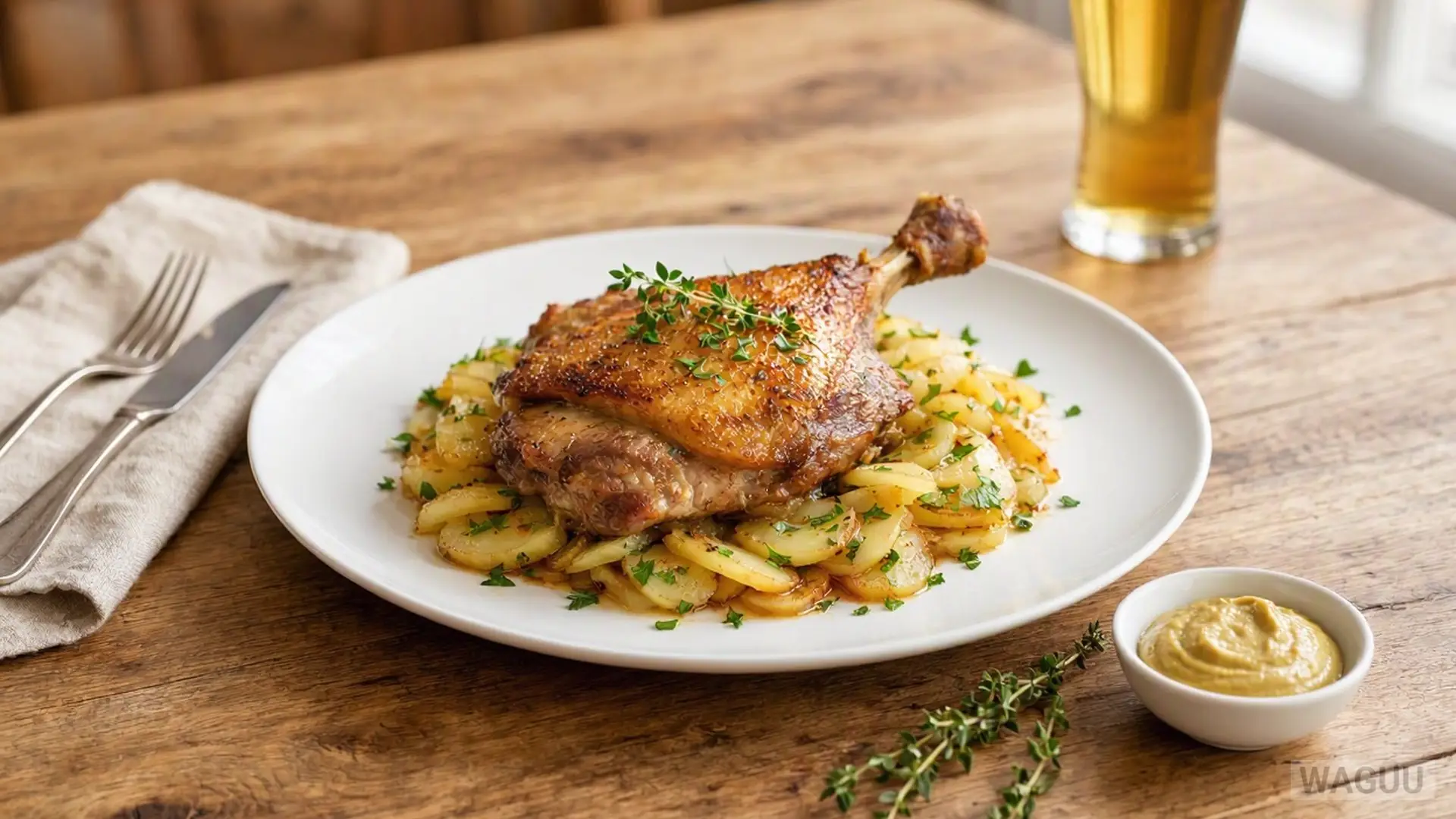
Summary: Confit de Canard is a classic French culinary masterpiece featuring duck legs slowly cooked in their own rendered fat until exceptionally tender, then finished with a high-heat sear for shatteringly crispy skin. This traditional technique requires curing the poultry with coarse sea salt, garlic, and fresh herbs overnight before a gentle, multi-hour oven braise. Designed for home cooks seeking authentic French flavors, this 6-serving preparation takes 24 hours of total curing and cooking time, delivering a melt-in-your-mouth interior encased in golden, crisp skin.
Did you make this recipe? Share the result with the community.
Category: Poultry, French Cuisine
Success rate: 96% of users successfully made this recipe
Quick overview
- Dish: Confit de Canard
- Category: Poultry, French Cuisine
- Cuisine: French
- Main ingredient: Duck legs, 3.75 lb (quality specifications: fresh, bone-in, skin-on Muscovy or Pekin duck legs)
- Guide: 12 Most Popular French Dishes: Favorite Recipes of French Cuisine
- Total time: 185 minutes (35 min prep + 150 min cooking, plus 24 hours curing)
- Difficulty: Intermediate
- Servings: 6 servings (Serving weight: 6.5 oz / 184 g per serving)
- Key technique: Low-temperature slow fat poaching followed by high-heat skin searing
- Preparation types: Curing, slow-roasting, pan-searing
- Dietary info & Allergens: Gluten-free, lactose-free, dairy-free
- Suitable for: Weekend dinners, festive gatherings, gourmet entertaining
- Nutritional values (per 1 serving): 620 kcal, Protein: 34.2 g, Fat: 51.5 g, Carbs: 0.8 g
- Storage: 5 days in the fridge (submerged in fat), 6 months in the freezer
- Pairing: Amber ale, French Bordeaux wine, sparkling mineral water
- In a nutshell: Salt-cured duck legs slowly braised in rendered fat until fork-tender, then finished with a crispy, golden sear.
- Last updated: September 21, 2026
WAGUU says: “The secret to legendary Confit de Canard lies in the patient, low-temperature rendering process that breaks down collagen while infusing the meat with garlic and thyme aromas.”
How to take it further: Add a pinch of crushed juniper berries to the curing salt, or finish the plated duck with a drizzle of aged balsamic reduction.
Key facts
| Prep time: | 35 minutes (plus 24 hours curing) |
| Cooking time: | 150 minutes |
| Temperature: | 275 °F (135 °C) |
| Number of servings: | 6 servings |
In a nutshell
Experience the pinnacle of French gastronomy with Confit de Canard. Fresh duck legs are seasoned with coarse sea salt, smashed garlic cloves, and fresh thyme, then left to cure overnight in the refrigerator. This traditional preservation step seasons the meat deeply and draws out excess moisture. The duck legs are subsequently submerged in rendered duck fat and slow-roasted in a low-temperature oven for two and a half hours until the meat easily pulls away from the bone. Just before serving, the cooked legs are pan-seared until the skin transforms into a shatteringly crisp, golden crust while the interior remains astonishingly succulent and tender.
Ingredients
Base servings: 6 servings • Serving weight: 6.5 oz (184 g)
| Ingredient | Quantity | Quality |
|---|---|---|
| Duck legs | 3.75 lb | Fresh, bone-in, skin-on |
| Coarse sea salt | 2 tbsp | High-grade culinary salt |
| Garlic cloves | 6 cloves | Fresh, peeled and smashed |
| Fresh thyme sprigs | 8 sprigs | Fresh aromatic herbs |
| Cracked black pepper | 1 tsp | Freshly ground |
| Rendered duck fat | 3 cups | Pure, high-quality fat |
| Whole black peppercorns | 1 tsp | Whole dried spice |
Why you’ll love this recipe
- Exceptional Texture: Slow cooking in duck fat renders collagen completely, yielding meltingly tender meat.
- Shattering Crispiness: A final high-heat pan sear turns the skin ultra-crisp and golden brown.
- Traditional Authenticity: Utilizes time-honored French preservation and braising techniques for genuine bistro quality.
Why it works: Curing the duck legs with coarse salt draws out excess water, concentrating flavor and firming the protein structure before the gentle fat-poaching stage.
Recipe overview
Prep: 35 min | Cooking: 150 min | Difficulty: Intermediate | Servings: 6 servings | Type: Main Dish | Origin: French
Detailed instructions
Overall progress: 0% completed
Phase 1: Salt Curing and Seasoning – 20 min
Appliances: Refrigerator
1. Rinse 3.75 lb of duck legs thoroughly under cold running water and pat them completely dry with clean paper towels. In a small mixing bowl, combine 2 tbsp of coarse sea salt, 1 tsp of cracked black pepper, and half of the crushed garlic cloves. Rub this seasoning mixture evenly over all sides of each duck leg. Place the seasoned duck legs in a shallow glass dish, scattering 4 sprigs of fresh thyme and half of the whole black peppercorns over and around the meat. Cover the dish tightly with plastic wrap and transfer it to the refrigerator to cure for 24 hours.
CP: Visual check point (VKB): The duck legs should feel slightly firmer after chilling as the salt draws out surface moisture.
Before moving to the next step:
Ensure the duck legs have cured for the full 24 hours to achieve proper salt penetration and moisture reduction.
Phase 2: Rinsing and Oven Preparation – 15 min
Appliances: Oven
2. Remove the cured duck legs from the refrigerator. Rinse each leg thoroughly under cold water to remove excess surface salt, then dry them completely with paper towels to prevent splattering during cooking. Preheat your oven to 275 °F (135 °C). Arrange the duck legs in a snug, heavy-bottomed Dutch oven or deep roasting pan in a single layer. Tuck the remaining 3 peeled garlic cloves, 4 sprigs of fresh thyme, and 1 tsp of whole black peppercorns between the pieces.
CP: VKB: The duck legs must fit snugly in the vessel so that 3 cups of rendered duck fat can completely submerge them.
Before moving to the next step:
Verify the oven has reached a stable 275 °F before introducing the roasting pan.
Phase 3: Slow Confit Braising – 135 min
Appliances: Oven
3. Gently melt 3 cups of rendered duck fat on the stovetop if solid, then pour it over the duck legs in the roasting pan until they are fully submerged. Cover the Dutch oven securely with its heavy lid or seal the roasting pan tightly with a double layer of heavy-duty aluminum foil. Transfer the pan to the preheated 275 °F (135 °C) oven. Let the duck legs bake undisturbed for 2 hours and 15 minutes (135 minutes), allowing the connective tissue to melt and the meat to become fork-tender.
CP: VKB: The internal fat should maintain a very gentle shimmer, bubbling only occasionally, to ensure proper confiting without frying the meat.
Before moving to the next step:
Check that the meat easily pierces with a fork and pulls away slightly from the bone ends.
Phase 4: Searing for Crispy Skin – 15 min
Appliances: Stovetop
4. Remove the roasting pan from the oven. Using a pair of kitchen tongs or a slotted spoon, carefully lift the tender duck legs out of the warm fat, allowing any excess fat to drain back into the pan. Heat a heavy stainless steel or cast-iron skillet over medium-high heat without adding extra oil. Place the duck legs skin-side down in the hot skillet. Sear them for 6 to 8 minutes until the skin becomes deep golden brown and exceptionally crispy. Flip the legs and sear the underside for 2 minutes just to heat through before serving.
CP: VKB: The skin must be crisp, crackling, and deeply browned without burning the surface sugars.
Required equipment
| Utensil | Ideal size | Alternative | Risk |
|---|---|---|---|
| Dutch oven | 5-quart capacity | Deep metal roasting pan | Spilling hot fat if too shallow |
| Cast-iron skillet | 10-inch diameter | Heavy stainless steel skillet | Uneven browning if pan is thin |
| Kitchen tongs | 12-inch metal tongs | Slotted spatula | Tearing tender meat if handled roughly |
Shopping list
Nutrition profile
Values per 1 serving (excluding side dishes). Calculated from average ingredient nutrition values.
| Nutrient | Per 3.5 oz (100 g) | Per 1 serving | Per 6 servings |
|---|---|---|---|
| Energy | 337.0 kcal | 620.0 kcal | 3,720.0 kcal |
| Fat | 28.0 g | 51.5 g | 309.0 g |
| of which saturates | 9.5 g | 17.5 g | 105.0 g |
| Carbohydrates | 0.4 g | 0.8 g | 4.8 g |
| of which sugars | 0.1 g | 0.2 g | 1.2 g |
| Protein | 18.6 g | 34.2 g | 205.2 g |
| Salt | 0.9 g | 1.7 g | 10.2 g |
Reference intake of an average adult (8400 kJ / 2000 kcal).
WAGUU Pro level
- Pro standard: Verified recipe with precise ratios and visual checkpoints.
- Tip 1: Strain and save the leftover duck fat after cooking; it can be reused multiple times for roasting potatoes.
- Tip 2: Ensure the duck legs are completely submerged in fat during the baking phase to prevent drying out.
- Tip 3: Start the skin-searing process in a cold or moderately heated pan to allow the fat to render slowly before crisping.
- Tip 4: Let the cooked duck legs rest for 5 minutes after searing to allow the juices to redistribute evenly throughout the meat.
Scientific background
Confit cooking relies on low-temperature thermal hydrolysis, where tough connective tissue collagen slowly converts into water-soluble gelatin over several hours at 275 °F. Submerging the meat in fat acts as an oxygen barrier and thermal cushion, cooking the protein gently without boiling out moisture. The salt cure initiates osmosis, drawing out free water and firming the muscle fibers while distributing seasoning evenly throughout the tissue.
Fine Dining – Professional techniques
- Plate composition: Center the crispy duck leg atop a vibrant pool of roasted garlic purée, garnishing with fresh microgreens.
- Texture contrasts: Pair the shatteringly crisp duck skin against silky, whipped potato mousseline.
- Temperature contrast: Serve the piping-hot seared duck alongside a chilled, brightly dressed frisée and pomegranate salad.
- Aromatic garnishes: Finish with a light dusting of finely minced fresh chives and flaked sea salt.
Sensory radar
- Appearance: Deep golden-brown crackling skin with a glistening, moist presentation.
- Aroma: Rich roasted poultry fragrance accented by earthy garlic and herbal thyme notes.
- Taste: Savory, deeply seasoned duck flavor with balanced saline undertones.
- Texture: Ultra-crisp exterior giving way to melt-in-your-mouth, tender muscle fibers.
Pairing
- BEER: Belgian Dubbel with caramel malt notes and dark fruit aromas.
- WINE: Dry French Bordeaux or Pinot Noir with bright acidity to cut through the rich fat.
- NON-ALCOHOLIC: Sparkling pomegranate juice with a squeeze of fresh lime.
Various preparation methods
- Slow Cooker Confit: Cook the cured duck submerged in fat on low heat for 8 hours in an electric slow cooker, then finish in a hot oven.
- Air Fryer Finish: After slow-roasting in the oven, crisp the duck legs in an air fryer at 400 °F for 8 minutes for maximum crunch.
Allergens and dietary information
Contains: None • Gluten: Gluten-free • Not suitable for: Low-fat diets
Suitable for
Weekend gourmet dinners, celebratory holiday feasts, French cuisine enthusiasts
Substitution guide
- Duck fat: Goose fat (substitute 1:1 with similar melting properties and rich flavor profile)
FAQ
Can I reuse the duck fat after cooking?
Yes, strain the cooled fat through a fine-mesh sieve into a clean container, store it in the refrigerator, and reuse it for roasting potatoes or future confit batches.
Why is the salt curing step necessary?
Curing draws out excess moisture, seasons the meat deeply, and acts as a natural preservative during the slow-cooking process.
How long can I store cooked confit duck in the fridge?
When completely submerged in its solidified fat inside an airtight container, cooked confit will keep safely for up to 5 days in the refrigerator.
What is the best way to reheat leftover confit duck?
Warm the duck legs in a 350 °F oven for 15 minutes to melt the fat and crisp the skin without drying out the meat.
WAGUU Petr advises: Cooking for 12 or more people?
12–16 people: Double the ingredient quantities and use two large roasting pans side by side in the oven to maintain proper heat circulation and fat depth. • 20+ people: Prepare the confit in two separate batches over two days, storing the cooked legs submerged in fat in the refrigerator until ready to crisp and serve.
Sides and serving
- Pommes Sarladaises – garlic and parsley potato slices cooked in duck fat (not included in the recipe)
- Braised red cabbage – sweet and tangy spiced red cabbage (not included in the recipe)
Serving: Serve hot on warmed ceramic plates with the crispy skin facing upward, garnished with fresh thyme and a wedge of lemon.
Storage and reheating
Fridge: 5 days • Freezer: 6 months • Reheating: Warm in a 350 °F oven for 15 minutes until heated through and skin is crisp.
Author: WAGUU Petr & Team • Published: 21 Sep 2026 • Updated: 30 Oct 2026
More Recipes in This Article
Guide: 12 Most Popular French Dishes: Favorite Recipes of French Cuisine
Beef à la Bourguignonne
Other recipes you might enjoy
Why WAGUU?
Recipes on WAGUU undergo checks for ingredient accuracy, procedures, and nutritional values.
Process photo gallery
Community photos: Cook, take a picture, and share your results.
You can upload photos in the comments below or send them via email.
Did you record a video of your process for our recipe? Paste a link to YouTube, YouTube Shorts, TikTok, Instagram Reels, Facebook Reels, Pinterest, Vimeo, or X (Twitter) in the comments – we’d love to share it and help give you and your content more visibility.
Common mistakes
- Skipping the salt cure – Failing to cure the duck legs overnight leads to under-seasoned meat and excess retained moisture.
- Cooking at too high a temperature – Baking the duck at temperatures above 300 °F will fry the meat rather than confiting it, resulting in toughness.
- Not submerging the legs – Leaving parts of the duck legs exposed above the fat layer causes them to dry out and burn in the oven.
- Skipping the final sear – Serving the duck straight from the braising fat without pan-searing leaves the skin soft and unappetizing.