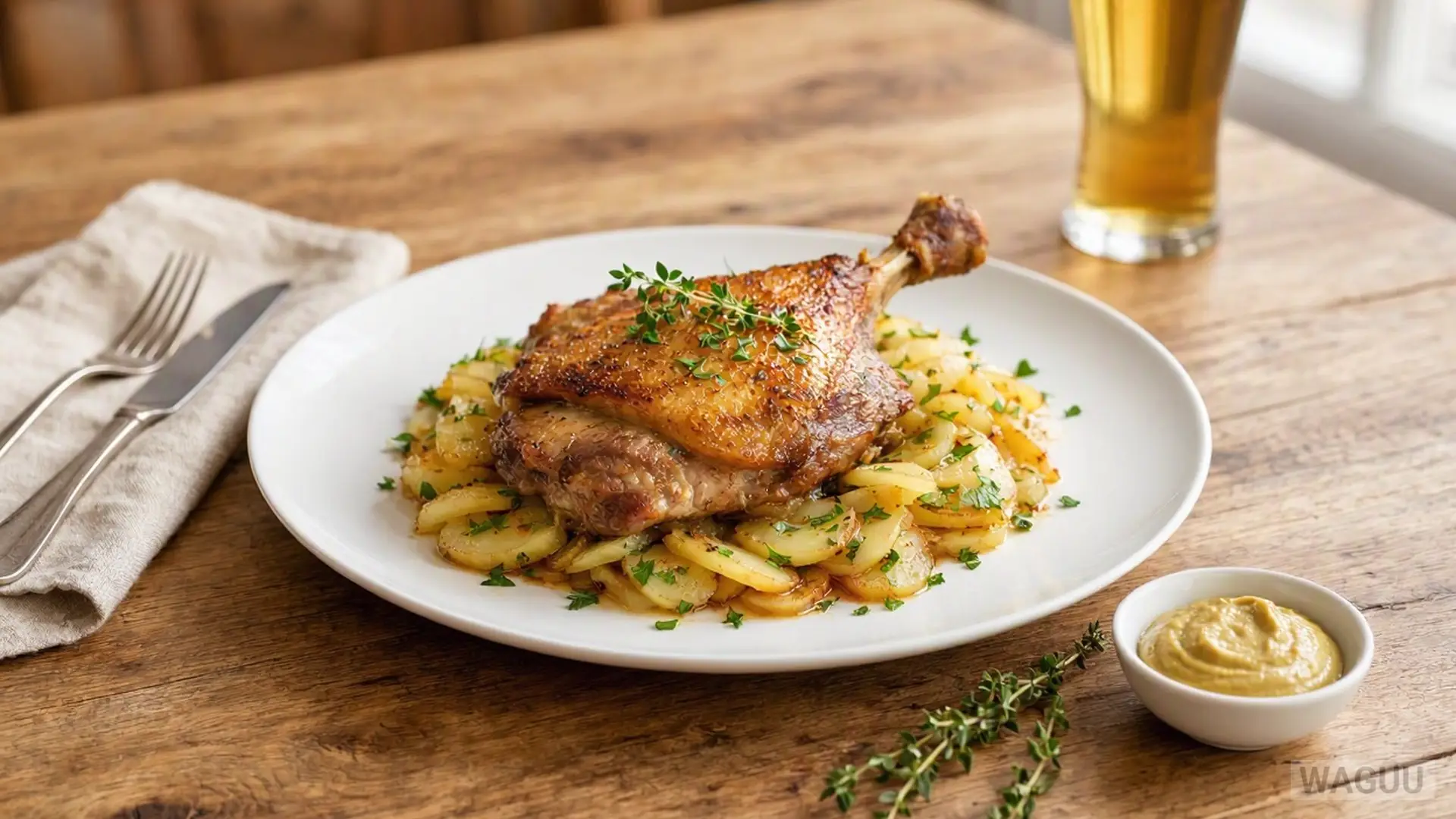
Summary: Confit de Canard is a masterpiece of traditional French culinary technique, featuring succulent duck legs slowly cured in coarse sea salt and garlic, then gently simmered in rendered duck fat until the meat effortlessly falls off the bone. This comprehensive guide covers the essential multi-stage curing process, low-temperature fat-immersion cooking, and the final high-heat crisping method. Requiring 30 minutes of active preparation, 18 hours of curing, and 3 hours of slow cooking, this recipe yields 6 hearty portions of exceptionally tender duck with a shatteringly crisp skin.
Did you cook this recipe? Share the result with the community.
Category: Poultry, French Cuisine
Success rate: 97.4% of users successfully made this recipe
Quick overview
- Dish: Confit de Canard
- Category: Poultry, French Cuisine
- Cuisine: French
- Main ingredient: Duck legs, 2,100 g (Grade-A Barbarie duck legs)
- Guide: 12 most popular French dishes: favourite recipes of French cuisine
- Total time: 1,230 minutes (30 min prep + 1,200 min cooking/curing)
- Difficulty: Advanced
- Portions: 6 portions (Portion weight: 280.0 g)
- Key technique: Slow fat-immersion confiting
- Preparation types: Curing, slow cooking, oven roasting
- Dietary info & Allergens: Gluten-free, lactose-free
- Suitable for: Festive dinners, Sunday lunches, gourmet gatherings
- Nutritional values (per 1 portion): 682.4 kcal, Protein: 34.2 g, Fat: 58.6 g, Carbohydrates: 0.4 g
- Storage: 14 days in the fridge (submerged in fat), 6 months in the freezer
- Pairing: Craft amber ale, full-bodied Bordeaux red wine, sparkling mineral water
- In short: Melt-in-the-mouth tender duck legs with an impossibly crisp, golden skin achieved through patient slow-cooking in pure rendered fat.
- Last updated: 21 September 2026
WAGUU says: “True French confit is both a preservation method and a triumph of texture, where slow-melted collagen meets clean, savory skin.”
How to take it further: Infuse the curing salt with crushed juniper berries and dried orange zest for extra aromatic complexity.
Key facts
| Prep time: | 30 minutes |
| Cooking time: | 180 minutes |
| Temperature: | 120 °C (confit), 220 °C (crisping) |
| Number of portions: | 6 portions |
In a nutshell
Confit de Canard represents the absolute peak of traditional French country cooking. By salting the duck legs overnight with garlic and fresh herbs, the meat undergoes a gentle osmosis that concentrates its rich flavor while firming the muscle fibers. Submerging the cured legs in rendered duck fat and baking them at a low temperature for three hours transforms tough connective tissue into velvety, unctuous tenderness. A final blast in a hot oven creates a magnificent, crackling skin that contrasts perfectly with the fork-tender meat inside.
Ingredients
Base portions: 6 portions • Portion weight: 280.0 g
| Ingredient | Amount | Quality |
|---|---|---|
| Duck legs | 2100 g | Fresh Barbarie duck legs, trimmed |
| Coarse sea salt | 30 g | High-grade grey sea salt |
| Fresh garlic cloves | 25 g | Peeled and lightly crushed (about 6 cloves) |
| Fresh thyme sprigs | 10 g | Fresh garden thyme |
| Fresh rosemary sprigs | 6 g | Fresh aromatic rosemary |
| Black peppercorns | 5 g | Whole black peppercorns, coarsely cracked |
| Rendered duck fat | 1200 g | Pure, clarified culinary duck fat |
| Table salt | 6 g | Fine seasoning salt |
Why you will love this recipe
- Unmatched tenderness: Slow cooking in fat breaks down all tough collagen into rich gelatin, making the meat melt effortlessly off the bone.
- Shattering crisp skin: The final high-temperature roasting step turns the duck skin into a golden, ultra-crispy delicacy.
- Natural preservation: Submerging cooked duck legs in rendered fat creates a traditional airtight seal that extends fridge storage safely for weeks.
Why it works: The overnight dry-curing draws out excess surface moisture while infusing aromatic compounds deep into the meat, ensuring intense flavor concentration during the long, low-heat confit process.
Recipe overview
Prep: 30 min | Cooking: 180 min | Difficulty: Advanced | Portions: 6 portions | Type: Main dish | Origin: French
Detailed instructions
Overall progress: 0% complete
Phase 1: Preparing and curing the duck legs – 20 min
Appliances: Refrigerator
1. Rinse 2,100 g of fresh Barbarie duck legs under cold running water and pat them thoroughly dry with clean kitchen paper towels. Trim away any excess dangling skin or heavy surface fat pockets. In a small mixing bowl, combine 30 g of coarse sea salt, 25 g of peeled and crushed fresh garlic cloves, 10 g of fresh thyme sprigs, 6 g of fresh rosemary sprigs, and 5 g of coarsely cracked black peppercorns to form the curing mixture. Rub this aromatic salt blend evenly over all sides of each duck leg, pressing the seasonings firmly into the skin and flesh. Place the seasoned duck legs in a shallow glass or ceramic dish, cover tightly with food wrap, and transfer them to the refrigerator to cure for 16 hours. Visual check point (VKB): The salt should have partially dissolved on the surface, and the meat should feel noticeably firmer to the touch after curing.
VKB: The salt should have partially dissolved on the surface, and the meat should feel noticeably firmer to the touch after curing.
Before moving to the next step:
Ensure the duck legs have cured for at least 16 hours so the salt penetrates the muscle tissue evenly and draws out excess moisture.
Phase 2: Rinsing and pre-heating for confit – 10 min
Appliances: Oven
2. Remove the cured duck legs from the refrigerator. Rinse each leg thoroughly under cold water to wash away all surface salt crystals, loose garlic pieces, and herbs, preventing an overly salty final taste. Pat the washed legs completely dry with fresh paper towels. Preheat your conventional kitchen oven to 120 °C. Select a heavy, deep cast-iron casserole dish or heavy-duty roasting tin that snugly fits all 6 duck legs in a single, compact layer without excessive overlapping. VKB: The duck legs must fit snugly so that the melted fat can completely submerge them without requiring an excessive surplus of fat.
VKB: The duck legs must fit snugly so that the melted fat can completely submerge them without requiring an excessive surplus of fat.
Before moving to the next step:
Verify that the oven has stabilized at precisely 120 °C before placing the casserole inside to guarantee gentle, even heat penetration.
Phase 3: Submerging in fat and slow baking – 150 min
Appliances: Oven
3. Arrange the dried duck legs skin-side down in the prepared roasting tin. Gently melt 1,200 g of rendered duck fat in a separate saucepan over medium-low heat until completely liquid, then pour the warm fat over the duck legs until they are fully submerged by at least 1 cm of liquid fat. Sprinkle 6 g of table salt evenly into the surrounding fat. Cover the casserole dish securely with a tight-fitting lid or a double layer of heavy-duty aluminum foil to seal in moisture. Place the covered dish into the preheated oven at 120 °C and bake undisturbed for 2 hours and 30 minutes. VKB: The fat should maintain a gentle, microscopic shimmer with occasional tiny bubbles, indicating a slow, steady simmer rather than a vigorous boil.
VKB: The fat should maintain a gentle, microscopic shimmer with occasional tiny bubbles, indicating a slow, steady simmer rather than a vigorous boil.
Before moving to the next step:
Check that the meat is starting to pull back slightly from the bone ends, revealing clean white bone tips.
Phase 4: Tenderizing finish and skin softening – 30 min
Appliances: Oven
4. Carefully remove the lid or foil cover from the roasting tin, taking extreme caution with escaping hot steam. Turn the duck legs over so they are now skin-side up, ensuring they remain submerged beneath the hot liquid fat. Return the uncovered dish to the 120 °C oven for an additional 30 minutes to soften the skin and complete the tenderization of the deeper muscle fibers. VKB: Testing with a metal skewer should reveal zero resistance as it enters the thickest part of the duck thigh.
VKB: Testing with a metal skewer should reveal zero resistance as it enters the thickest part of the duck thigh.
Before moving to the next step:
Ensure the oven temperature is adjusted upwards in preparation for the high-heat crisping phase.
Phase 5: High-heat skin crisping – 20 min
Appliances: Oven
5. Increase the oven temperature to 220 °C, or switch on the upper grill element to high. Using a slotted spoon or culinary tongs, carefully lift the tender duck legs out of the hot confit fat, allowing excess fat to drip off for a few seconds. Transfer the legs skin-side up onto a wire rack set inside a clean baking sheet. Place the baking sheet into the hot 220 °C oven and bake for 15 to 20 minutes until the skin bubbles, browns deeply, and achieves a crisp, glass-like texture. VKB: The skin should turn a rich mahogany-brown color with a uniform, crackling crust across the entire surface.
VKB: The skin should turn a rich mahogany-brown color with a uniform, crackling crust across the entire surface.
Before moving to the next step:
Monitor the skin closely during the final minutes to prevent scorching while ensuring maximum crispness.
Phase 6: Resting and plating – 10 min
Appliances: None
6. Remove the crispy duck legs from the oven and let them rest on the wire rack at room temperature for 5 to 8 minutes to allow internal juices to redistribute evenly. Strain the remaining liquid confit fat through a fine mesh sieve into a clean glass jar and reserve it in the refrigerator for future roasting tasks. Plate the warm, rested duck legs immediately alongside traditional accompaniments. VKB: The meat should remain piping hot and exceptionally moist inside while the skin retains its crisp crunch when pressed with a fork.
VKB: The meat should remain piping hot and exceptionally moist inside while the skin retains its crisp crunch when pressed with a fork.
Required equipment
| Utensil | Ideal size | Alternative | Risk |
|---|---|---|---|
| Cast-iron casserole dish | 4-litre capacity | Heavy roasting tin with foil | Uneven heat distribution |
| Wire cooling rack | 30 x 40 cm | Broiler rack insert | Skin sticking to metal |
| Fine mesh sieve | 15 cm diameter | Cheesecloth lined funnel | Sediment passing into fat |
Shopping list
Nutritional profile
Values per 1 portion (excluding side dishes). Calculated from average nutritional values of ingredients.
| Nutrient | Per 100 g | Per 1 portion | Per 6 portions |
|---|---|---|---|
| Energy | 243.7 kcal | 682.4 kcal | 4,094.4 kcal |
| Fat | 20.9 g | 58.6 g | 351.6 g |
| of which saturates | 6.8 g | 19.0 g | 114.0 g |
| Carbohydrates | 0.1 g | 0.4 g | 2.4 g |
| of which sugars | 0.0 g | 0.0 g | 0.0 g |
| Protein | 12.2 g | 34.2 g | 205.2 g |
| Salt | 1.3 g | 3.6 g | 21.6 g |
Reference intake of an average adult (8400 kJ / 2000 kcal).
WAGUU Pro Level
- Pro standard: Verified recipe with precise ratios and visual control points.
- Tip 1: Always use Barbarie duck legs as their muscle-to-fat ratio yields superior texture compared to Pekin ducks.
- Tip 2: Ensure the curing salt is completely rinsed off before cooking to prevent surface salt spots and overly salty meat.
- Tip 3: Save and strain every gram of leftover duck fat—it can be reused up to five times for roasting potatoes or vegetables.
- Tip 4: For an ultra-crisp finish, brush a thin layer of rendered fat over the skin just before placing the legs under the oven grill.
Scientific background
The confit technique relies on two fundamental culinary science principles: osmosis and collagen hydrolysis. During the 16-hour dry cure, sodium ions from coarse sea salt penetrate the muscle tissue via osmosis, drawing out intracellular water while binding proteins. This firms the meat structure and prevents microbial growth. Subsequently, cooking the duck submerged in fat at a low temperature (120 °C) over several hours creates a thermal environment that hydrolyzes tough collagen in the connective tissue, converting it into unctuous, soluble gelatin without boiling away the moisture. Finally, dry radiant heat in a 220 °C oven triggers the Maillard reaction between amino acids and reducing sugars on the skin surface, producing complex savory aromas and a crisp texture.
Fine Dining – Professional techniques
- Plate composition: Position the crispy duck leg diagonally across a smooth potato purée, anchoring it with a vibrant pool of tart cherry reduction.
- Textural contrasts: Pair the shattering crunch of the roasted skin against the meltingly soft, silky texture of slow-cooked duck meat.
- Temperature contrast: Serve the duck piping hot alongside a cool, refreshing frisée and shallot salad dressed in a sharp vinaigrette.
- Aromatic garnishes: Garnish with finely minced chives and freshly cracked black pepper to lift the rich profile of the dish.
Sensory radar
- Appearance: Golden-brown, crackling skin with visible meat separation at the bone ends and a glossy presentation.
- Aroma: Deep, savory duck aroma infused with earthy garlic, aromatic thyme, and roasted fat notes.
- Taste: Rich, deeply savory, and perfectly seasoned with a balanced salt profile and herbal undertones.
- Texture: Exceptionally tender, fork-pull meat encased in a crisp, dry, and crunchy skin.
Pairing
- BEER: Belgian Dubbel craft beer with caramel malt notes and subtle dark fruit esters.
- WINE: Aged French Bordeaux or a structured Burgundy Pinot Noir with high acidity to cut through the rich fat.
- NON-ALCOHOLIC: Sparkling apple and blackcurrant shrub with crisp acidity and botanical tannins.
Various preparation variants
- Gascon Confit Style: Incorporate dried juniper berries, a pinch of mace, and crushed bay leaves into the curing salt for a traditional rustic Southwest French profile.
- Orange and Honey Glazed Confit: Brush the crisped duck legs with a warm glaze made from fresh orange juice, honey, and a splash of sherry vinegar during the final two minutes of oven grilling.
Allergens and dietary information
Contains: None • Gluten: Gluten-free • Not suitable for: Vegans and vegetarians
Suitable for
Festive dinner parties, traditional French Sunday lunches, romantic gourmet evenings, and celebratory family gatherings.
Substitution catalog
- Duck fat: Goose fat (can be substituted 1:1 with identical cooking properties)
FAQ
Can I reuse the duck fat after cooking?
Yes, absolutely. Strain the used fat through a fine sieve to remove any food particles, pour it into a clean jar, and store it in the refrigerator for up to 6 months. It can be reused multiple times for confit or roasting potatoes.
Why is the curing step necessary?
The dry cure draws out surface moisture through osmosis, concentrating the natural duck flavors and firming the muscle fibers so the meat holds its shape during long cooking.
How long can I store cooked confit in the fridge?
When completely submerged in its solidified fat layer inside an airtight container, cooked confit will keep safely in the refrigerator for up to 14 days.
What is the best way to reheat stored confit?
Scrape away excess solid fat, place the duck legs on a wire rack, and bake in a preheated oven at 200 °C for 20 minutes until heated through and the skin is crisp.
WAGUU Petr advises: Cooking for 12 or more people?
12–16 people: Double all ingredient quantities and use two large roasting pans side by side in the oven, rotating their positions halfway through cooking to ensure even heat distribution. • 20+ people: Prepare the confit in two separate batches over two days, storing the cooked legs submerged in fat until the day of the event, then crisp them all together in commercial convection ovens.
Sides and Serving
- Pommes Sarladaises – potato slices sautéed in duck fat with garlic and parsley (not included in the recipe)
-
Braised red cabbage with apples and red wine (not included in the recipe)
Serving: Serve one crispy duck leg per guest on heated plates alongside garlic-roasted potatoes and a bright green salad dressed with lemon vinaigrette.
Storage and reheating
Fridge: 14 days • Freezer: 6 months • Reheating: Bake in a preheated oven at 200 °C for 20 minutes on a wire rack until skin is hot and crisp.
Author: WAGUU Petr & Team • Published: 21 Sep 2026 • Updated: 30 Oct 2026
More Recipes from This Article
Guide: 12 most popular French dishes: favourite recipes of French cuisine
Boeuf à la Bourguignonne
Other recipes you might be interested in
Why WAGUU?
Recipes on WAGUU undergo checks for the accuracy of ingredients, procedures, and nutritional values.
Process photo gallery
Community photos: Cook, take a photo, and share the result.
You can upload photos in the comments below or send them via email.
Did you record a video guide for our recipe? Insert a link to YouTube, YouTube Shorts, TikTok, Instagram Reels, Facebook Reels, Pinterest, Vimeo, or X (Twitter) in the comment – we’d be happy to publish it and help promote you and your content.
Common mistakes
- Skipping the curing step – Fails to draw out surface moisture, resulting in stringy meat and uneven salt penetration.
- Cooking at too high a temperature – Boiling the duck in fat instead of gently simmering it toughens the muscle fibers and dries out the protein.
- Failure to rinse the salt – Leaving excess curing salt on the legs makes the final dish unpleasantly salty.
- Rushing the skin crisping – Not allocating enough time under high heat leaves the skin flaccid rather than crackling and golden.