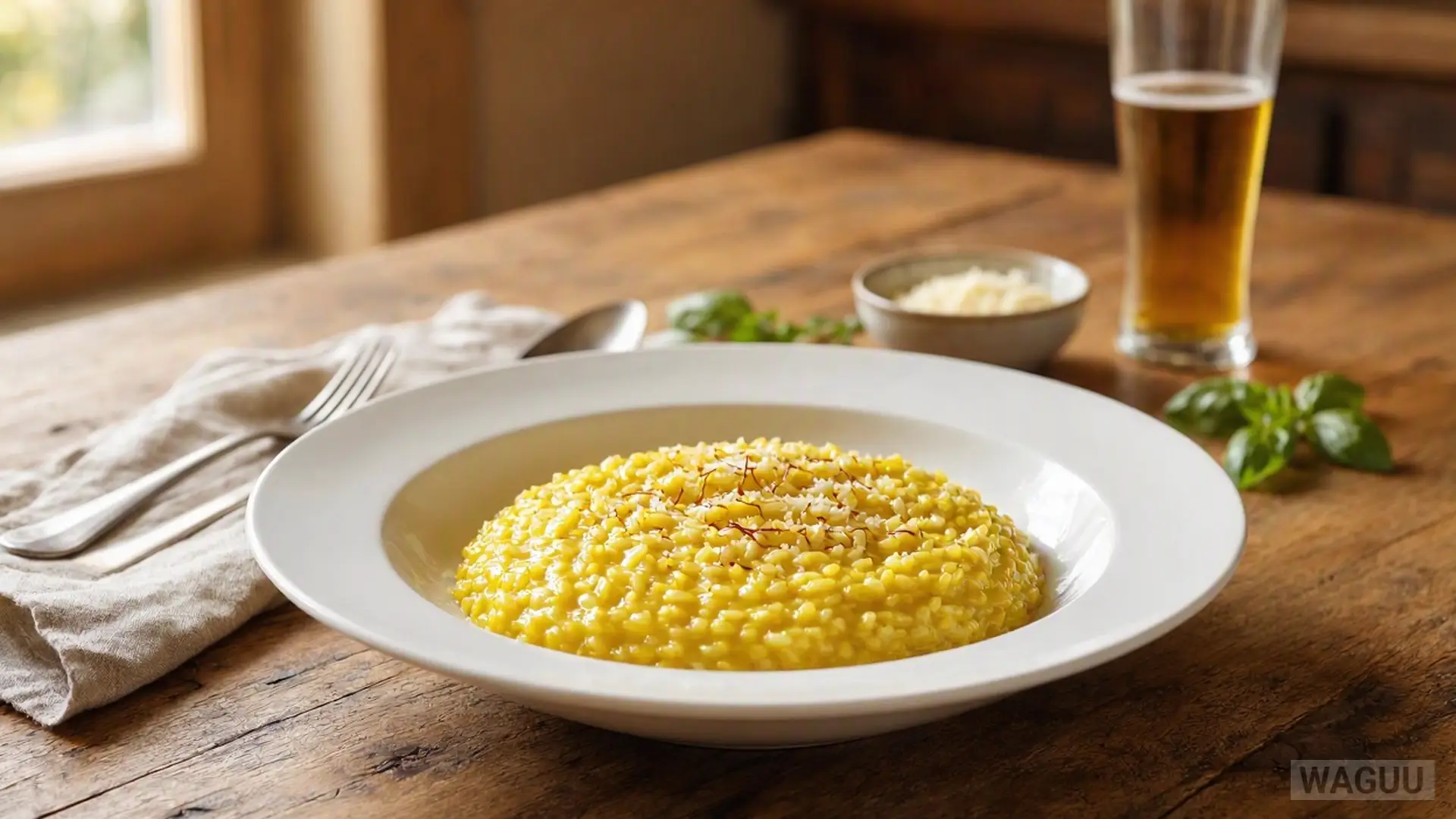
Summary: Risotto alla Milanese is a classic Italian masterpiece featuring Carnaroli rice cooked slowly in a rich homemade beef and bone marrow stock, delicately infused with fragrant saffron threads, white wine, and butter, and finished with freshly grated Parmigiano Reggiano. This traditional preparation takes 45 minutes from start to finish, yielding a creamy, golden dish with a velvety texture and an exquisite aromatic profile.
Did you cook this recipe? Share the result with the community.
Category: Risotto and Grains, Italian Cuisine
Quick overview
- Dish: Risotto alla Milanese
- Category: Risotto and grains, Italian cuisine
- Cuisine: Italian
- Main ingredient: Carnaroli rice, 500 g (high-starch Italian rice)
- Guide: 12 most popular Italian dishes: favourite recipes of Italian cuisine
- Total time: 45 minutes (15 min prep + 30 min cooking)
- Difficulty: Medium
- Portions: 6 (Portion weight: 320 g)
- Key technique: Tostatura and mantecatura
- Preparation types: Simmering and stirring
- Dietary info & Allergens: Contains milk, sulphites
- Suitable for: Lunch, dinner, festive dining
- Nutritional values (per 1 portion): 420.5 kcal, Protein: 12.4 g, Fat: 16.8 g, Carbohydrates: 54.2 g
- Storage: 2 days in the fridge, 3 months in the freezer
- Pairing: Craft lager, dry Italian white wine, sparkling water with lemon
- In short: The ultimate golden saffron risotto with a rich marrow stock and velvety texture.
- Last updated: 21 September 2026
WAGUU says: “True risotto relies on patience, continuous stirring, and gradual stock addition to release starches naturally.”
How to take it further: Infuse the hot stock with a strip of lemon zest, or finish the dish with freshly grated nutmeg.
Key facts
| Prep time: | 15 min |
| Cooking time: | 30 min |
| Temperature: | Medium simmer |
| Number of portions: | 6 |
In a nutshell
Experience the timeless elegance of Milanese cooking with this authentic saffron risotto. By toasting the rice grains to seal their starches, simmering them in a marrow-enriched beef stock, and vigorously beating in cold butter and aged cheese at the very end, you achieve a luxurious all’onda texture that flows gently across the plate.
Ingredients
Base portions: 6 portions • Portion weight: 320 g
| Ingredient | Amount | Quality |
|---|---|---|
| Carnaroli rice | 500 g | High-grade Italian rice |
| Beef and bone marrow stock | 1500 ml | Rich homemade broth |
| Unsalted butter | 90 g | High fat content, chilled |
| Yellow onion | 120 g | Finely minced |
| Dry white wine | 150 ml | Crisp and acidic |
| Saffron threads | 1 g | Pure Iranian or Italian threads |
| Parmigiano Reggiano cheese | 100 g | Aged 24 months, freshly grated |
| Beef bone marrow | 40 g | Fresh marrow bone extract |
| Fine sea salt | 12 g | Pure sea salt |
| Rapeseed oil | 30 ml | Neutral cooking oil |
Why you will love this recipe
- Authentic tradition: Follows time-honored Lombardy techniques for genuine regional flavor.
- Luxurious texture: Achieves the perfect al dente bite combined with a creamy, flowing finish.
- Exquisite aroma: Combines premium saffron threads with rich marrow stock for unmatched depth.
Why it works: Proper toasting locks in the starch, while gradual stock addition and vigorous final beating with cold butter create a stable emulsion.
Recipe overview
Prep: 15 min | Cooking: 30 min | Difficulty: Medium | Portions: 6 | Type: Main dish | Origin: Italian
Detailed instructions
Overall progress: 0% complete
Phase 1: Stock preparation and saffron steeping – 10 min
Appliances: Hob
1. Pour 1500 ml of beef and bone marrow stock into a medium saucepan and bring it to a gentle simmer over medium heat at 95 °C. Stir in 1 g of saffron threads, cover with a lid, and let it steep off the heat for 10 minutes to release its golden color and complex aroma.
Visual check point (VKB): The stock turns a vibrant golden-yellow hue with visible saffron specks throughout.
Before moving to the next step:
Ensure the stock remains piping hot on a low burner so it does not cool down the rice during cooking.
Phase 2: Sautéing aromatics and melting marrow – 5 min
Appliances: Hob
2. Place a wide, heavy-bottomed Dutch oven over medium heat at 170 °C. Add 30 ml of rapeseed oil and 40 g of beef bone marrow, stirring until the marrow melts completely. Add 120 g of finely minced yellow onion and sauté for 4 minutes until translucent and soft without browning.
VKB: The onions are soft and glossy, enveloped in rendered marrow fat.
Before moving to the next step:
Check that the onions have no charred edges, as burnt pieces will discolor the pale golden risotto base.
Phase 3: Toasting the rice and deglazing with wine – 5 min
Appliances: Hob
3. Pour 500 g of Carnaroli rice directly into the Dutch oven with the onions. Toast the grains over medium heat for 3 minutes, stirring constantly with a wooden spoon until translucent at the edges. Pour in 150 ml of dry white wine and cook for 2 minutes, stirring continuously until the alcohol evaporates entirely.
VKB: Rice grains feel very hot to the touch and emit a pleasant toasted aroma, with all wine absorbed.
Before moving to the next step:
Make sure the wine aroma has shifted from sharp alcohol to fruity acidity before adding the first ladle of stock.
Phase 4: Simmering and gradual stock addition – 18 min
Appliances: Hob
4. Add a ladleful of the hot saffron stock (about 250 ml) to the rice along with 12 g of fine sea salt. Stir gently over medium-low heat at 90 °C until the liquid is absorbed. Continue adding stock one ladle at a time, stirring frequently, for 18 minutes until the rice is tender yet firm to the bite (al dente).
VKB: The rice releases its starches, creating a thick, creamy sauce surrounding individual grains.
Before moving to the next step:
Taste a grain of rice to ensure it is cooked through without any hard chalky center.
Phase 5: Mantecatura and final resting – 2 min
Appliances: None
5. Remove the Dutch oven from the heat source completely. Add 90 g of chilled unsalted butter cut into cubes and 100 g of freshly grated Parmigiano Reggiano cheese. Stir vigorously for 2 minutes to incorporate air and emulsify the fats, then cover with a lid and let rest for 2 minutes before serving.
VKB: The risotto is glossy, creamy, and self-levels across the plate with a gentle wave motion.
Required equipment
| Utensil | Ideal size | Alternative | Risk |
|---|---|---|---|
| Dutch oven | 28 cm wide | Heavy-bottomed skillet | Uneven heat distribution |
| Saucepan | 2 l capacity | Standard soup pot | Boiling over of stock |
| Wooden spoon | Standard size | Heat-resistant silicone spatula | Breaking rice grains |
Shopping list
Nutritional profile
Values per 1 portion (excluding side dishes). Calculated from average nutritional values of ingredients.
| Nutrient | Per 100 g | Per 1 portion | Per 6 portions |
|---|---|---|---|
| Energy | 131.4 kcal | 420.5 kcal | 2523.0 kcal |
| Fat | 5.25 g | 16.8 g | 100.8 g |
| of which saturates | 3.125 g | 10.0 g | 60.0 g |
| Carbohydrates | 16.94 g | 54.2 g | 325.2 g |
| of which sugars | 0.625 g | 2.0 g | 12.0 g |
| Protein | 3.875 g | 12.4 g | 74.4 g |
| Salt | 0.625 g | 2.0 g | 12.0 g |
Reference intake of an average adult (8400 kJ / 2000 kcal).
WAGUU Pro Level
- Pro standard: Verified recipe with precise ratios and visual control points.
- Tip 1: Always use high-starch Italian rice varieties such as Carnaroli or Arborio for optimal creaminess.
- Tip 2: Keep the stock simmering continuously so it does not drop the temperature of the rice during additions.
- Tip 3: Ensure the butter is thoroughly chilled before the mantecatura step to create a glossy, stable emulsion.
- Tip 4: Toast the rice until individual grains turn translucent at the edges to seal in the starch properly.
Scientific background
Risotto relies on starch gelatinisation and mechanical friction. As the rice grains rub against each other during stirring, surface amylopectin starch breaks off and mixes with the simmering stock. Combined with the fats from butter, bone marrow, and aged cheese during the final mantecatura, this creates a stable colloidal suspension that gives risotto its signature velvety texture without the need for heavy cream.
Fine Dining – Professional techniques
- Plate composition: Serve on a pre-warmed shallow plate, tapping the bottom gently to let the risotto flow into an even layer.
- Textural contrasts: Balance the velvety rice cream with a delicate crispness from toasted breadcrumbs or grated Parmigiano crisps.
- Temperature contrast: Ensure the dish is served piping hot immediately after resting.
- Aromatic garnishes: Garnish with a few extra saffron threads and a drizzle of cold-pressed extra virgin olive oil.
Sensory radar
- Appearance: Brilliant golden-yellow hue with a glossy, flowing consistency.
- Aroma: Rich aroma of saffron, toasted rice, and savory marrow stock.
- Taste: Deeply savory, buttery, and warming with subtle earthy floral notes from saffron.
- Texture: Creamy sauce surrounding tender rice grains with a firm al dente core.
Pairing
- BEER: Crisp artisanal Czech lager or Belgian blonde ale.
- WINE: Dry Italian white wine such as Pinot Grigio or a structured Franciacorta sparkling wine.
- NON-ALCOHOLIC: Sparkling mineral water with a slice of fresh lemon.
Various preparation variants
- Traditional Ossobuco pairing: Serve the risotto alongside slow-braised veal shanks for the ultimate Milanese feast.
- Herb-infused variant: Fold in a tablespoon of finely minced fresh flat-leaf parsley right before serving for a vibrant color contrast.
Allergens and dietary information
Contains: Milk, sulphites • Gluten: Gluten-free naturally • Not suitable for: Vegans and dairy-allergic individuals
Suitable for
Lunch, dinner, festive dining
Substitution catalog
- Carnaroli rice: Arborio or Vialone Nano rice
- Beef and bone marrow stock: High-quality vegetable stock
- Dry white wine: Dry vermouth or lemon juice diluted with water
FAQ
Why must the stock be kept hot during cooking?
Adding cold stock lowers the temperature of the rice, halting starch release and resulting in unevenly cooked grains.
Can I use powdered saffron instead of threads?
Threads provide a superior aroma and authentic appearance, but powdered saffron can be used in equal weight if necessary.
What is the purpose of mantecatura?
Vigorously beating in cold butter and cheese off the heat creates a creamy emulsion that gives risotto its signature gloss.
How do I know when the rice is done?
The rice should be tender on the outside with a slight al dente bite and a chalk-free core.
WAGUU Petr advises: Cooking for 12 or more people?
12–16 people: Prepare the risotto in two separate wide Dutch ovens to maintain proper heat distribution and stirring control. • 20+ people: Cook the rice in batches up to the final stock addition, then finish mantecatura in smaller portions immediately before service.
Sides and Serving
- Ossobuco alla Milanese – traditional slow-braised veal shanks (not included in the recipe)
- Arugula salad with lemon dressing – crisp green contrast (not included in the recipe)
Serving: Serve immediately on warm plates garnished with a pinch of saffron threads.
Storage and reheating
Fridge: 2 days • Freezer: 3 months • Reheating: Reheat gently in a saucepan with a splash of warm stock or water, stirring constantly.
Author: WAGUU Petr & Team • Published: 23 Aug 2026 • Updated: 1 Nov 2026
More Recipes from This Article
Other recipes you might be interested in
Why WAGUU?
Recipes on WAGUU undergo checks for the accuracy of ingredients, procedures, and nutritional values.
Process photo gallery
Community photos: Cook, take a photo, and share the result.
You can upload photos in the comments below or send them via email.
Did you record a video guide for our recipe? Insert a link to YouTube, YouTube Shorts, TikTok, Instagram Reels, Facebook Reels, Pinterest, Vimeo, or X (Twitter) in the comment – we’d be happy to publish it and help promote you and your content.
Common mistakes
- Adding cold stock: Lowers the cooking temperature and halts starch release.
- Skipping toasting: Prevents grains from retaining their structural integrity during simmering.
- Stirring too aggressively: Breaks down rice grains and releases excess pasty starch.
- Skipping mantecatura: Results in a dry, separated dish instead of a creamy emulsion.