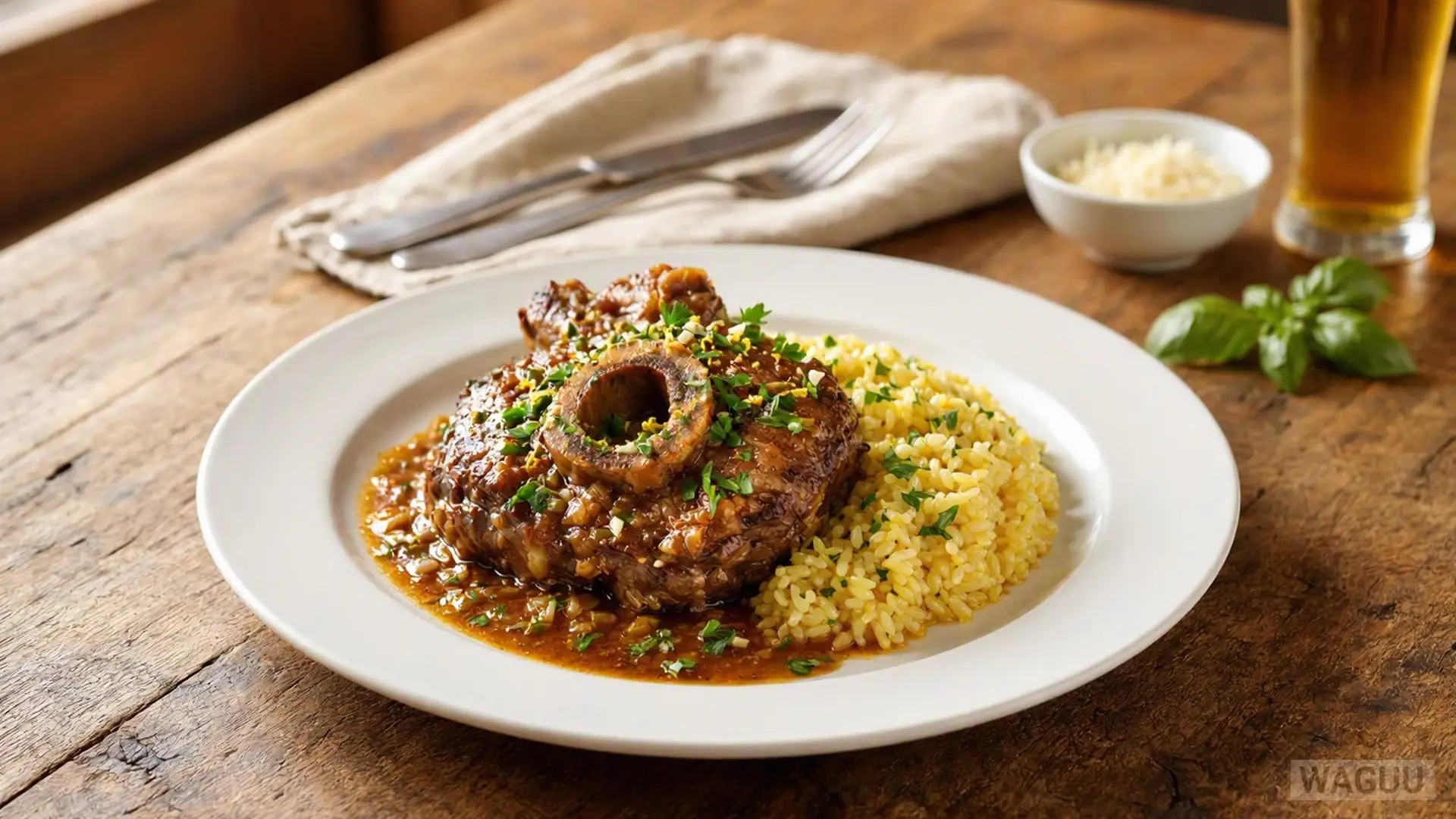
Summary: Slow-braised veal shanks on the bone cooked in white wine, rich veal stock, and aromatic vegetables, traditionally served with gremolata and saffron risotto. This classic Milanese specialty utilizes a gentle braising technique over 180 minutes, resulting in tender meat that melts off the bone and a rich, gelatinous sauce. Designed for 6 portions, featuring precise culinary steps for home cooks.
Did you cook this recipe? Share the result with the community.
Category: Main Dishes, Italian Cuisine
Success rate: 96% of users successfully made this recipe
Quick overview
- Dish: Ossobuco alla Milanese
- Category: Main Dishes, Italian Cuisine
- Cuisine: Italian
- Main ingredient: Veal shanks, 2.4 kg (bone-in, cross-cut)
- Guide: 12 most popular Italian dishes: favourite recipes of Italian cuisine
- Total time: 210 minutes (30 min prep + 180 min cooking)
- Difficulty: Medium
- Portions: 6 portions (Portion weight: 450 g)
- Key technique: Braising
- Preparation types: Searing, simmering, slow braising
- Dietary info & Allergens: Sulphites (wine), celery (stock)
- Suitable for: Festive dinners, Sunday lunches, gourmet gatherings
- Nutritional values (per 1 portion): 542.4 kcal, Protein: 51.6 g, Fat: 28.4 g, Carbohydrates: 12.2 g
- Storage: 3 days in the fridge, 3 months in the freezer
- Pairing: Craft lager, Nebbiolo wine, sparkling mineral water
- In short: Tender veal shanks slow-braised with white wine and vegetables, finished with zesty gremolata.
- Last updated: 21 September 2026
WAGUU says: “The secret to authentic Ossobuco alla Milanese lies in rendering the connective tissue around the bone marrow completely gelatinous without letting the meat dry out.”
How to take it further: Add a pinch of saffron threads to the braising liquid for a golden hue, or finish the sauce with a teaspoon of softened bone marrow stirred in just before serving.
Key facts
| Prep time: | 30 minutes |
| Cooking time: | 180 minutes |
| Temperature: | 160 °C (oven) |
| Number of portions: | 6 portions |
In a nutshell
Experience the pinnacle of Milanese comfort food with thick-cut veal shanks simmered patiently in white wine and aromatic vegetables. Each bite offers butter-soft meat and rich marrow, heightened by a vibrant citrus gremolata.
Ingredients
Base portions: 6 portions • Portion weight: 450 g
| Ingredient | Amount | Quality |
|---|---|---|
| Veal shanks | 2.4 kg | Cross-cut, on the bone, 4 cm thick |
| Plain flour | 60 g | Standard white flour for dredging |
| Unsalted butter | 60 g | High-fat dairy butter |
| Rapeseed oil | 40 ml | Refined for high-heat searing |
| Yellow onions | 200 g | Finely diced |
| Carrots | 150 g | Finely diced brunoise |
| Celery stalks | 120 g | Finely diced |
| Dry white wine | 300 ml | Crisp Italian white wine (e.g. Pinot Grigio) |
| Veal stock | 600 ml | Rich, homemade gelatinous stock |
| Lemon zest | 15 g | Freshly grated organic lemon peel |
| Fresh garlic | 10 g | Minced cloves |
| Fresh parsley | 15 g | Finely chopped flat-leaf parsley |
| Fine sea salt | 18 g | Pure sea salt |
| Black pepper | 3 g | Freshly cracked black peppercorns |
Why you will love this recipe
- Authentic tradition: Follows classic Milanese methods focusing on slow braising and rich marrow extraction.
- Melt-in-the-mouth texture: Long, gentle cooking transforms connective tissue into a velvety sauce.
- Vibrant contrast: The citrus and garlic gremolata cuts through the rich braising juices.
Why it works: Dredging the shanks in flour and searing them creates a deep Maillard crust that thickens the braising liquid as collagen breaks down.
Recipe overview
Prep: 30 min | Cooking: 180 min | Difficulty: Medium | Portions: 6 | Type: Main dish | Origin: Italian
Detailed instructions
Overall progress: 0% complete
Phase 1: Preparing and searing the veal shanks – 20 min
Appliances: Hob
1. Tie each veal shank securely around the circumference with kitchen twine (not part of the recipe) to maintain its shape during braising. Season the shanks with 12 g of fine sea salt and 2 g of black pepper. Lightly dredge the shanks in 60 g of plain flour, shaking off any excess. Heat a heavy-bottomed roasting pan or Dutch oven on the hob over medium-high heat with 40 ml of rapeseed oil and 30 g of unsalted butter. Add the shanks and sear for 4 minutes on each side until a golden-brown crust forms. Remove the shanks and set them aside on a clean plate.
Visual check point (VKB): The meat surface is evenly browned with a deep golden crust and no raw flour patches remain visible.
Before moving to the next step:
Ensure the pan fond is deep golden brown without burning, as this forms the aromatic foundation of the braising sauce.
Phase 2: Sautéing aromatics and deglazing – 15 min
Appliances: Hob
2. In the same roasting pan with remaining pan juices, melt another 30 g of unsalted butter over medium heat. Add 200 g of finely diced yellow onions, 150 g of diced carrots, and 120 g of diced celery stalks. Sauté the vegetables stirring frequently for 10 minutes until they soften and turn translucent. Pour in 300 ml of dry white wine, scraping the bottom of the pan with a wooden spoon to dissolve all caramelized bits. Simmer for 5 minutes until the alcohol aroma softens and the liquid volume reduces by half.
VKB: The vegetables are tender and fragrant, and the wine has reduced to a syrupy glaze coating the vegetables.
Before moving to the next step:
Check that the wine alcohol has fully evaporated to prevent a sharp, acidic taste in the braise.
Phase 3: Slow braising in the oven – 150 min
Appliances: Oven
3. Preheat your oven to 160 °C. Return the seared veal shanks to the roasting pan, nestling them among the aromatic vegetables. Pour 600 ml of rich veal stock over the shanks; the liquid should come about halfway up the sides of the meat. Add the remaining 6 g of fine sea salt and 1 g of black pepper. Cover the roasting pan tightly with a heavy lid or double layer of aluminum foil. Place in the preheated oven and braise undisturbed for 150 minutes.
VKB: The meat is exceptionally tender, pulling away slightly from the bone, and the sauce is glossy and thick.
Before moving to the next step:
Verify meat tenderness with a fork; if resistance remains, continue braising for an additional 20 minutes.
Phase 4: Preparing the gremolata – 15 min
Appliances: None
4. While the shanks finish braising, prepare the traditional gremolata garnish. On a clean cutting board using a sharp chef’s knife (not part of the recipe), finely chop 15 g of fresh flat-leaf parsley leaves. Mince 10 g of fresh garlic cloves into a very fine paste. Carefully grate 15 g of fresh lemon zest, avoiding the bitter white pith underneath. Combine the chopped parsley, minced garlic, and lemon zest in a small bowl, mixing gently with a spoon until evenly distributed.
VKB: The gremolata is vibrant, finely minced, and releases a potent aroma of fresh citrus and pungent garlic.
Phase 5: Final reduction and resting – 10 min
Appliances: Hob
5. Remove the roasting pan from the oven and carefully transfer the cooked veal shanks to a warm platter, covering them loosely to keep warm. Place the roasting pan with the remaining vegetable sauce back onto the hob over medium heat. Simmer the sauce for 8 minutes to reduce further until it coats the back of a spoon. Taste the sauce and adjust seasoning if necessary. Remove the kitchen twine from the shanks.
VKB: The sauce has a rich, velvety consistency with visible vegetable solids and a glossy sheen.
Phase 6: Plating and serving – 10 min
Appliances: None
6. Arrange each braised veal shank onto warm individual serving plates. Spoon the rich vegetable sauce generously over and around the meat. Sprinkle a generous teaspoon of the freshly prepared gremolata directly over the top of each shank just before serving. Serve immediately while piping hot.
VKB: The dish presents an appealing contrast of dark braised meat, colorful vegetable sauce, and bright green-and-yellow gremolata.
Required equipment
| Utensil | Ideal size | Alternative | Risk |
|---|---|---|---|
| Roasting pan or Dutch oven | 30 cm diameter | Heavy-bottomed casserole pot | Thin bottom may cause scorching |
| Chef’s knife | 20 cm blade | Santoku knife | Dull blade crushes gremolata herbs |
| Microplane grater | Standard fine | Box grater fine side | Grating bitter white pith into zest |
Shopping list
Nutritional profile
Values per 1 portion (excluding side dishes). Calculated from average nutritional values of ingredients.
| Nutrient | Per 100 g | Per 1 portion | Per 6 portions |
|---|---|---|---|
| Energy | 120.5 kcal | 542.4 kcal | 3254.4 kcal |
| Fat | 6.3 g | 28.4 g | 170.4 g |
| of which saturates | 3.1 g | 14.0 g | 84.0 g |
| Carbohydrates | 2.7 g | 12.2 g | 73.2 g |
| of which sugars | 1.1 g | 5.0 g | 30.0 g |
| Protein | 11.5 g | 51.6 g | 309.6 g |
| Salt | 0.7 g | 3.0 g | 18.0 g |
Reference intake of an average adult (8400 kJ / 2000 kcal).
WAGUU Pro Level
- Pro standard: Verified recipe with precise ratios and visual control points.
- Tip 1: Tie the shanks with kitchen twine to prevent them from falling apart as the collagen dissolves during braising.
- Tip 2: Use bone-in veal shanks cut specifically from the hind leg for optimal marrow content and meat-to-bone ratio.
- Tip 3: Add the gremolata strictly at the very end of plating to preserve its volatile citrus oils and pungent garlic bite.
- Tip 4: Deglaze the roasting pan thoroughly with white wine to incorporate all browned fond into the braising sauce.
Scientific background
Slow braising at a moderate temperature of 160 °C initiates the thermal hydrolysis of tough collagen fibrils within the connective tissue, transforming them into soluble gelatin. This gelatin thickens the braising liquid naturally, creating a glossy sauce that coats the palate. Concurrently, searing the floured meat triggers the Maillard reaction, generating complex savoury flavor compounds that infuse the entire dish.
Fine Dining – Professional techniques
- Plate composition: Center the veal shank upright on the plate to showcase the marrow bone, draping sauce cleanly around the base.
- Textural contrasts: Balance the ultra-tender braised meat against the crisp brightness of raw garlic and lemon zest in the gremolata.
- Temperature contrast: Serve the piping hot braised shank alongside a warm, freshly prepared saffron risotto.
- Aromatic garnishes: Dust the rim of the plate lightly with extra chopped flat-leaf parsley for a polished presentation.
Sensory radar
- Appearance: Deep golden-brown braised meat with visible marrow bone, coated in a glossy amber sauce and topped with vibrant green and yellow gremolata.
- Aroma: Rich savory broth, caramelized vegetables, bright lemon zest, and pungent garlic notes.
- Taste: Deeply savory and unctuous meat balanced by the acidity of white wine and the citrus freshness of gremolata.
- Texture: Succulent, fork-tender meat that yields effortlessly, paired with a velvety, gelatinous sauce.
Pairing
- BEER: Crisp Italian craft lager with a clean malt profile.
- WINE: Structured red wine such as Nebbiolo or Barbaresco with high acidity to cut through the rich gelatin.
- NON-ALCOHOLIC: Sparkling mineral water infused with fresh lemon slices and a sprig of rosemary.
Various preparation variants
- Ossobuco alla Romana: Prepared without white wine, substituting dry white wine with a splash of white wine vinegar and adding fresh tomatoes for a brighter, acidic profile.
- Ossobuco di Tacchino: A rustic budget-friendly variation substituting veal shanks with thick-cut turkey shanks, adjusting the cooking time down to 90 minutes.
Allergens and dietary information
Contains: Sulphites (wine), celery (stock), gluten (flour), milk (butter) • Gluten: Contains gluten from flour dredging • Not suitable for: Vegan, vegetarian, gluten-free diets
Suitable for
Festive dinners, Sunday family lunches, gourmet gatherings, traditional Italian feasts
Substitution catalog
- Plain flour: Rice flour for a gluten-free dredging alternative
- Dry white wine: Dry white vermouth or diluted fresh lemon juice with water
FAQ
Why do the veal shanks need to be tied with kitchen twine?
Tying the shanks keeps the meat securely attached to the bone and prevents the cut from falling apart as the connective tissue breaks down during long braising.
Can I make ossobuco a day in advance?
Yes, ossobuco actually tastes even better the next day as the flavors meld. Reheat gently on the hob and prepare fresh gremolata right before serving.
What is the purpose of gremolata?
Gremolata provides a burst of citrus freshness and sharp garlic aromatics that cut through the rich, unctuous profile of the braised meat and sauce.
What cut of meat should I ask my butcher for?
Ask for cross-cut hind leg veal shanks that are approximately 4 cm thick, ensuring a generous marrow bone in the center of each piece.
WAGUU Petr advises: Cooking for 12 or more people?
12–16 people: Double all ingredients proportionally and use two large roasting pans in the oven to ensure the shanks are not overcrowded, which would hinder proper searing and browning. • 20+ people: Prepare the braised shanks in batches across multiple Dutch ovens a day prior, store them in the refrigerator, and reheat them gently in their sauce on the stove before finishing with freshly made gremolata.
Sides and Serving
- Saffron risotto (Risotto alla Milanese) – traditional golden rice infused with rich stock and saffron (not included in the recipe)
- Polenta – creamy cornmeal mash that absorbs the rich braising sauce wonderfully (not included in the recipe)
Serving: Serve piping hot on heated plates with a small spoon provided specifically for scooping out the marrow from the center of the bone.
Storage and reheating
Fridge: 3 days • Freezer: 3 months • Reheating: Reheat slowly in a covered pan on the hob over medium-low heat with a splash of stock until warmed through.
Author: WAGUU Petr & Team • Published: 21 Sep 2026 • Updated: 30 Oct 2026
More Recipes from This Article
Other recipes you might be interested in
Why WAGUU?
Recipes on WAGUU undergo checks for the accuracy of ingredients, procedures, and nutritional values.
Process photo gallery
Community photos: Cook, take a photo, and share the result.
You can upload photos in the comments below or send them via email.
Did you record a video guide for our recipe? Insert a link to YouTube, YouTube Shorts, TikTok, Instagram Reels, Facebook Reels, Pinterest, Vimeo, or X (Twitter) in the comment – we’d be happy to publish it and help promote you and your content.
Common mistakes
- Skipping the flour dredging – Fails to build a proper crust and prevents the sauce from thickening naturally during braising.
- Braising at too high a temperature – Boiling the meat instead of simmering gently causes the veal to toughen rather than become tender.
- Adding gremolata too early – Cooking the lemon zest and garlic destroys their fresh volatile oils and dulls the aromatic punch.
- Crowding the pan – Overcrowding prevents even browning of the shanks and reduces the formation of the essential pan fond.