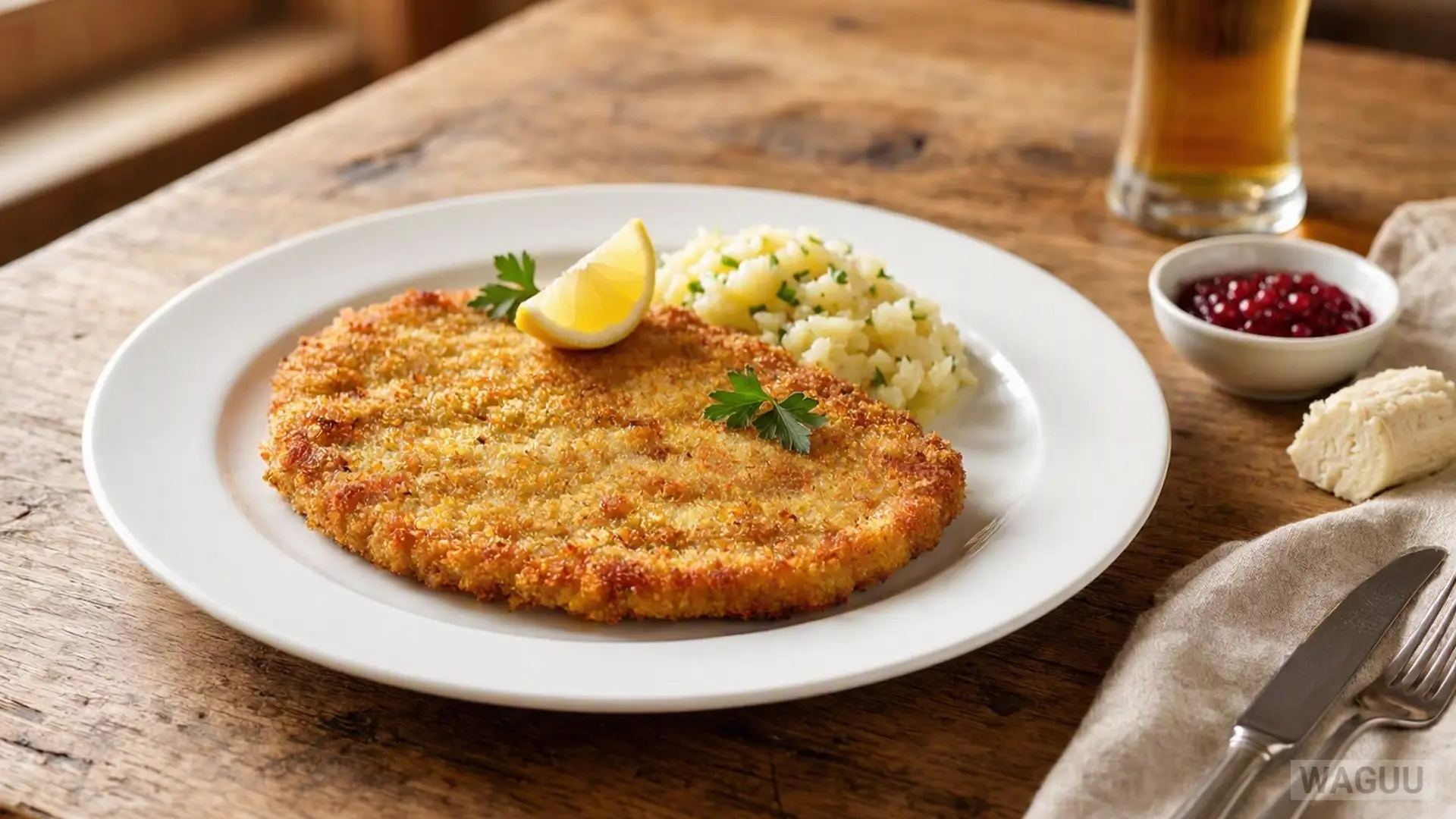
Summary: The quintessential Austrian classic, Wiener Schnitzel consists of a butterflied veal escalope that is meticulously tenderised, breaded, and shallow-fried in clarified butter. This preparation results in a golden, crisp exterior and incredibly succulent meat. Designed for six portions, the process takes approximately 45 minutes to master, delivering an authentic taste of Viennese culinary tradition.
Did you cook this recipe? Share the result with the community.
Category: Main Dishes, Austrian Cuisine
Success rate: 98% of users successfully made this recipe
Quick overview
- Dish: Wiener Schnitzel
- Category: Main Dishes, Austrian Cuisine
- Cuisine: Austrian
- Main ingredient: Veal topside, 900 g (high quality)
- Guide: 12 Most Popular Austrian Dishes: Favourite Recipes of Austrian Cuisine
- Total time: 45 minutes (15 min prep + 30 min cooking)
- Difficulty: Medium
- Portions: 6 (Portion weight: 260 g)
- Key technique: Shallow frying
- Preparation types: Breaded and fried
- Dietary info & Allergens: Contains gluten, eggs, milk
- Suitable for: Main course
- Nutritional values (per 1 portion): 540.2 kcal, Protein: 42.1 g, Fat: 28.5 g, Carbohydrates: 25.8 g
- Storage: 2 days in the fridge, 3 months in the freezer
- Pairing: Lager beer, Grüner Veltliner, Sparkling mineral water
- In short: The ultimate Viennese veal delicacy, crispy outside and tender inside.
- Last updated: 21 September 2026
WAGUU says: “The secret to a perfect Wiener Schnitzel is the ‘soufflé’ effect of the breading, achieved by using enough fat and constant motion.”
How to take it further: Add freshly grated horseradish to your potato salad or serve with a side of warm lingonberry compote.
Key facts
| Prep time: | 15 min |
| Cooking time: | 30 min |
| Temperature: | 170 °C |
| Number of portions: | 6 |
In a nutshell
Wiener Schnitzel is a testament to the beauty of simplicity. By using high-quality veal and the traditional three-stage breading process, you create a dish that is both elegant and deeply satisfying. Its golden, wavy crust and tender meat represent the pinnacle of Viennese gastronomy.
Ingredients
Base portions: 6 portions • Portion weight: 260 g
| Ingredient | Amount | Quality |
|---|---|---|
| Veal topside | 900 g | Freshly sliced |
| Plain flour | 150 g | Fine, sifted |
| Eggs | 3 pcs | Free-range |
| Breadcrumbs | 250 g | Fine, dry |
| Clarified butter | 300 g | High smoke point |
| Salt | 15 g | Fine sea salt |
Why you will love this recipe
- Authentic Technique: Follows the traditional Viennese method for breading and frying.
- Texture Contrast: Achieves the iconic light, wavy crust that defines a proper Schnitzel.
- Pure Ingredients: Focuses on high-quality veal for a clean, sophisticated flavour profile.
Why it works: The precise temperature management ensures the crust sets perfectly without absorbing excess fat, keeping the meat succulent.
Recipe overview
Prep: 15 min | Cooking: 30 min | Difficulty: Medium | Portions: 6 | Type: Main Dishes | Origin: Austrian
Detailed instructions
Overall progress: 0% complete
Phase 1: Preparation – 5 min
Appliances: None
1. Slice the veal topside into 150 g portions. Place between cling film and flatten gently with a meat mallet until 0.5 cm thick. Visual check point (VKB): The meat should be uniform in thickness.
VKB: Uniform thickness of 0.5 cm.
Phase 2: Breading – 5 min
Appliances: None
2. Season meat with salt. Dredge in flour, dip in beaten eggs, and coat with breadcrumbs. Press the breadcrumbs on lightly. VKB: No bald spots on the meat.
VKB: Even coating without loose crumbs.
Phase 3: Frying – 20 min
Appliances: Hob
3. Heat clarified butter in a pan to 170 °C. Fry Schnitzels until golden brown on both sides. VKB: The crust should be wavy and crisp.
VKB: Golden, wavy, bubbling crust.
Required equipment
| Utensil | Ideal size | Alternative | Risk |
|---|---|---|---|
| Meat mallet | Standard | Heavy pan | Tearing the meat |
| Frying pan | 28 cm | Cast iron skillet | Overcrowding |
| Thermometer | Probe | Sensory test | Burnt butter |
Shopping list
Nutritional profile
Values per 1 portion (excluding side dishes). Calculated from average nutritional values of ingredients.
| Nutrient | Per 100 g | Per 1 portion | Per 6 portions |
|---|---|---|---|
| Energy | 207.8 kcal | 540.2 kcal | 3241.2 kcal |
| Fat | 11.0 g | 28.5 g | 171.0 g |
| of which saturates | 6.2 g | 16.1 g | 96.6 g |
| Carbohydrates | 9.9 g | 25.8 g | 154.8 g |
| of which sugars | 0.3 g | 0.8 g | 4.8 g |
| Protein | 16.2 g | 42.1 g | 252.6 g |
| Salt | 0.4 g | 1.0 g | 6.0 g |
Reference intake of an average adult (8400 kJ / 2000 kcal).
WAGUU Pro Level
- Pro standard: Verified recipe with precise ratios and visual control points.
- Tip 1: Use clarified butter for a higher smoke point and cleaner flavour.
- Tip 2: Ensure the meat is cold when breading to keep the crust crisp.
- Tip 3: Do not press the breadcrumbs too hard, or the crust won’t ‘soufflé’.
- Tip 4: Serve immediately to maintain the texture of the crust.
Scientific background
The Maillard reaction is key here, responsible for the deep golden colour and aromatic complexity of the crust. The protein-rich egg wash creates a barrier that prevents the meat juices from softening the breadcrumbs, while the high heat of the clarified butter causes the steam to lift the crust, creating the signature ‘soufflé’ effect.
Fine Dining – Professional techniques
- Plate composition: Serve on a large, warm plate with the Schnitzel taking centre stage.
- Textural contrasts: Pair with a refreshing, slightly acidic cucumber-dill salad.
- Temperature contrast: Serve the hot Schnitzel alongside cool, crisp mixed greens.
- Aromatic garnishes: A classic lemon wedge and a sprig of fresh flat-leaf parsley.
Sensory radar
- Appearance: Golden, wavy, and invitingly crisp.
- Aroma: Nutty butter and delicate, savoury veal.
- Taste: Balanced, savoury, with a hint of lemon acidity.
- Texture: A delicate, crunchy crust protecting tender, juicy veal.
Pairing
- BEER: A crisp, cold Austrian lager.
- WINE: A dry, acidic Grüner Veltliner.
- NON-ALCOHOLIC: Sparkling mineral water with a slice of lemon.
Various preparation variants
- Pork Schnitzel: Use pork loin instead of veal for a more robust flavour.
- Chicken Schnitzel: Use chicken breast for a lighter, everyday variation.
Allergens and dietary information
Contains: Gluten, eggs, milk • Gluten: Present in the flour and breadcrumbs • Not suitable for: Vegetarians, vegans, or those with gluten intolerance.
Suitable for
Main course for family dinners or celebratory gatherings.
Substitution catalog
- Clarified butter: Ghee or a high-smoke point vegetable oil.
FAQ
Can I use breadcrumbs from store-bought bread?
Yes, but ensure they are very fine to avoid a heavy, coarse crust.
Why did my crust fall off?
Usually because the meat was too damp before flouring or the heat was too low.
Can I bake it instead?
Baking will result in a drier crust; traditional frying is recommended.
Is it necessary to use veal?
Authentic Wiener Schnitzel must be veal; other meats are called Schnitzel ‘Viennese style’.
WAGUU Petr advises: Cooking for 12 or more people?
12–16 people: Prepare the breaded Schnitzels in advance and keep them cold. Fry in batches just before serving. • 20+ people: Use multiple pans or a large electric griddle to maintain consistent heat.
Sides and Serving
- Austrian Potato Salad – Classic with vinegar and beef stock (not included in the recipe)
- Parsley Potatoes – Boiled with butter and fresh parsley (not included in the recipe)
Serving: Always serve with a fresh lemon wedge to cut through the richness of the butter.
Storage and reheating
Fridge: 2 days • Freezer: 3 months • Reheating: Reheat in a pan with a little butter or in an oven at 180 °C to restore crispness.
Author: WAGUU Petr & Team • Published: 21 Sep 2026 • Updated: 30 Oct 2026
More Recipes from This Article
Guide: 12 Most Popular Austrian Dishes: Favourite Recipes of Austrian Cuisine
Schweinsbraten mit Knödeln
Other recipes you might be interested in
Why WAGUU?
Recipes on WAGUU undergo checks for the accuracy of ingredients, procedures, and nutritional values.
Process photo gallery
Community photos: Cook, take a photo, and share the result.
You can upload photos in the comments below or send them via email.
Did you record a video guide for our recipe? Insert a link to YouTube, YouTube Shorts, TikTok, Instagram Reels, Facebook Reels, Pinterest, Vimeo, or X (Twitter) in the comment – we’d be happy to publish it and help promote you and your content.
Common mistakes
- Low heat: Results in soggy, oil-soaked breading rather than crisp crust.
- Overcrowding the pan: Lowers the temperature of the butter, preventing the crust from setting.
- Uneven meat thickness: Causes uneven cooking, leading to dry parts and raw spots.
- Skipping the lemon: Deprives the dish of the acidity needed to balance the richness of the fried crust.