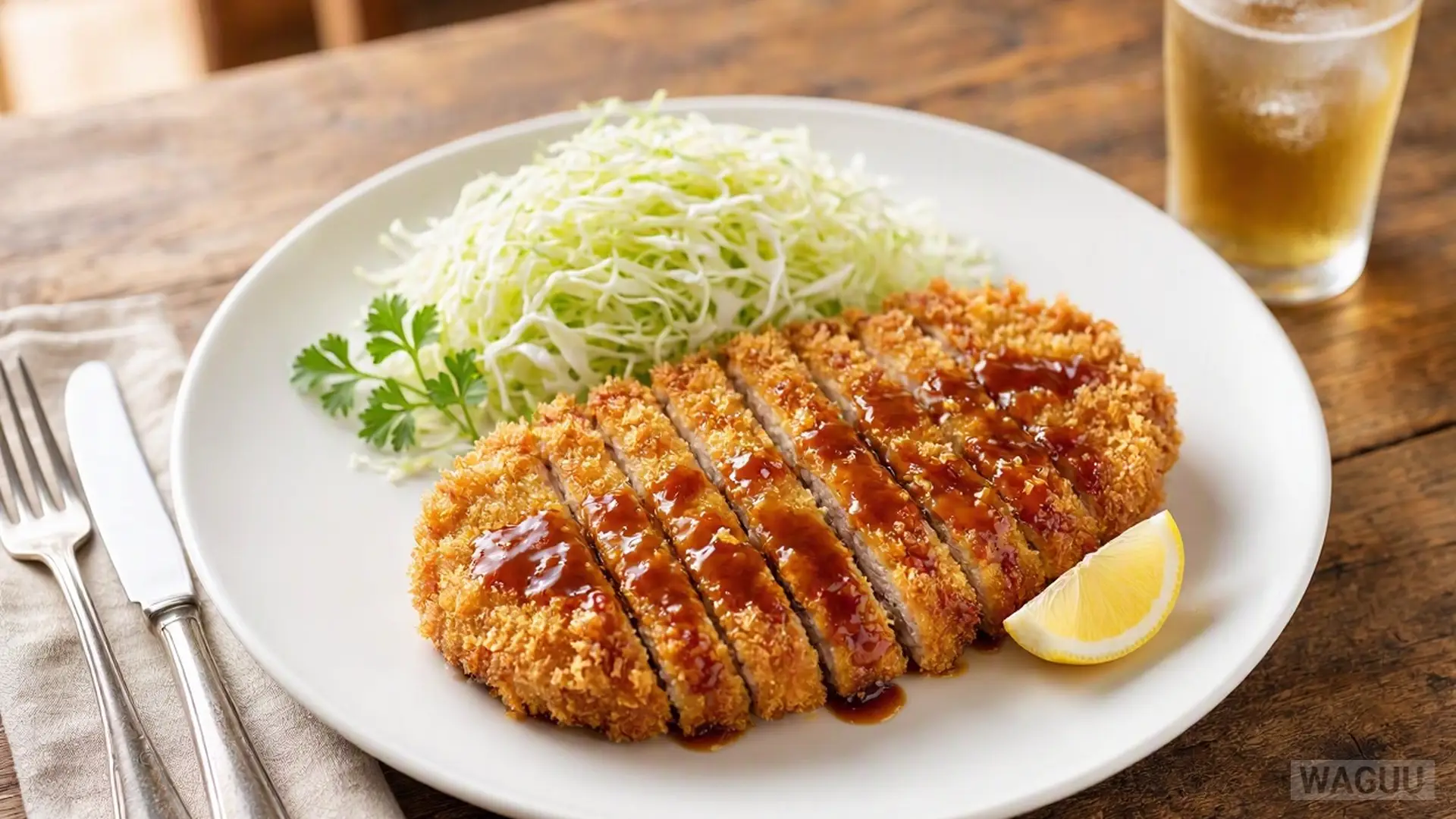
Summary: Authentic Japanese Tonkatsu featuring thick center-cut boneless pork loin chops, tenderized to perfection, breaded in light Japanese panko breadcrumbs, and double-fried to golden, airy crispiness. Served with shredded green cabbage, sweet and savory tonkatsu sauce, steamed Japanese short-grain rice, and warm miso soup. Total prep time is 25 minutes, cooking time is 20 minutes, yielding 6 hearty servings.
Did you make this recipe? Share the result with the community.
Category: Pork Dishes, Japanese Cuisine
Success rate: 98% of users successfully made this recipe
Quick overview
- Dish: Tonkatsu
- Category: Pork Dishes, Japanese Cuisine
- Cuisine: Japanese (Yoshoku)
- Main ingredient: Center-cut boneless pork loin chops, 6 pieces (approx. 2.25 lbs / 36 oz total weight)
- Guide: 12 Most Popular Japanese Dishes: Favorite Recipes of Japanese Cuisine
- Total time: 45 minutes (25 min prep + 20 min cooking)
- Difficulty: Intermediate
- Servings: 6 servings (Serving weight: approx. 8.8 oz / 250 g per serving including cabbage and sauce)
- Key technique: Double deep-frying (low temperature seal followed by high temperature crisping)
- Preparation types: Deep-frying, Shredding, Sauce mixing
- Dietary info & Allergens: Contains wheat (gluten), eggs, soy, sesame, mustard, and fish/anchovy (in Worcestershire sauce)
- Suitable for: Meat lovers, dinner parties, weekend family meals, Asian comfort food cravings
- Nutritional values (per 1 serving): 520 kcal, Protein: 38 g, Fat: 26 g, Carbs: 34 g
- Storage: 3 days in the fridge, up to 2 months in the freezer (unfried coated cutlets)
- Pairing: Japanese Asahi or Sapporo lager, Riesling, or iced green tea
- In a nutshell: Thick pork cutlets tenderized, dredged in flour, egg, and coarse panko breadcrumbs, then double-fried until shatteringly crispy on the outside and moist inside.
- Last updated: October 24, 2024
WAGUU says: “The secret to an irresistible Japanese Tonkatsu lies in two critical steps: scoring the white connective connective membrane along the fat layer to prevent curling, and utilizing double-stage deep frying. The first fry cooks the pork through softly at 340 °F, while the second quick flash fry at 375 °F crisps the flaky panko breadcrumbs into a gold standard crust without absorbing excess oil.”
Key facts
| Prep time: | 25 minutes |
| Cooking time: | 20 minutes |
| Temperature: | First fry: 340 °F (170 °C) | Second fry: 375 °F (190 °C) | Pork core: 145 °F (63 °C) |
| Number of servings: | 6 servings |
In a nutshell
Experience ultimate Japanese soul food at home with this master-class Tonkatsu recipe. Thick center-cut pork loin chops are lightly pounded, seasoned, wrapped in airy panko crumbs, and fried to golden perfection. Paired with razor-thin crunchy cabbage and an easy homemade tangy tonkatsu sauce, every bite delivers a crunch that sounds as magnificent as it tastes.
Ingredients
Base servings: 6 servings • Serving weight: approx. 8.8 oz (250 g) cutlet with sauce and cabbage garnish
| Ingredient | Quantity | Quality |
|---|---|---|
| Center-cut pork loin chops (boneless, 1 inch thick) | 36 oz | Fresh pork loin with clear white fat trim, 6 chops (~6 oz each) |
| Fine sea salt | 1.5 tsp | Fine grain sea salt for even seasoning |
| Freshly cracked black pepper | 0.75 tsp | Finely ground freshly cracked black pepper |
| All-purpose flour | 0.75 cup | Unbleached all-purpose flour for dredging |
| Large eggs | 3 large | Whisked with 1 tbsp vegetable oil and 1 tbsp water |
| Japanese panko breadcrumbs | 3 cups | Authentic coarse Japanese white panko breadcrumbs |
| Neutral frying oil (canola or peanut oil) | 6 cups | High smoke point neutral oil for deep-frying |
| Green cabbage | 12 oz | Fresh crisp green cabbage, sliced razor-thin |
| Ketchup | 0.5 cup | Classic tomato ketchup for homemade sauce |
| Worcestershire sauce | 0.33 cup | Standard savory Worcestershire sauce |
| Oyster sauce | 2 tbsp | Rich umami oyster sauce |
| Granulated sugar | 1.5 tbsp | White granulated sugar |
| Toasted white sesame seeds | 2 tbsp | Ground coarsely before serving |
| Lemon wedges | 6 wedges | Fresh organic lemons for garnish |
Why you’ll love this recipe
- Unmatched Crispiness: Real Japanese white panko crumbs create large, needle-like flakes that stay amazingly crunchy long after frying.
- Double-Fry Technique: Cooking the meat twice locks in succulent pork juices while drying out the crust for non-greasy perfection.
- Homemade Tonkatsu Sauce: Whisked in under 2 minutes, balancing sweet tomato, tangy Worcestershire, and rich savory oyster sauce.
Success guaranteed: By slitting the thin fascia muscle line between the meat and outer fat edge, your cutlets will remain 100% flat in the oil without curling up.
Recipe overview
Prep: 25 min | Cooking: 20 min | Difficulty: Intermediate | Servings: 6 | Type: Main Pork Dish | Origin: Japan
Detailed instructions
Overall progress: 0% completed
Phase 1: Pork Cutlet Trimming and Tenderizing – 10 min
Appliances: Cutting board, meat mallet, chef’s knife
1. Place the boneless center-cut pork loin chops (36 oz total weight across 6 chops) flat on a clean cutting board. Inspect the edge where the white fat layer connects to the lean meat. Using the tip of a chef’s knife, make small perpendicular slits about 1 inch apart along the white connective tissue line on both sides. This severs the tough membrane and prevents the chop from curling into a cup shape during frying. Next, cover the chops with plastic wrap and gently pound them using the flat side of a meat mallet until they reach a uniform thickness of roughly 3/4 inch. Evenly season all sides with 1.5 tsp of fine sea salt and 0.75 tsp of freshly cracked black pepper. Allow the seasoned pork to rest at room temperature for 10 minutes to absorb the salt.
CP: Pork chops are flat, uniform in thickness (3/4 inch), with severed connective membrane and light surface moisture from salt absorption.
Before moving to the next step:
Ensure you do not skip slitting the fat membrane. If left intact, heat will cause the connective tissue to shrink rapidly, forcing the meat to warp and causing the panko crust to fall off in the fryer.
Phase 2: Shredding Cabbage & Homemade Tonkatsu Sauce – 10 min
Appliances: Mandoline slicer or chef’s knife, mixing bowl, whisk, suribachi (Japanese mortar) or small bowl
2. Core the green cabbage and slice 12 oz of cabbage into razor-thin, angel-hair strands using a sharp knife or mandoline slicer. Transfer the shredded cabbage into a large bowl of ice water and soak for 5 minutes to intensify crispness. Drain thoroughly and spin dry using a salad spinner, then refrigerate until serving time. In a separate small bowl, whisk together 0.5 cup tomato ketchup, 0.33 cup Worcestershire sauce, 2 tbsp oyster sauce, and 1.5 tbsp white granulated sugar until smooth and the sugar is completely dissolved. Toast 2 tbsp of white sesame seeds in a dry skillet over medium heat for 2 minutes until fragrant, then grind them coarsely using a Japanese mortar (suribachi) or spice grinder, reserving them for garnishing the sauce at serving time.
CP: Cabbage is ice-cold and fully dry; tonkatsu sauce is glossy, well-emulsified, with a balanced sweet and tangy flavor profile.
Before moving to the next step:
Drying the cabbage after ice-soaking is critical. Excess water on the plate will melt the crispy panko coating of your tonkatsu upon serving.
Phase 3: Breading Station Setup & Cutlet Coating – 10 min
Appliances: Three shallow rimmed dishes or baking trays, whisk
3. Set up three wide shallow trays in a linear breading station. Dish 1: 0.75 cup of all-purpose flour. Dish 2: 3 large eggs thoroughly whisked with 1 tbsp vegetable oil and 1 tbsp water (adding oil to egg wash helps the breadcrumb coat adhere seamlessly). Dish 3: 3 cups of fresh Japanese white panko breadcrumbs. Take one pork chop, dredge it completely in flour, and shake off all excess flour leaving a thin dusty veil. Dip it into the egg wash, ensuring every crevice is wet, then let excess egg drip off for 3 seconds. Lay the chop onto the bed of panko breadcrumbs and pile fresh panko liberally over the top. Press down firmly with the palms of your hands so the flakes adhere thoroughly without crushing them into dust. Repeat with all 6 chops and lay them on a parchment-lined baking sheet for 5 minutes so the breading sets before frying.
CP: Pork cutlets are evenly blanketed in dense, dry panko flakes without bald spots or wet clumps.
Before moving to the next step:
Do not rush the flour stage. Too much loose flour acts as a barrier and causes the entire crispy skin to slide off the meat when sliced.
Phase 4: First Deep-Frying Stage (Low Temperature Seal) – 8 min
Appliances: Heavy deep Dutch oven or deep fryer, deep-fry thermometer, wire cooling rack set over a rimmed baking sheet, spider skimmer
4. Pour 6 cups of neutral frying oil into a heavy deep Dutch oven until it reaches a depth of at least 2 inches. Heat over medium-high flame until the oil temperature reaches exactly 340 °F (170 °C) on a clip-on deep-fry thermometer. Carefully lower 2 breaded cutlets into the hot oil, sliding them gently away from you to prevent splattering. Fry for 3 to 4 minutes total, gently turning the cutlets over halfway through using tongs or a spider skimmer. The crust should reach a pale blonde color, and the oil bubbles will slow down slightly. Transfer the partially cooked cutlets to the wire cooling rack and let them rest for 4 minutes. Fry the remaining cutlets in two batches, making sure to skim off any loose panko floating in the oil between batches to prevent burning.
CP: Light golden-blonde cutlets resting on a rack, internal meat thermal steam distributing evenly toward core.
Before moving to the next step:
Never overcrowd the pot with more than 2 cutlets at once. Overcrowding drops oil temperature rapidly, turning the breading soggy and oil-soaked.
Phase 5: Second Deep-Frying Stage (High Temperature Crisping) – 4 min
Appliances: Dutch oven, instant-read digital thermometer, wire cooling rack, spider skimmer
5. Increase heat under the pot and raise the oil temperature to 375 °F (190 °C). Carefully reintroduce the rested cutlets, 2 at a time, into the hot oil for their second flash-fry. Fry for 1 to 1.5 minutes until the panko turns a rich, deep reddish-golden color and sizzles vigorously. Remove from oil and place vertically on the wire cooling rack (resting them on their sides or upright allows air circulation around both sides so moisture doesn’t trap underneath). Verify the internal temperature of the thickest part of the pork chop with an instant-read thermometer—it should register 145 °F (63 °C) for tender, juicy pork. Let rest for 3 minutes on the rack.
CP: Deep amber golden crust, crisp texture, interior pork core reached safe and tender 145 °F.
Before moving to the next step:
Do not place freshly fried tonkatsu on paper towels! Paper towels trap escaping steam against the bottom crust, turning crispy panko soggy in seconds.
Phase 6: Slicing, Plating, and Presentation – 3 min
Appliances: Heavy chef’s knife, wooden cutting board, individual serving plates
6. Move each rested cutlet onto a dry wooden cutting board. Using a sharp chef’s knife, slice each tonkatsu into 3/4-inch thick strips in single downward decisive strokes (do not saw back and forth, as sawing tears the crunchy panko shell). Arrange a mound of the ice-chilled shredded green cabbage on the side of each white plate. Place the sliced cutlet next to the cabbage. Drizzle homemade tonkatsu sauce over the pork or serve it in small individual ramekins sprinkled with toasted ground white sesame seeds. Add a fresh lemon wedge to each plate alongside steamed short-grain Japanese rice and hot miso soup.
CP: Visually stunning plated Japanese meal with neat, crunchy sliced pork cutlets, fluffy rice, and airy cabbage.
Required equipment
| Utensil | Ideal size | Alternative | Risk |
|---|---|---|---|
| Dutch oven / Deep pot | 5–6 quart capacity | Countertop electric deep fryer | Shallow pan risks oil boil-over and uneven frying temperature. |
| Deep-fry thermometer | Clip-on analog or digital probe | Infrared thermometer gun | Frying without thermometer leads to greasy or burnt breadcrumbs. |
| Wire cooling rack | 12×17 inch baking sheet rack | Elevated steamer rack | Placing fried meat on paper towels softens the bottom panko crust. |
Shopping list
Nutrition profile
Values per 1 serving (approx. 8.8 oz / 250 g including pork, coating, cabbage, and sauce, excluding side rice). Calculated from average ingredient nutrition values.
| Nutrient | Per 100 g | Per 1 serving | Per 6 servings |
|---|---|---|---|
| Energy | 208 kcal | 520 kcal | 3120 kcal |
| Fat | 10.4 g | 26.0 g | 156.0 g |
| of which saturates | 2.8 g | 7.0 g | 42.0 g |
| Carbohydrates | 13.6 g | 34.0 g | 204.0 g |
| of which sugars | 4.8 g | 12.0 g | 72.0 g |
| Protein | 15.2 g | 38.0 g | 228.0 g |
| Salt | 1.0 g | 2.5 g | 15.0 g |
Reference intake of an average adult (8400 kJ / 2000 kcal).
WAGUU Pro level
- Pro standard: Verified recipe with precise ratios and visual checkpoints.
- Tip 1: Oil Addition in Egg Wash: Adding 1 tbsp of vegetable oil into the whisked eggs emulsifies the coating, allowing panko crumbs to bond seamlessly to the flour barrier without peeling during slicing.
- Tip 2: Coarse Panko Hydration: Spritzing coarse Japanese panko breadcrumbs lightly with a tiny mist of water 2 minutes before breading makes the crumbs expand and frizzle into needle-sharp crispy spikes upon hitting oil.
- Tip 3: Rest Between Frying Stages: The 4-minute rest off heat allows residual thermal energy to heat the interior core gently without drying out the pork fibers.
- Tip 4: Vertical Wire Rack Cooling: Resting cutlets edge-down on a wire rack ensures maximum air flow on both sides, stopping steam condensation completely.
Scientific background
The exceptional texture of Japanese Tonkatsu is rooted in starch structure and water activity control. Japanese panko breadcrumbs are baked using electric current without a traditional crust, yielding airy, open-pored bread flakes that absorb far less oil than traditional Western breadcrumbs. During the initial fry at 340 °F (170 °C), starch gelatinizes and egg proteins coagulate into a firm seal while muscle proteins in the pork warm slowly. Resting the meat lets steam escape without rupturing the crust. The secondary fry at 375 °F (190 °C) triggers rapid Maillard browning, caramelizing sugars and creating a rigid, low-moisture outer shell that delivers an acoustic crunch measuring up to 60 decibels.
Fine Dining – Professional techniques
- Plate composition: Arrange a neat, high tower of ice-crisped shredded cabbage at 10 o’clock on a dark stoneware plate. Lay sliced tonkatsu fan-wise at 4 o’clock to highlight the pale succulent pork core against the dark golden crust.
- Texture contrasts: Juxtapose the glass-like crispiness of golden panko with the moist, tender pork interior and the fresh, cold crunch of shredded green cabbage.
- Temperature contrast: Serve piping hot pork cutlets right beside ice-cold shredded cabbage for an invigorating mouthfeel contrast.
- Aromatic garnishes: Provide a freshly halved lemon along with a mini mortar (suribachi) filled with freshly toasted sesame seeds so guests can grind their own garnishes tableside.
Sensory radar
- Appearance: Deep golden amber panko coating with prominent needle-like spikes, showcasing a moist, pale pink pork interior.
- Aroma: Nutty toasted breadcrumbs, savory fried pork, tangy fruit Worcestershire notes, and warm toasted sesame.
- Taste: Umami-rich savory pork balanced by sweet and tangy tonkatsu sauce and refreshing, sweet raw cabbage.
- Texture: Shatteringly crisp external crust transitioning into a tender, juicy pork core.
Pairing
- BEER: Crisp Japanese lagers like Asahi Super Dry or Sapporo Premium. The high carbonation and dry finish cleave through fried richness cleanly.
- WINE: Off-dry German Riesling or sparkling Cava, whose bright acidity complements the savory cutlet and sweet-tangy sauce.
- NON-ALCOHOLIC: Ice-cold unsweetened Japanese green tea (Sencha) or sparkling lemon water.
Various preparation methods
- Hirekatsu (Pork Tenderloin Version): Prepared using pork tenderloin (hire) instead of loin (rosu). Leaner, softer, and milder in fat content.
- Air-Fryer Tonkatsu: Toast panko crumbs in a dry skillet with 1 tbsp oil until golden before breading. Air fry pre-breaded cutlets at 390 °F for 12–14 minutes, turning halfway through.
Allergens and dietary information
Contains: Wheat (gluten), eggs, soy, sesame, and fish/anchovy (in Worcestershire sauce) • Gluten: Contains wheat flour and panko breadcrumbs. For gluten-free tonkatsu, substitute white rice flour and gluten-free panko made from rice puff • Not suitable for: Low-carb or strict keto diets due to flour and panko breading.
Suitable for
Perfect for family dinners, Japanese culinary theme nights, meal-prep bento lunches, and feeding hungry guests looking for satisfying comfort food.
Substitution guide
- Pork Loin: Can be substituted with boneless chicken breasts/thighs (Chicken Katsu) or beef sirloin steaks (Gyukatsu).
- Oyster Sauce: Replace with hoisin sauce or soy sauce mixed with a pinch of brown sugar if unavailable.
- Worcestershire Sauce: Japanese Bull-Dog sauce can directly replace both ketchup and Worcestershire sauce mix.
FAQ
Why does my breading separate from the pork when I slice it?
Breading separates when the pork surface is too wet before flouring, or when excess flour isn’t dusted off properly. Ensure the meat is patted completely dry, dusted lightly with flour, and rested on a tray for 5 minutes after breading so egg and flour bind firmly.
Can I use standard Western breadcrumbs instead of Japanese panko?
Standard fine breadcrumbs will produce a dense, hard crust rather than the signature light, airy spike texture of true Tonkatsu. Japanese panko breadcrumbs are strongly recommended for authentic results.
Why is double frying necessary for Tonkatsu?
Double frying ensures the pork cooks gently through at a moderate temperature without burning the crust, while the second quick fry at high heat drives off trapped moisture from the exterior, making the panko crisp and grease-free.
Why is raw shredded cabbage always served with Tonkatsu?
Cabbage contains dietary fiber and enzymes (including vitamin U) that help digest fried foods while providing an ice-cold, refreshing crunchy element that cleanses the palate between rich bites of pork.
WAGUU Petr advises: Cooking for 12 or more people?
12–16 people: When scaling up for large parties, double-fry the first stage up to 2 hours in advance and lay all cutlets on wire cooling racks at room temperature. Perform the second high-heat 375 °F flash-fry right before serving—this delivers sizzling hot, piping fresh cutlets to every guest simultaneously. 20+ people: Maintain two separate oil pots or a commercial dual-tank electric fryer to keep oil temperatures stable and prevent drop-offs in heat.
Sides and serving
- Steamed Short-Grain Japanese Rice – Fluffy, sticky white rice served in a side bowl (not included in the recipe).
- Traditional Miso Soup – Warm bowl of dashi broth with miso paste, tofu cubes, and green onions (not included in the recipe).
Serving: Place sliced cutlet on a plate beside shredded cabbage, a lemon wedge, and a small dish of tonkatsu sauce dusted with crushed sesame seeds. Serve immediately while red hot.
Storage and reheating
Fridge: Up to 3 days stored in an airtight container lined with parchment paper. Freezer: Unfried breaded chops can be frozen for up to 2 months on a baking sheet, then packed into freezer bags. Fry directly from frozen at 330 °F for 6 minutes, then flash fry at 375 °F for 2 minutes. Reheating: Reheat cooked cutlets in a preheated oven or toaster oven at 375 °F (190 °C) for 8–10 minutes on a wire rack. Avoid microwaving, as it destroys crispiness.
Author: WAGUU Petr & Team • Published: 30 Oct 2026
More Recipes in This Article
Other recipes you might enjoy
Why WAGUU?
Recipes on WAGUU undergo checks for ingredient accuracy, procedures, and nutritional values.
Process photo gallery
Community photos: Cook, take a picture, and share your results.
You can upload photos in the comments below or send them via email.
Did you record a video of your process for our recipe? Paste a link to YouTube, YouTube Shorts, TikTok, Instagram Reels, Facebook Reels, Pinterest, Vimeo, or X (Twitter) in the comments – we’d love to share it and help give you and your content more visibility.
Common mistakes
- Failing to sever the white fat membrane line – Causes the pork chop to curl up into a bowl shape in oil, cooking unevenly and losing its crust.
- Placing hot fried cutlets directly on paper towels – Traps hot steam underneath the fried pork, rendering the lower panko layer soggy within seconds. Always cool on an elevated wire rack.
- Frying at incorrect temperatures without a thermometer – Cold oil results in greasy, heavy breadcrumb absorption; overly hot oil burns panko before the thick pork center reaches safe 145 °F temperature.
- Cutting with a dull knife in sawing motions – Crushes the delicate panko shell off the pork cutlet. Use a sharp chef’s knife in single downward slicing strokes.