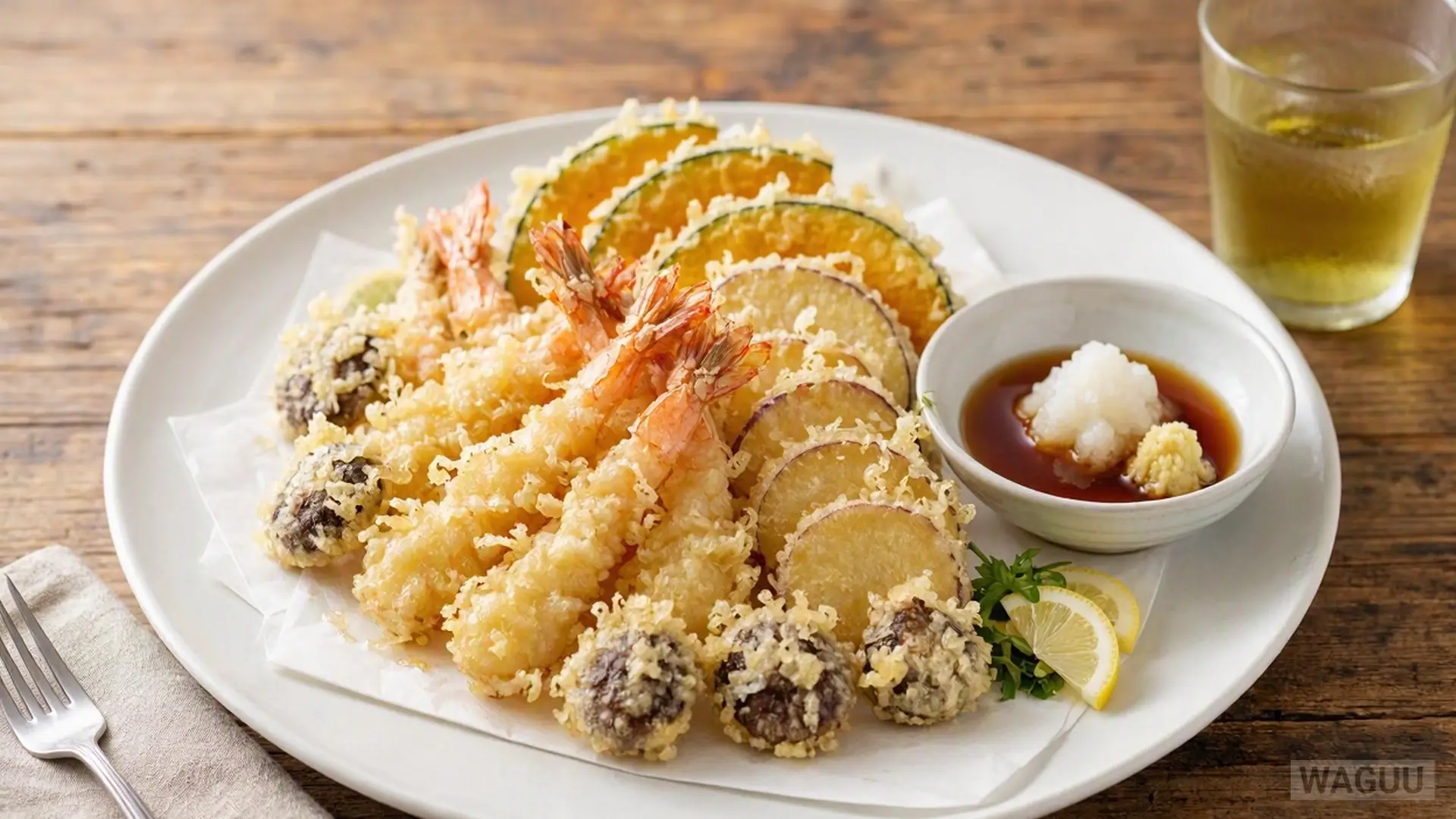
Summary: Authentic Japanese Tempura featuring succulent tiger shrimp and crisp autumn vegetables encased in an ultra-light, lace-like batter. Deep-fried at a precise 350 °F (175 °C) to achieve a delicate, non-greasy golden crust while retaining maximum internal juiciness. Prepared in under 45 minutes and served with traditional warm dashi-mirin dipping sauce for 6 portions.
Did you make this recipe? Share the result with the community.
Category: Fish and Seafood, Japanese Cuisine
Success rate: 96% of users successfully made this recipe
Quick overview
- Dish: Tempura
- Category: Fish and Seafood, Japanese Cuisine
- Cuisine: Japanese
- Main ingredient: Fresh Black Tiger Shrimp (12 oz / 340 g, peeled and deveined with tails attached) and mixed vegetables
- Guide: 12 Most Popular Japanese Dishes: Favorite Recipes of Japanese Cuisine
- Total time: 45 minutes (25 min prep + 20 min cooking)
- Difficulty: Intermediate
- Servings: 6 servings (Serving weight: 10 oz / 280 g)
- Key technique: Flash deep-frying in ice-cold batter
- Preparation types: Deep-frying, knife trimming, flash battering
- Dietary info & Allergens: Contains Crustaceans (shrimp), Wheat (gluten), Eggs, Soy, Fish (dashi)
- Suitable for: Dinner parties, authentic Japanese feasts, seafood lovers
- Nutritional values (per 1 serving): Energy: 410 kcal, Protein: 17 g, Fat: 21 g, Carbs: 38 g
- Storage: 1 day in the fridge (best consumed fresh), not recommended for freezing
- Pairing: Asahi Super Dry lager, Dry Riesling, Ice-cold Sencha Green Tea
- In a nutshell: Feather-light crispy batter encasing sweet shrimp and tender vegetables, flash-fried to non-greasy golden perfection.
- Last updated: October 24, 2024
WAGUU says: “The secret to ethereal tempura lies in thermal shock: keep your batter ice-cold and your oil precisely at 350 °F (175 °C). Never whisk the flour smooth—lumps are your friends because they prevent gluten from turning the coating heavy!”
Key facts
| Prep time: | 25 minutes |
| Cooking time: | 20 minutes |
| Temperature: | 350 °F (175 °C) oil temperature |
| Number of servings: | 6 servings |
In a nutshell
Experience the ultimate Japanese comfort standard with crisp, gossamer-thin tempura. Succulent tiger shrimp and thinly sliced root vegetables are dipped in an icy, minimally mixed batter before taking a brief dip in hot neutral oil. The instant steam effect cooks the ingredients inside their delicate shell, creating an unforgettable balance of crunch, tender texture, and clean umami flavor.
Ingredients
Base servings: 6 servings • Serving weight: 10 oz (280 g)
| Ingredient | Quantity | Quality |
|---|---|---|
| Large Black Tiger Shrimp | 12 oz | 16–20 count, fresh, peeled, deveined, tails intact |
| Sweet Potato (Satsumaimo) | 8 oz | Firm Japanese or orange sweet potato, sliced into ¼-inch rounds |
| Kabocha Squash (or Zucchini) | 6 oz | Fresh, sliced into ¼-inch wedges |
| Shiitake Mushrooms | 6 pcs | Fresh caps, stems removed, tops decorative decorative-scored |
| Cake Flour (for batter) | 1 cup | Sifted low-protein flour (approx. 4 oz / 115 g) |
| Cornstarch | 2 tbsp | Pure cornstarch for extra crispness |
| Egg Yolk | 1 large | Chilled, organic or pasture-raised |
| Ice-Cold Water | 1¼ cups | Chilled filtered water with ice cubes added |
| Extra Flour (for dusting) | ¼ cup | For dusting seafood and vegetables prior to dipping |
| Neutral High-Heat Oil | 32 fl oz | Canola, peanut, or high-oleic sunflower oil for frying |
| Toasted Sesame Oil (optional) | 2 tbsp | Added to frying oil for signature fragrant aroma |
| Dashi Stock (for sauce) | 1 cup | Fresh or instant kombu and bonito stock |
| Mirin (Japanese sweet wine) | ¼ cup | Authentic sweet rice wine |
| Japanese Soy Sauce | ¼ cup | Naturally brewed soy sauce (Shoyu) |
| Granulated Sugar | ½ tsp | Pure cane sugar to balance dipping sauce acidity |
| Fine Sea Salt | 1 tsp | Divided (for shrimp seasoning and finishing) |
| Daikon Radish (for garnish) | 3 oz | Peeled and finely grated, squeezed gently of excess juice |
| Fresh Ginger Root | ½ oz | Peeled and finely grated |
Why you’ll love this recipe
- Feather-light texture: Utilizing low-gluten cake flour paired with icy cold water prevents toughness, yielding a brittle, glass-like crunch that melts in your mouth.
- Straight and succulent shrimp trick: Learn professional Japanese knife scoring techniques to keep shrimp perfectly straight and elongated during frying instead of curling up.
- Balanced dipping experience: Accompanied by homemade Tentsuyu dipping sauce with grated daikon radish, which cuts through rich fried notes while boosting umami.
Success guaranteed: Following our core rules—maintaining exact oil temperature, using cold ingredients, and minimal batter mixing—ensures professional izakaya-quality tempura on your first try without oily sogginess.
Recipe overview
Prep: 25 min | Cooking: 20 min | Difficulty: Intermediate | Servings: 6 | Type: Main Dish / Appetizer | Origin: Japan
Detailed instructions
Overall progress: 0% completed
Phase 1: Seafood Preparation and Straightening – 8 min
Appliances: Chef’s knife, cutting board, paper towels
1. Take 12 oz (340 g) of peeled tiger shrimp with tails attached. Snip off the pointed tip of the tail fan with kitchen shears and scrape out the trapped water inside the tail pocket using your knife blade to avoid oil splatters during frying. Flip the shrimp onto its back side. Make 4 to 5 small horizontal diagonal incisions across the underside belly (about ¼ of the way through the flesh). Press the shrimp flat onto the cutting board belly-side down and gently squeeze along its back with your fingers until you hear small popping sounds (muscle fibers breaking). Season lightly with ¼ tsp fine sea salt, line up on a paper towel, and set aside in the refrigerator to stay thoroughly cold.
CP: Shrimp stay completely straight when held horizontally by the tail and feel thoroughly chilled to the touch.
Before moving to the next step:
Make sure you do not cut too deep into the shrimp belly or the shrimp will break in half. Ensure you squeeze out the dark fluid inside the tail pocket to prevent dangerous hot oil pops.
Phase 2: Vegetable Slicing and Dry Dredge Setup – 7 min
Appliances: Sharp knife, vegetable peeler, baking sheet
2. Wash and dry all vegetables thoroughly. Slice 8 oz (225 g) of sweet potato into ¼-inch thick oval rounds (soak in cold water for 3 minutes to remove excess surface starch, then dry thoroughly with towels). Cut 6 oz (170 g) of kabocha squash into ¼-inch thin crescent wedges. Remove the stems from 6 fresh shiitake mushrooms and carve a neat cross or star notch on top of each cap. Arrange all cut vegetables and prepared shrimp on a large rimmed tray lined with paper towels. Lightly dust all surfaces with ¼ cup of extra cake flour using a small mesh sifter. Dusting ensures the wet tempura batter adheres evenly to the smooth surfaces.
CP: All vegetable slices are uniform in thickness (¼-inch) and completely dry with a ultra-thin veil of flour dusting.
Phase 3: Tentsuyu Dipping Sauce Preparation – 5 min
Appliances: Small saucepan, stovetop burner, fine grater
3. In a small saucepan, combine 1 cup of dashi stock, ¼ cup of mirin, ¼ cup of Japanese soy sauce, and ½ tsp of granulated sugar. Place over medium heat and bring to a gentle simmer for 2 minutes to cook off alcohol sharp notes and dissolve sugar completely. Remove from heat immediately and keep warm. Fine-grate 3 oz (85 g) of daikon radish and ½ oz (15 g) of fresh ginger root. Gently squeeze excess moisture from the grated daikon so it holds a neat soft ball shape. Divide warm sauce into 6 individual small dipping bowls and serve grated daikon and ginger on the side.
CP: Tentsuyu sauce is fragrant, clear, warm, with a balanced sweet-savory umami profile.
Phase 4: Heating Fryer Oil and Mixing Cold Batter – 5 min
Appliances: Heavy Dutch oven or deep fryer, deep-fry thermometer, mixing bowl, chopsticks
4. Pour 32 fl oz (950 ml) of high-heat neutral oil (mixed with 2 tbsp toasted sesame oil) into a deep Dutch oven or heavy cast-iron pot. Heat over medium-high heat until the deep-fry thermometer registers precisely 350 °F (175 °C). Meanwhile, prepare the ice batter right before frying: In a chilled bowl, beat 1 large cold egg yolk into 1¼ cups of ice-cold water (discard ice cubes before measuring). Add 1 cup of sifted cake flour, 2 tbsp cornstarch, and ½ tsp fine sea salt. Using long cooking chopsticks, stroke vertically 10 to 12 times in a figure-eight pattern. Leave plenty of dry flour lumps; do NOT whisk or overmix!
CP: Batter is cold, fluid, lumpy with visible flour specks, and oil holds steady at 350 °F (175 °C).
Before moving to the next step:
Do not mix batter in advance or whisk until smooth! Overmixing develops gluten, which results in a heavy, doughy, oily crust instead of a light, crispy tempura lace.
Phase 5: Batch Frying Seafood and Vegetables – 15 min
Appliances: Deep pot with oil, long wooden chopsticks, wire skimmer (spider), wire cooling rack
5. Fry in small batches to maintain oil temperature at 340–350 °F (170–175 °C). Start with vegetables: Dip sweet potato rounds and squash wedges into batter, let excess drip off, and gently drop into hot oil. Fry vegetables for 2 to 3 minutes until tender inside and crisp outside. Next, dip shiitake caps (batter underside only) and fry for 1½ minutes. Finally, dip flour-dusted shrimp holding by tails into cold batter, lay into oil, and flick extra droplets of batter over them using your fingers to build a lacey coating (hana-age technique). Fry shrimp for 2 to 2½ minutes until light golden and opaque. Skim floating batter bits (tenkasu) between batches.
CP: Tempura pieces sound crisp when tapped with chopsticks, show minimal golden coloring, and feel non-greasy.
Phase 6: Draining, Plating, and Serving – 5 min
Appliances: Wire rack setup, serving platters, paper liners
6. Transfer fried items immediately onto a wire cooling rack set over a paper-towel-lined baking sheet. Stand pieces upright or at an angle so oil drains rapidly without pooling underneath. Arrange a mix of 2 shrimp, sweet potato, squash, and shiitake mushroom artistically on each individual ceramic plate lined with white tempura paper or a folded bamboo leaf. Sprinkle ¼ tsp fine sea salt over the piping hot tempura. Serve immediately alongside individual bowls of warm Tentsuyu dipping sauce with mounds of grated daikon and ginger root.
CP: Tempura arrives steaming hot, visually elevated, delightfully crisp, and thoroughly drained.
Required equipment
| Utensil | Ideal size | Alternative | Risk |
|---|---|---|---|
| Heavy Dutch Oven or Tempura Pot | 4-quart capacity, deep sides | Heavy wok or cast-iron skillet | Shallow pan causes oil heat fluctuations and splatters |
| Deep-Fry Thermometer | Instant-read clip-on probe | Infrared thermometer | Incorrect oil temperature leads to greasy soggy crust or burnt exterior |
| Wire Mesh Skimmer (Spider) | 5-inch brass/stainless skimmer | Slotted spoon | Leftover batter bits burn in oil and ruin taste of next batch |
Shopping list
Nutrition profile
Values per 1 serving (10 oz / 280 g, including fried items and Tentsuyu dipping sauce). Calculated from average ingredient nutrition values.
| Nutrient | Per 100 g | Per 1 serving | Per 6 servings |
|---|---|---|---|
| Energy | 146.4 kcal | 410 kcal | 2460 kcal |
| Fat | 7.5 g | 21 g | 126 g |
| of which saturates | 1.1 g | 3 g | 18 g |
| Carbohydrates | 13.6 g | 38 g | 228 g |
| of which sugars | 1.8 g | 5 g | 30 g |
| Protein | 6.1 g | 17 g | 102 g |
| Salt | 1.0 g | 2.8 g | 16.8 g |
Reference intake of an average adult (8400 kJ / 2000 kcal).
WAGUU Pro level
- Pro standard: Master chefs use cake flour (7–8% protein content) instead of all-purpose flour to eliminate gluten formation and guarantee a brittle lace structure.
- Tip 1: Ice-water temperature stability: Keep your mixing bowl nested over a larger bowl filled with ice water if cooking in a warm kitchen. Cold batter prevents oil absorption.
- Tip 2: The Hana-Age technique: When frying shrimp, dip your fingers into cold batter and flick extra droplets over the frying shrimp to create delicate flour flowers (hana) on the surface.
- Tip 3: Tail pocket moisture extraction: Always clip and scrape the sharp tip of the shrimp tail. Water trapped in the tail expansion sac causes violent oil pops.
- Tip 4: Sesame oil aromatic boost: Adding 2 tbsp of dark toasted sesame oil to your frying oil infuses tempura with the distinctive nutty aroma of classic Tokyo-style tempura houses.
Scientific background
Tempura relies heavily on thermodynamics and starch chemistry. When cold batter hits hot oil at 350 °F (175 °C), water instantly vaporizes into steam. This rapid evaporation expands the batter cells while creating an outward positive pressure steam shield that prevents oil from penetrating inward. The starch granules in cake flour rapidly gelatinize and harden into a fragile porous matrix before gluten protein networks can form. Low temperature slows enzymatic chemical bonding and minimizes gluten elasticity, preserving the delicate glass-like crunch signature to authentic Japanese tempura.
Fine Dining – Professional techniques
- Plate composition: Mound pieces vertically using Japanese asymmetry. Lean two straight shrimp against sweet potato wedges to construct height and architectural elegance.
- Texture contrasts: Contrast the delicate, airy crunch of the fried coating against the velvety interior of kabocha squash and tender, juicy shrimp.
- Temperature contrast: Serve piping hot tempura directly off the draining rack alongside room-temperature warm Tentsuyu sauce with cool, refreshing grated daikon radish.
- Aromatic garnishes: Provide a side mound of matcha sea salt (sea salt blended with powdered green tea) or yuzu peel zest for high-end salt dipping instead of liquid sauce.
Sensory radar
- Appearance: Pale golden lacy crust with visible specks of vibrant orange shrimp tail and deep green kabocha skin.
- Aroma: Clean toasted sesame highlights balanced by fresh oceanic sweet shrimp and comforting dashi-soy fragrance.
- Taste: Sweet natural seafood flavor enveloped in a savory crunch, complemented by warm umami-rich Tentsuyu dip.
- Texture: Incredibly light, brittle, glass-thin initial crunch giving way to tender, juicy shrimp and smooth creamy vegetable interiors.
Pairing
- BEER: Crisp Japanese rice lager such as Asahi Super Dry or Sapporo Premium. Dry carbonation cuts through residual oils cleanly.
- WINE: Bone-dry Riesling, Champagne Brut, or crisp Gruner Veltliner with vibrant acidity and mineral notes.
- NON-ALCOHOLIC: Ice-cold Sencha Japanese green tea or chilled sparkling water with a twist of yuzu or fresh lemon.
Various preparation methods
- Kakiage (Vegetable Nest Tempura): Julienne carrots, onions, and sweet potatoes into thin matchsticks, toss with batter, and drop in loose clusters for ultra-crispy vegetable fritters.
- Tendon (Tempura Donburi Bowl): Arrange freshly fried tempura over a bowl of hot steamed short-grain rice and drizzle with a thickened sweet soy glaze (tare sauce).
Allergens and dietary information
Contains: Crustaceans (shrimp), Wheat (gluten in cake flour), Eggs, Soy (soy sauce), Fish (bonito in dashi) • Gluten: Contains gluten. For a gluten-free variation, substitute cake flour with pure white rice flour or potato starch • Not suitable for: Shellfish allergies, strict vegan diets (unless using vegetable-only items and kombu-only dashi).
Suitable for
Ideal for formal dinner parties, home Japanese izakaya nights, seafood lovers, and festive weekend meals with family.
Substitution guide
- Cake Flour: Mix ¾ cup all-purpose flour with 2 tbsp cornstarch sifted together twice to lower overall protein content.
- Tiger Shrimp: Substitute with sea scallops, white fish fillets (cod, halibut cut into strips), or firm extra-firm tofu blocks.
- Dashi Stock: Use vegetable kombu stock (kelp stock) or mushroom broth for a pescatarian or vegetarian alternative sauce.
FAQ
Why is my tempura batter soggy and heavy instead of crispy?
Sogginess is caused by overmixing the batter (which develops gluten), using warm water, or dropping oil temperature below 340 °F (170 °C). Always use ice water, mix minimally with chopsticks leaving dry lumps, and fry in small batches.
How do I keep shrimp from curling up during deep-frying?
Score 4 to 5 small horizontal diagonal shallow cuts along the shrimp’s belly side, then press the shrimp firmly back-side up against the board until you feel and hear the connective muscle fibers snap straight.
Can I make the tempura batter ahead of time?
No. Tempura batter must be prepared right before dipping into hot oil. Resting batter allows flour to absorb water and activates gluten, ruining the feather-light texture.
What is the best oil for tempura frying?
Use neutral high-smoke-point oils such as canola, peanut, or sunflower oil. For authentic aroma, stir in 1 to 2 tablespoons of dark toasted sesame oil into your frying pot.
WAGUU Petr advises: Cooking for 12 or more people?
12–16 people: Use two separate frying vessels simultaneously or employ a dedicated tabletop electric deep fryer. Preheat your oven to 200 °F (95 °C) and place fried items single-layer on wire racks inside to keep warm while finishing remaining batches. Prepare batter in two fresh separate batches rather than doubling one large bowl. • 20+ people: Set up a live frying station where tempura is served immediately batch-by-batch straight from wire draining racks. Cold tempura loses crispness quickly if left standing in steam racks for extended periods.
Sides and serving
- Steamed Japanese Short-Grain Rice – Fluffy plain rice balances crisp savory tempura (not included in the recipe)
- Miso Soup – Warm fermented soybean soup with wakame seaweed and tofu (not included in the recipe)
Serving: Serve tempura immediately while crackling hot on paper-lined plates with individual warm bowls of Tentsuyu sauce, grated daikon, grated ginger, and optional matcha sea salt.
Storage and reheating
Fridge: Up to 1 day in an airtight container lined with paper towels (texture softens over time) • Freezer: Not recommended (freezing ruins delicate batter integrity) • Reheating: Reheat in a preheated oven or toaster oven at 375 °F (190 °C) for 4 to 5 minutes on a wire rack, or air-fry at 350 °F (175 °C) for 3 minutes. Never microwave fried tempura or it will turn rubbery!
Author: WAGUU Petr & Team • Published: 30 Oct 2026
More Recipes in This Article
Other recipes you might enjoy
Why WAGUU?
Recipes on WAGUU undergo checks for ingredient accuracy, procedures, and nutritional values.
Process photo gallery
Community photos: Cook, take a picture, and share your results.
You can upload photos in the comments below or send them via email.
Did you record a video of your process for our recipe? Paste a link to YouTube, YouTube Shorts, TikTok, Instagram Reels, Facebook Reels, Pinterest, Vimeo, or X (Twitter) in the comments – we’d love to share it and help give you and your content more visibility.
Common mistakes
- Overmixing the tempura batter – Whisking the batter smooth develops wheat gluten networks, making tempura batter doughy, heavy, and oily instead of light and crispy. Always mix gently with chopsticks leaving flour lumps.
- Frying in low oil temperatures – Letting oil drop below 340 °F (170 °C) causes batter to absorb oil like a sponge instead of instantly flash-steaming the contents inside. Use a thermometer and fry in small batches.
- Crowding the frying pot – Adding too many cold ingredients at once severely drops oil temperature and makes pieces stick together into a soggy mass.
- Failing to dry shrimp thoroughly – Moisture on shrimp or tail pockets causes explosive hot oil pops and prevents flour dusting from adhering properly.