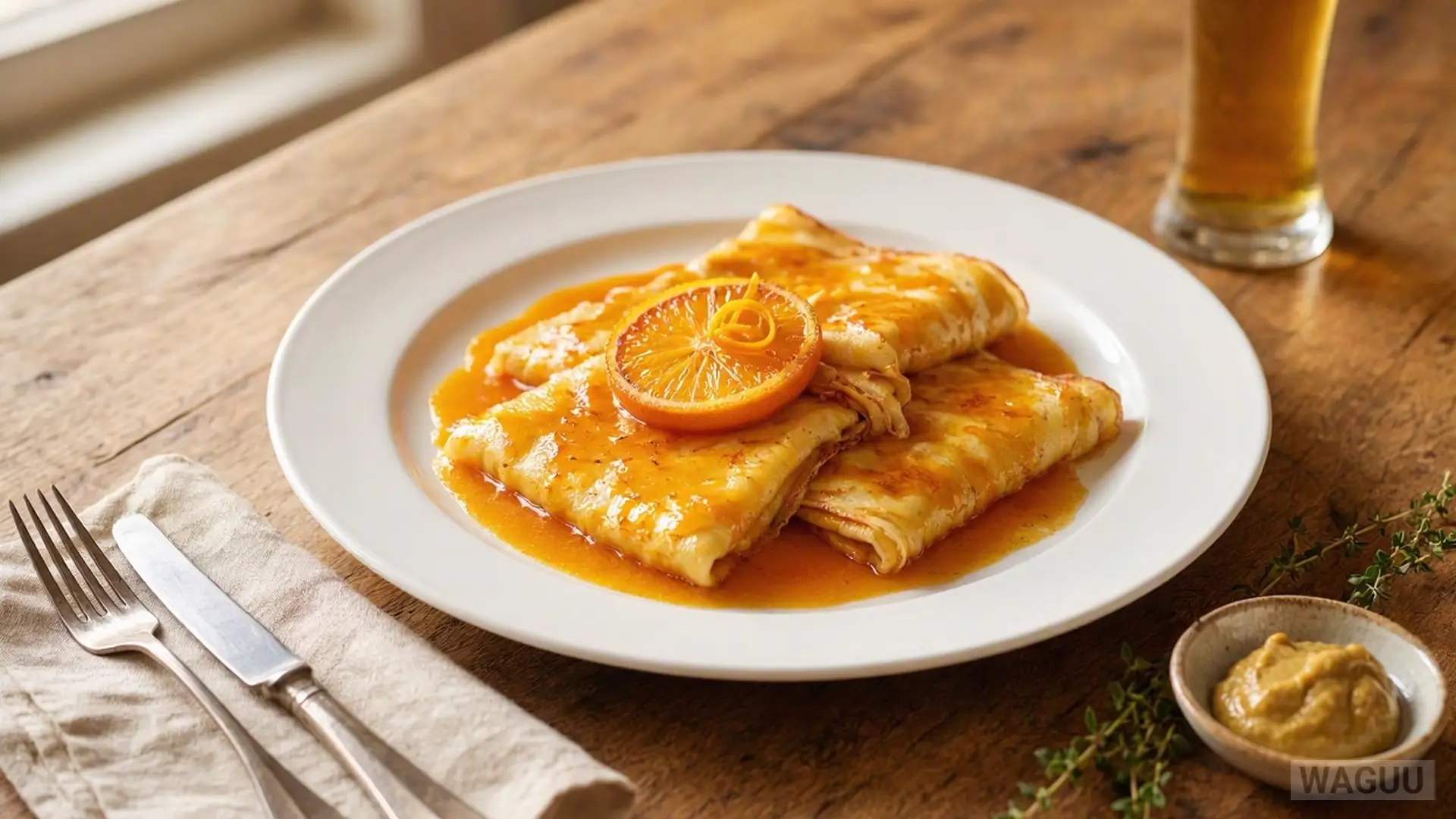
Summary: Crêpes Suzette are delicate, paper-thin French pancakes bathed in a vibrant, buttery citrus sauce infused with caramelised sugar, fresh orange juice, lemon juice, and aromatic orange liqueur. This classic dessert relies on precise batter-making techniques and careful flambéing to achieve its signature tender texture and balanced bitter-sweet flavour profile. Designed for 6 portions, preparation takes 30 minutes with an additional 20 minutes of cooking time.
Did you cook this recipe? Share the result with the community.
Category: Desserts, French Cuisine
Success rate: 96% of users successfully made this recipe
Quick overview
- Dish: Crêpes Suzette
- Category: Desserts, French Cuisine
- Cuisine: French
- Main ingredient: Plain white wheat flour, 250 g (high gluten strength for elasticity)
- Guide: 12 most popular French dishes: favourite recipes of French cuisine
- Total time: 50 minutes (30 min prep + 20 min cooking)
- Difficulty: Intermediate
- Portions: 6 portions (Portion weight: 165.0 g)
- Key technique: Whisking, emulsifying, pan-frying, flambéing
- Preparation types: Mixing, resting, frying, reducing, flambéing
- Dietary info & Allergens: Contains milk, eggs, gluten, sulphites
- Suitable for: Festive menus, romantic dinners, weekend treats
- Nutritional values (per 1 portion): 375.4 kcal, Protein: 7.2 g, Fat: 16.5 g, Carbohydrates: 48.6 g
- Storage: 2 days in the fridge, 1 month in the freezer
- Pairing: Dry cider, Sauternes dessert wine, sparkling mineral water with fresh lemon
- In short: Exquisite buttery orange pancakes finished with a theatrical flame and glossy citrus glaze.
- Last updated: 21 September 2026
WAGUU says: “Mastering Crêpes Suzette is all about temperature control and emulsifying your butter slowly into the warm citrus reduction to prevent separation.”
How to take it further: Add a pinch of freshly grated tonka bean to the batter, or finish the sauce with a handful of finely julienned candied angelica.
Key facts
| Prep time: | 30 minutes |
| Cooking time: | 20 minutes |
| Temperature: | 180 °C frying pan temperature |
| Number of portions: | 6 portions |
In a nutshell
Experience the timeless elegance of French patisserie right in your home kitchen. These delicate crêpes are folded into quarters, warmed in a rich reduction of caramelised sugar, salted butter, fresh orange juice, lemon juice, and zest, then dramatically ignited with orange liqueur for an unforgettable dining experience.
Ingredients
Base portions: 6 portions • Portion weight: 165.0 g
| Ingredient | Amount | Quality |
|---|---|---|
| Plain white wheat flour | 250 g | Fine, sifted |
| Whole milk | 400 ml | Full fat, room temperature |
| Free-range chicken eggs | 3 pcs | Medium size, fresh |
| Caster sugar for batter | 30 g | Fine white crystals |
| Unsalted butter for batter | 40 g | Melted and cooled |
| Fine table salt | 4 g | Pure sea salt |
| Rapeseed oil for frying | 20 ml | Neutral cooking oil |
| Caster sugar for sauce | 80 g | Fine white crystals |
| Unsalted butter for sauce | 100 g | Chilled, cubed |
| Fresh oranges | 4 pcs | Juicy, unwaxed for zesting |
| Fresh lemons | 1 pcs | Freshly squeezed juice |
| Orange liqueur (Grand Marnier) | 80 ml | High proof cognac-based liqueur |
| Water for thinning batter | 100 ml | Filtered room temperature water |
Why you will love this recipe
- Authentic French technique: Follows traditional culinary methods for creating feather-light crêpes and a glossy butter-citrus reduction.
- Spectacular presentation: The table-side flambéing creates a dramatic visual effect and cooks off harsh alcohol while concentrating complex fruit flavours.
- Perfect flavor balance: The tart brightness of fresh citrus juice cuts seamlessly through the rich, buttery caramel sauce.
Why it works: Rested batter allows gluten strands to relax completely, yielding exceptionally tender crêpes that absorb the fragrant sauce without tearing.
Recipe overview
Prep: 30 min | Cooking: 20 min | Difficulty: Intermediate | Portions: 6 portions | Type: Dessert | Origin: French
Detailed instructions
Overall progress: 0% complete
Phase 1: Preparing and resting the crêpe batter – 15 min
Appliances: Digital kitchen scales, hand whisk, mixing bowl
1. Sift 250 g of plain white wheat flour and 4 g of fine table salt into a large mixing bowl. Create a well in the centre and add 3 free-range chicken eggs, 30 g of caster sugar, and 400 ml of whole milk. Whisk vigorously from the centre outwards, gradually incorporating the flour to prevent lumps. Pour in 100 ml of filtered water and 40 g of melted, cooled unsalted butter, mixing until completely smooth. Cover the bowl with cling film and let the batter rest at room temperature for 30 minutes to hydrate the starch granules.
VKB: Visual check point (VKB): The finished batter should have the consistency of single cream, flowing smoothly off a spoon without any flour lumps.
Before moving to the next step:
Ensure the batter has rested for the full duration so that the gluten relaxes, preventing tough or rubbery crêpes.
Phase 2: Zesting and juicing the citrus fruits – 10 min
Appliances: Microplane grater, citrus juicer
2. Wash 4 unwaxed fresh oranges thoroughly in warm water and dry them with a clean cloth. Using a microplane grater, carefully zest only the bright orange outer layer of the peel, avoiding the bitter white pith underneath. Cut the zested oranges and 1 fresh lemon in half, then squeeze them using a citrus juicer to extract all the fresh juice, straining out any pips and pulp. Set the extracted juice, zest, 80 g of caster sugar, 100 g of chilled unsalted butter, and 80 ml of orange liqueur out on the worktop ready for cooking.
VKB: VKB: The zest is aromatic and free of white pith, and the combined juice is completely free of seeds.
Before moving to the next step:
Double-check that all sauce ingredients are measured and accessible near the hob for rapid assembly.
Phase 3: Frying the thin crêpes – 15 min
Appliances: Electric hob, crêpe pan or frying pan, silicone spatula
3. Place a 24 cm crêpe pan over medium-high heat on the hob and brush lightly with 20 ml of rapeseed oil. Once hot at 180 °C, pour a small ladleful of batter into the centre of the pan, swirling quickly to coat the base in an extremely thin, even layer. Cook for 90 seconds until the edges turn golden and lift easily, then loosen with a spatula, flip carefully, and cook for another 30 seconds on the second side. Slide the finished crêpe onto a warm plate, and repeat the process with the remaining batter until you have roughly 12 thin crêpes.
VKB: VKB: Crêpes are pliable, evenly golden on both sides, and approximately 1 mm thick without any holes.
Before moving to the next step:
Keep the stack of finished crêpes covered with a warm damp tea towel to prevent them from drying out.
Phase 4: Preparing the Beurre Suzette sauce – 5 min
Appliances: Large frying pan, electric hob, wooden spoon
4. Place a large, deep frying pan over medium heat on the hob. Scatter 80 g of caster sugar evenly across the dry pan and allow it to melt undisturbed for 3 to 4 minutes until it turns into a pale amber caramel. Carefully pour in the freshly squeezed orange and lemon juice along with the orange zest, whisking constantly as the caramel bubbles and partially seizes. Reduce the heat to medium-low and simmer the liquid for 3 minutes until the caramel dissolves completely into the citrus juice, forming a fragrant syrup.
VKB: VKB: The caramel is a rich golden-amber colour, and the citrus juice has blended into a smooth, fragrant syrup.
Before moving to the next step:
Exercise caution when adding juice to hot caramel as hot steam and sputtering can occur.
Phase 5: Emulsifying the butter and warming crêpes – 5 min
Appliances: Electric hob, large frying pan, metal tongs
5. Add 100 g of chilled, cubed unsalted butter to the simmering citrus syrup piece by piece, swirling the pan continuously to emulsify the butter into a glossy, velvety sauce. Take each crêpe, fold it neatly into quarters (first in half, then in quarters again to form triangles), and lay them flat in the pan in a single overlapping layer. Spoon the bubbling citrus-butter sauce generously over the folded crêpes, allowing them to absorb the liquid and warm through thoroughly for 2 minutes.
VKB: VKB: The sauce has thickened into a glossy emulsion that coats the back of a spoon, and the crêpes are fully saturated.
Before moving to the next step:
Ensure the heat is kept at a gentle simmer so the butter emulsion does not split into oil.
Phase 6: Flambéing and final plating – 5 min
Appliances: Electric hob, long kitchen lighter, serving plates
6. Pour 80 ml of orange liqueur evenly over the warm crêpes in the frying pan. Turn off any overhead extractor fan, and carefully ignite the alcohol vapors using a long kitchen lighter. Allow the blue flames to dance across the pan for 20 to 30 seconds until the alcohol burns off and the flame extinguishes naturally. Using metal tongs, transfer 2 folded crêpes onto each warmed serving plate, spoon the remaining glossy citrus glaze generously over top, and serve immediately while piping hot.
VKB: VKB: The liqueur ignites with a clean blue flame, leaving a concentrated citrus-caramel sauce with a mellowed alcohol finish.
Required equipment
| Utensil | Ideal size | Alternative | Risk |
|---|---|---|---|
| Mixing bowl | 1.5 l capacity | Large ceramic bowl | Splashing batter during whisking |
| Crêpe pan | 24 cm diameter | Non-stick frying pan | Sticking if pan is not properly seasoned |
| Microplane grater | Standard fine blade | Box grater fine side | Gratinating bitter white pith |
Shopping list
Nutritional profile
Values per 1 portion (excluding side dishes). Calculated from average nutritional values of ingredients.
| Nutrient | Per 100 g | Per 1 portion | Per 6 portions |
|---|---|---|---|
| Energy | 227.5 kcal | 375.4 kcal | 2,252.4 kcal |
| Fat | 10.0 g | 16.5 g | 99.0 g |
| of which saturates | 6.1 g | 10.1 g | 60.6 g |
| Carbohydrates | 29.5 g | 48.6 g | 291.6 g |
| of which sugars | 14.2 g | 23.4 g | 140.4 g |
| Protein | 4.4 g | 7.2 g | 43.2 g |
| Salt | 0.4 g | 0.7 g | 4.2 g |
Reference intake of an average adult (8400 kJ / 2000 kcal).
WAGUU Pro Level
- Pro standard: Verified recipe with precise ratios and visual control points.
- Tip 1: Strain the crêpe batter through a fine-mesh sieve before resting to catch any tiny lumps of flour for ultimate silkiness.
- Tip 2: Use high-fat unsalted European butter (82% butterfat or higher) for the Beurre Suzette sauce to ensure a stable, velvety emulsion.
- Tip 3: Ensure the orange liqueur is warmed slightly before pouring into the pan to guarantee an immediate and clean ignition during flambéing.
- Tip 4: Heat the serving plates in a low oven beforehand so the butter glaze remains glossy and does not solidify on contact with the plate.
Scientific background
The success of Crêpes Suzette relies on several fundamental food science principles. Resting the batter allows the gluten network in the flour to hydrate fully and relax, preventing the crêpes from becoming rubbery when exposed to heat. Caramelising sugar creates complex thermal degradation compounds that impart rich butterscotch and nutty notes. When citrus juice is added to the hot caramel, the water content abruptly halts caramelisation and dissolves the sugar matrix into a smooth syrup. Finally, emulsifying chilled butter into the simmering citrus reduction creates a stable water-in-oil emulsion thickened by milk proteins and citrus pectin, yielding a glossy glaze that clings perfectly to the delicate folds of the crêpes.
Fine Dining – Professional techniques
- Plate composition: Arrange two neatly folded triangular crêpes overlapping slightly in the centre of a warm white porcelain plate, garnished with fine orange zest curls.
- Textural contrasts: The silky softness of the folded crêpes contrasts delightfully with the rich, unctuous mouthfeel of the glossy butter emulsion.
- Temperature contrast: Serve piping hot directly from the flambé pan alongside a cool scoop of Madagascar vanilla bean ice cream (not part of the recipe).
- Aromatic garnishes: Finish with a light dusting of icing sugar and a few delicate drops of concentrated orange blossom water around the rim of the plate.
Sensory radar
- Appearance: Golden-brown folded crêpes glistening beneath a rich amber butter-orange glaze dotted with fine citrus zest.
- Aroma: Intensely fragrant bouquet of caramelised sugar, sweet valencia orange, zesty lemon, and warming orange liqueur.
- Taste: Harmonious balance of buttery richness, tart citrus acidity, deep caramel sweetness, and subtle orange liqueur bitterness.
- Texture: Incredibly tender, moist, and delicate crêpes soaked in a velvety, smooth citrus sauce.
Pairing
- BEER: Belgian fruit lambic or crisp artisan apple cider.
- WINE: Sweet Sauternes or late-harvest Tokaji dessert wine.
- NON-ALCOHOLIC: Sparkling blood orange juice with fresh mint.
Various preparation variants
- Grand Marnier variation: Substitute standard orange liqueur with high-end Cognac and triple sec for a more robust, traditional French flavour profile.
- Blood orange twist: Replace standard sweet oranges with vibrant blood oranges for a deeper crimson sauce and a slightly tarter, berry-like citrus note.
Allergens and dietary information
Contains: Milk, eggs, gluten, sulphites • Gluten: Contains wheat flour • Not suitable for: Coeliacs, dairy-allergic individuals, vegans
Suitable for
Festive dinner parties, romantic celebrations, Sunday gourmet brunches, and sophisticated evening desserts.
Substitution catalog
- Plain white wheat flour: Spelt flour or light pastry flour for a slightly nutty undertone.
- Whole milk: Oat milk or almond milk combined with a splash of cream (not part of the recipe).
- Orange liqueur: Alcohol-free orange extract mixed with fresh orange juice for a non-alcoholic version.
FAQ
Why do my crêpes tear when I try to flip them?
Tearing usually happens when the pan is not hot enough, the batter lacks sufficient gluten relaxation time, or there is too little fat in the pan. Ensure you rest the batter fully and use a well-seasoned non-stick pan.
Can I make the crêpe batter in advance?
Yes, you can prepare the batter up to 24 hours in advance and store it covered in the refrigerator. Stir well before using, and let it warm up to room temperature for 15 minutes.
What should I do if my Beurre Suzette sauce splits?
If the butter separates from the liquid, remove the pan from the heat immediately, add a tablespoon of warm water or milk, and whisk vigorously until the emulsion reforms.
Is it safe to flambé on an electric hob?
Yes, but ensure you switch off any overhead extractor fans and keep flammable items away from the stove. Use a long kitchen lighter to ignite the alcohol safely from arm’s length.
WAGUU Petr advises: Cooking for 12 or more people?
12–16 people: Double the batter recipe and fry the crêpes in two separate pans simultaneously. Prepare the Beurre Suzette sauce in a large wide roasting pan on two hob burners, then fold and warm the crêpes in batches before flambéing.
20+ people: Fry all the crêpes the day before, layer them between sheets of greaseproof paper, wrap tightly, and store in the fridge. On the day of the event, make the citrus sauce in large catering pans, warm the pre-made crêpes in the sauce, and flambé in service-sized batches.
Sides and Serving
- Madagascar vanilla bean ice cream – creamy contrast (not included in the recipe)
- Fresh mint sprigs and candied citrus peel – aromatic garnish (not included in the recipe)
Serving: Serve immediately while piping hot on pre-warmed porcelain plates, generously spooning the glossy amber citrus glaze over the folded crêpes.
Storage and reheating
Fridge: 2 days • Freezer: 1 month • Reheating: Reheat leftover assembled crêpes gently in a frying pan over low heat with a splash of fresh orange juice until warmed through.
Author: WAGUU Petr & Team • Published: 21 Sep 2026 • Updated: 30 Oct 2026
More Recipes from This Article
Guide: 12 most popular French dishes: favourite recipes of French cuisine
Boeuf à la Bourguignonne
Other recipes you might be interested in
Why WAGUU?
Recipes on WAGUU undergo checks for the accuracy of ingredients, procedures, and nutritional values.
Process photo gallery
Community photos: Cook, take a photo, and share the result.
You can upload photos in the comments below or send them via email.
Did you record a video guide for our recipe? Insert a link to YouTube, YouTube Shorts, TikTok, Instagram Reels, Facebook Reels, Pinterest, Vimeo, or X (Twitter) in the comment – we’d be happy to publish it and help promote you and your content.
Common mistakes
- Not resting the batter – Results in tough, rubbery crêpes because the gluten strands do not have time to relax fully before cooking.
- Gratinating the white pith – Scraping too deeply when zesting oranges introduces harsh bitterness into the delicate citrus sauce.
- Splitting the butter emulsion – Adding cold butter over too high heat causes the Beurre Suzette sauce to separate into oily liquid.
- Using low-proof liqueur – Failing to use high-proof orange liqueur prevents the alcohol from igniting properly during the flambé stage.