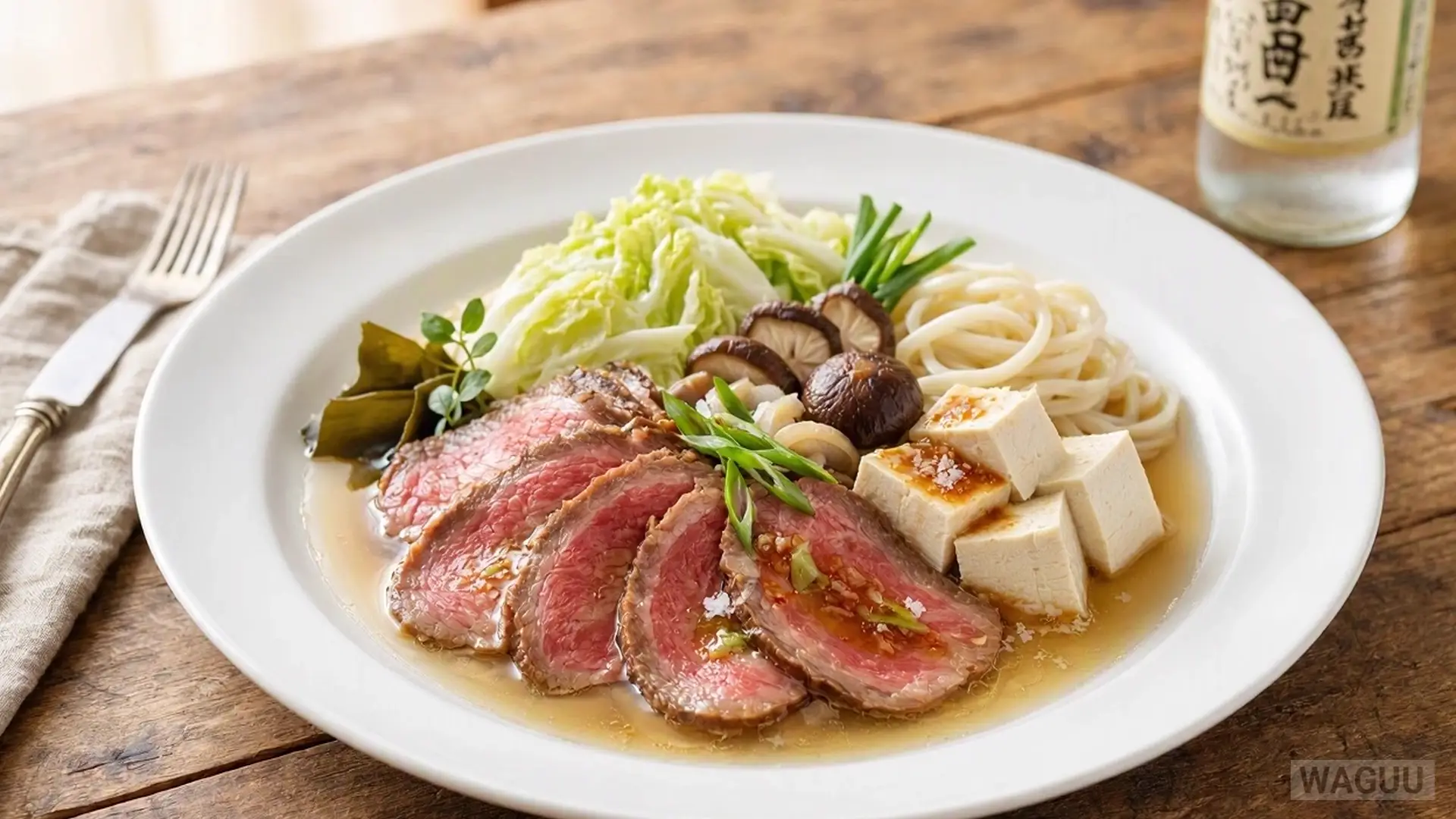
Summary: Authentic Japanese Shabu-Shabu featuring paper-thin slices of prime marbled ribeye beef, firm tofu, and fresh seasonal vegetables cooked table-side in a delicate kombu kelp broth, complemented by homemade citrusy ponzu and rich roasted sesame dipping sauces. Preparation time: 30 minutes, cooking time: 30 minutes, yield: 6 portions.
Did you cook this recipe? Share the result with the community.
Category: Japanese Cuisine, Beef Dishes
Success rate: 98% of users successfully made this recipe
Quick overview
- Dish: Shabu-Shabu
- Category: Japanese Cuisine, Beef Dishes
- Cuisine: Japanese
- Main ingredient: Ultra-thin sliced ribeye beef, 900 g (A5 Wagyu or highly marbled Choice/Prime beef sliced to 1.5 mm thickness)
- Guide: 12 most popular Japanese dishes: favourite Japanese cuisine recipes
- Total time: 60 minutes (30 min prep + 30 min cooking)
- Difficulty: Medium
- Portions: 6 (Portion weight: 450 g)
- Key technique: Table-side flash poaching in sub-boiling broth (swishing technique)
- Preparation types: Cold emulsion blending, precise knife cutting, flash poaching
- Dietary info & Allergens: Soya, Sesame, Gluten (contained in standard soy sauce and udon noodles)
- Suitable for: Interactive dinner parties, family celebrations, healthy low-fat dining
- Nutritional values (per 1 portion): Energy: 580 kcal, Protein: 42.0 g, Fat: 32.0 g, Carbohydrates: 28.0 g
- Storage: 2 days in the fridge (raw components kept separately), 1 month in the freezer (broth base only)
- Pairing: Crisp Japanese draft lager (Asahi/Sapporo), chilled Junmai Daiginjo Sake, or cold Mugicha tea
- In short: Swish paper-thin marbled beef in steaming kelp broth for 3 seconds, dip into citrus ponzu or velvety sesame sauce, and enjoy pure Japanese umami.
- Last updated: May 20, 2024
WAGUU says: “The true essence of Shabu-Shabu resides in restraint and timing. By maintaining your kombu broth at a gentle 85–90 °C, the intramuscular fat melts instantly into a silky coating, while the protein stays exquisitely tender without ever turning tough.”
Key facts
| Prep time: | 30 minutes |
| Cooking time: | 30 minutes |
| Temperature: | 85–90 °C (gentle table-side simmer) |
| Number of portions: | 6 portions |
In a nutshell
Shabu-Shabu is Japan’s most celebrated communal hot-pot experience. Named after the rhythmic sound “swish-swish” made as paper-thin beef is waved through bubbling kombu broth, this dish combines fine dining luxury with healthy, wholesome eating. Guests pick tender beef, fresh napa cabbage, earthy shiitake, and delicate enoki mushrooms, dipping each freshly cooked morsel into bright citrus ponzu or rich sesame cream.
Ingredients
Base portions: 6 portions • Portion weight: 450 g
| Ingredient | Amount | Quality |
|---|---|---|
| Paper-thin sliced ribeye beef (Shabu-shabu cut) | 900 g | A5 Wagyu or Prime Grade marbled beef, sliced 1.5 mm thick |
| Water (for Kombu Dashi broth) | 2400 ml | Filtered fresh cold water |
| Kombu (dried kelp) | 30 g | Rishiri or Hidaka dried giant kombu sheet |
| Sake (Japanese cooking rice wine) | 60 ml | Junmai dry cooking sake |
| Napa cabbage (Hakusai) | 450 g | Fresh crisp leaves, washed and cut into 5 cm pieces |
| Firm Tofu (Momen Tofu) | 400 g | Drained and cut into bite-sized cubes |
| Tokyo Negi (or thick leek) | 200 g | Sliced diagonally into 1 cm thick pieces |
| Shiitake mushrooms | 150 g | Fresh caps with decorative star cross-cut on top |
| Enoki mushrooms | 200 g | Base trimmed, separated into small bundles |
| Carrot | 100 g | Sliced thinly into plum flower or round shapes |
| Garland Chrysanthemum leaves (Shungiku) or Spinach | 150 g | Fresh young leaves, stalks trimmed |
| Kuzukiri noodles (or Udon noodles) | 200 g | Dried kudzu starch glass noodles, pre-soaked |
| Japanese soy sauce (Shoyu) | 140 ml | Naturally brewed Koikuchi soy sauce (split between sauces) |
| Yuzu juice (or fresh lemon juice) | 50 ml | 100% pure yuzu citrus juice |
| Rice vinegar | 60 ml | Unseasoned pure Japanese rice vinegar |
| Mirin (sweet rice wine) | 45 ml | Hon-mirin true brewed sweet cooking wine |
| Japanese white sesame paste (Neri Goma) | 80 g | 100% roasted unhulled white sesame paste |
| Granulated sugar | 15 g | Fine white caster sugar |
| Toasted white sesame seeds | 15 g | Freshly crushed roasted sesame seeds |
| Grated Daikon radish with chili (Momiji-oroshi) | 60 g | Grated daikon tinted with red chili powder |
| Spring onions | 40 g | Finely chopped green scallion tops |
| Fine sea salt | 4 g | Pure sea salt for final broth seasoning balance |
Why you will love this recipe
- Interactive Social Dining: Cooking table-side brings family and guests together, turning dinner into an engaging, customized culinary feast.
- Clean and Health-Conscious: Minimal added oils, fresh mineral-rich vegetables, and fat-melting quick poaching make this one of Japan’s healthiest classic meals.
- Dual Dipping Sensations: Experience contrast between the bright, tart acidity of citrus Ponzu and the luxurious, nutty richness of house-made Goma-dare sesame sauce.
Success guaranteed: By removing the kombu dried kelp just before water reaches a boil and keeping beef slices at 1.5 mm thickness, your broth stays crystal clear and free of bitterness, ensuring melted tenderness in every slice.
Recipe overview
Prep: 30 min | Cooking: 30 min | Difficulty: Medium | Portions: 6 | Type: Main Dish / Hot Pot | Origin: Japan
Detailed instructions
Overall progress: 0% complete
Phase 1: Kombu Dashi Extraction – 15 min
Appliances: Stovetop burner, large stockpot or Donabe clay pot
1. Wipe the 30 g sheet of dried kombu gently with a damp paper towel to clean surface dust (do NOT scrub off the white natural glutamic acid powder). Pour 2400 ml cold filtered water into your pot, submerge the kombu, and add 60 ml sake. Heat slowly over medium-low heat. Right as tiny bubbles form around the pot edges and water reaches 80–85 °C (approx. 12–14 minutes), remove the kombu sheet immediately with tongs. Stir in 4 g fine sea salt. Do not allow kombu to boil, or broth will turn slimily bitter.
VKB (Visual Control Benchmark): Kombu is extracted and removed when broth shows tiny steady bubbles at perimeter (80–85 °C), leaving liquid clear, pale golden-green, and free of cloudiness or slime.
Before moving to the next step:
Ensure kombu has been lifted out prior to boiling point. Boiling dried kelp releases bitter alginic acid and mucilage, ruining the delicate umami profile.
Phase 2: Vegetable and Tofu Knife Preparation – 15 min
Appliances: Cutting board, chef’s knife, prep bowls
2. Trim the base of 450 g Napa cabbage; cut thick white stalks into 3 cm diagonal cuts and leafy greens into 6 cm broad slices. Slice 200 g Tokyo Negi leek diagonally at a 45-degree angle into 1 cm thick slices. Cut stems off 150 g shiitake mushrooms and carve decorative X notches into the caps. Trim root stems off 200 g enoki mushrooms and gently separate into bite-sized clumps. Cut 100 g peeled carrot into thin 2 mm flower-shaped slices. Cut 400 g firm tofu into 6 uniform bite-sized cubes. Wash 150 g garland chrysanthemum leaves and remove coarse bottom stems. Soak 200 g kuzukiri starch noodles in warm water for 10 minutes until flexible.
VKB: All vegetables cut into clean, uniform sizes with separated firm stems and delicate leaf greens ready for staggered cooking times.
Before moving to the next step:
Keep hard vegetable stems (cabbage bases, carrots) separated from delicate leafy green tops on your prep platter as they require longer poaching in hot broth.
Phase 3: Crafting Homemade Ponzu and Goma-dare Sauces – 10 min
Appliances: Whisk, small mixing bowls, measuring cups
3. For Ponzu Sauce: In a bowl, combine 100 ml Japanese soy sauce, 50 ml fresh yuzu juice (or lemon juice), 30 ml rice vinegar, 30 ml mirin, and 30 ml warm warm kombu dashi broth. Stir until smooth and pour into 6 small dipping ramekins. For Goma-dare Sesame Sauce: In another bowl, place 80 g white sesame paste (neri goma). Gradually whisk in 15 g fine sugar, 30 ml soy sauce, 30 ml rice vinegar, 15 ml mirin, and slowly stream in 60 ml reserved kombu dashi broth until a creamy, velvet emulsion forms. Stir in 15 g crushed toasted sesame seeds. Divide into 6 second dipping bowls.
VKB: Ponzu is translucent dark amber with zesty citrus aromatics; Goma-dare is smooth, velvety beige without oil separation.
Phase 4: Meat Cutting and Platter Arrangement – 5 min
Appliances: Slicing knife or meat slicer, large decorative serving platters
4. Arrange 900 g ultra-thin sliced ribeye beef onto chilled serving platters, folding each slice loosely into an elegant ribbon shape so guests can easily grab individual pieces with chopsticks. On a second large platter, group prepared vegetables aesthetically: pile Napa cabbage stems at the base, place tofu blocks, mushroom clusters, carrot flowers, sliced negi, pre-soaked kuzukiri noodles, and top with chrysanthemum leaves. Place condiment dishes containing 60 g Momiji-oroshi (spiced grated daikon) and 40 g finely sliced spring onions alongside.
VKB: Sliced beef rolls are separated for effortless pickup without tearing; vegetable platter is artfully organized by color and texture.
Phase 5: Table Setup and Initial Broth Heating – 5 min
Appliances: Portable table induction or butane gas burner, Donabe clay pot or wide shallow hot pot
5. Set up portable burner in table center. Transfer prepared warm kombu dashi broth into Donabe pot and set over medium flame. Turn burner control so liquid maintains gentle simmer around 85–90 °C. Add tough vegetable components first to begin flavoring broth: lower firm cabbage stems, shiitake caps, carrot flowers, and tofu cubes into broth, simmer gently for 3–4 minutes until tender-crisp.
VKB: Gentle lazy bubbles emerging from pot center; vegetables submerge smoothly without chilling broth excessively.
Phase 6: Table-Side Cooking and Noodle Finish – 10 min
Appliances: Table burner, chopsticks, skimmer net
6. Instruct diners to pick single slice of marbled beef with long chopsticks, submerge into hot 85–90 °C broth, and swish back and forth 2 to 3 times (“shabu-shabu”) for 3 to 5 seconds until beef turns light pink. Immediately dip beef into citrus Ponzu or creamy Goma-dare sauce. Skim off gray protein foam periodically using mesh skimmer. Add remaining greens, mushrooms, and kuzukiri noodles continuously as space frees up. Once meat and greens are consumed, add pre-cooked udon noodles or cooked rice with beaten egg into rich remaining broth to cook final comfort soup dish (Zosui).
VKB: Poached beef remains silky pink and tender; liquid remains clean through regular skimmer removal of foam.
Required equipment
| Utensil | Ideal size | Alternative | Risk |
|---|---|---|---|
| Japanese Donabe clay pot (or Nabe pot) | 30 cm diameter (3.5 litre capacity) | Wide shallow stainless steel pot or Dutch oven | Narrow deep pot makes table access difficult and uneven heating |
| Portable table burner | Butane gas table stove or single induction hob | Electric hot plate or fondue burner | Insufficient heating allows broth temperature to drop below poaching threshold |
| Mesh broth skimmer (Aku-nuki) | Fine mesh skimmer net 10 cm | Standard fine mesh tea strainer | Accumulated grey fat scum turns stock cloudy and bitter |
Shopping list
Nutritional profile
Values calculated per 1 portion (approx. 450 g cooked serving including broth, meat, vegetables, and dipping sauces). Values based on average composition of raw ingredients.
| Nutrient | Per 100 g | Per 1 portion | Per 6 portions |
|---|---|---|---|
| Energy | 128.9 kcal | 580.0 kcal | 3480.0 kcal |
| Fat | 7.1 g | 32.0 g | 192.0 g |
| of which saturates | 2.7 g | 12.2 g | 73.2 g |
| Carbohydrates | 6.2 g | 28.0 g | 168.0 g |
| of which sugars | 1.6 g | 7.2 g | 43.2 g |
| Protein | 9.3 g | 42.0 g | 252.0 g |
| Salt | 1.0 g | 4.5 g | 27.0 g |
Reference intake of an average adult (8400 kJ / 2000 kcal).
WAGUU Pro Level
- Pro standard: Verified recipe with precise ratios and visual control benchmarks (VKB).
- Tip 1 (Temperature Control): Never bring kombu kelp broth to a rolling boil during dashi extraction. Maintain broth at 85–90 °C table-side to prevent beef protein fibers from contracting tightly, keeping meat exquisitely supple.
- Tip 2 (Freezer Slicing Trick): If slicing beef at home without a commercial slicer, freeze the ribeye loin for 45–60 minutes until firm but not rock-hard, then slice across the grain with a razor-sharp Yanagiba or carving knife.
- Tip 3 (Broth Skimming Discipline): Use an Aku-nuki mesh skimmer every 3 minutes to remove coagulated grey protein foam, preserving crystal broth clarity for the final Zosui noodle course.
- Tip 4 (Emulsion Stability in Goma-dare): Add hot kombu dashi broth into sesame paste in small micro-doses while whisking constantly; streaming hot liquid too quickly will cause sesame oils to break.
Scientific background
The fundamental science of Shabu-Shabu relies on the synergistic umami effect between glutamic acid extracted from Kombu kelp (Saccharina japonica) and inosinic acid found in beef muscle tissue. When combined, monosodium glutamate and inosinate bind to human T1R1/T1R3 taste receptors simultaneously, amplifying perceived savory flavor up to eightfold compared to either ingredient alone. Flash-poaching paper-thin (1.5 mm) beef slices at sub-boiling temperatures (85–90 °C) rapidly melts intramuscular fat (marbling) without heat-denaturing actin proteins into dry, rubbery strands, creating an immediate melt-in-the-mouth texture.
Fine Dining – Professional techniques
- Plate composition: Fan out thin beef slices in circular concentric ribbons over chilled ceramic platters lined with fresh bamboo leaves, creating a flower petal silhouette. Arrange vegetables in distinct color quadrants.
- Textural contrasts: Balance silky tender poached Wagyu with crunch from Napa cabbage stalks and chewy elasticity of kuzukiri starch noodles.
- Temperature contrast: Contrast hot, steaming broth-dipped beef with room-temperature citrus ponzu spiked with chilled Momiji-oroshi (spiced grated daikon).
- Aromatic garnishes: Garnish dipping bowls with micro-planed yuzu zest and freshly toasted white sesame seeds pulverized right before serving.
Sensory radar
- Appearance: Vibrantly marbled pink beef ribbons, crystal-clear golden broth, colorful bouquet of fresh green chrysanthemum leaves, orange carrots, and white tofu.
- Aroma: Delicate oceanic marine aroma from kombu dashi, roasted nuttiness from sesame paste, and bright citrus bursts of yuzu.
- Taste: Deeply savory umami core balanced by clean acidic yuzu citrus notes and rich, creamy sweet-salty sesame finish.
- Texture: Butter-soft beef that dissolves on the tongue, velvety tofu, tender mushrooms, crisp cabbage stalks, and slippery starch noodles.
Pairing
- BEER: Crisp, super-dry Japanese draft lager (such as Asahi Super Dry or Sapporo Premium) cuts cleanly through rich sesame sauce and beef fat.
- WINE: Off-dry German Riesling, Austrian Grüner Veltliner, or a delicate, un-oaked Oregon Pinot Noir; chilled Junmai Daiginjo Sake with floral aromatics works magnificently.
- NON-ALCOHOLIC: Ice-cold Japanese Roasted Barley Tea (Mugicha) or hot, high-grade Sencha green tea to cleanse the palate between bites.
Various preparation variants
- Pork Shabu-Shabu (Kurobuta Shabu): Substitute beef ribeye with paper-thin slices of Berkshire pork shoulder or belly, serving with a ponzu sauce enriched with grated fresh ginger.
- Seafood Shabu-Shabu (Kani / Buri Shabu): Replace beef with paper-thin fresh king crab legs, sashimi-grade yellowtail (buri), or sea bream slices poached for 5 seconds in kombu broth.
Allergens and dietary information
Contains: Soya (soy sauce, tofu), Sesame (neri goma, sesame seeds), Gluten (standard soy sauce and udon noodles) • Gluten: Replace standard soy sauce with certified gluten-free Tamari and use Kuzukiri starch noodles instead of udon • Not suitable for: Strictly vegan diets (contains beef; easily adapted to vegetable-only hot pot), low-sodium diets (requires monitoring dipped sauce quantities).
Suitable for
Interactive dinner parties, family weekend feasts, winter communal gathering meals, keto and low-carb diets (when skipping starch noodles), and healthy nutrient-dense dining.
Substitution catalog
- Yuzu juice: Equal parts fresh lemon juice and lime juice mixed together.
- Neri Goma (Japanese sesame paste): Unhulled Tahini enriched with a few drops of toasted sesame oil and fine sugar.
- Kuzukiri noodles: Asian sweet potato glass noodles (Dangmyeon) or cellophane bean thread vermicelli.
- Tokyo Negi: Thick sweet leek stalks (white and light green parts only).
- Garland Chrysanthemum (Shungiku): Fresh baby spinach leaves or crown daisy greens.
FAQ
Why should kombu kelp be removed before the broth boils?
Boiling dried kombu causes its cellular structure to break down, releasing bitter alginic acids and viscous mucilage into the water. Lift kombu out when water reaches 80–85 °C to keep stock sweet, clear, and delicate.
How thin must beef be sliced for authentic Shabu-Shabu?
Beef should be sliced to a thickness of 1.2 to 1.5 mm. Thicker cuts will take too long to cook table-side and become chewy, whereas paper-thin slices cook perfectly within 3 to 5 seconds of swishing.
What is the difference between Shabu-Shabu and Sukiyaki?
Shabu-Shabu uses a mild, clear kombu water broth and dipping sauces served post-cooking. Sukiyaki simmers beef and vegetables directly in a heavy, sweet-savory soy-mirin-sugar broth and dips cooked items into raw beaten egg.
How do you make the final soup course (Zosui) at the end of the meal?
After all meat and vegetables are eaten, skim remaining broth clean. Add cooked white rice or udon noodles, simmer for 2 minutes, then stream in a beaten egg and chopped scallions. Turn off heat, cover for 1 minute, and serve hot.
WAGUU Petr advises: Cooking for 12 or more people?
12–16 people: Set up 2 or 3 separate table burner stations so every group of 4–5 guests has easy access to a shared hot pot. Double broth volume to 5 litres and prep meat platters on ice trays to keep raw beef chilled during long social dinners. • 20+ people: Organize a hot pot buffet style or run 4 distinct table stations. Pre-mix large batches of Ponzu and Goma-dare dipping sauces 24 hours in advance and store chilled; sauce flavor improves after sitting overnight.
Sides and Serving
- Steamed Japanese short-grain rice (Uchigohan) – Fluffy white rice bowl served alongside dipping sauces (not included in the recipe).
- Sunomono cucumber salad – Refreshing sliced cucumber and wakame seaweed in sweet rice vinegar dressing (not included in the recipe).
Serving: Present hot pot in center of table. Place one dish of Ponzu and one dish of Goma-dare at each guest’s place setting, accompanied by chopsticks, a small skimmer, and a bowl for finished broth.
Storage and reheating
Fridge: Raw beef and sliced vegetables keep up to 2 days stored separately in airtight containers in the fridge. Cooked broth and remaining cooked items keep up to 2 days. • Freezer: Kombu dashi broth base freezes well for up to 1 month; raw sliced beef can be vacuum-sealed and frozen for 1 month. • Reheating: Bring remaining broth and vegetables back to a simmer on the stovetop for 3–4 minutes. Reheat dipping sauces to room temperature before serving.
Author: WAGUU Petr & Team • Published: 30 Oct 2026
More Recipes from This Article
Other recipes you might be interested in
Why WAGUU?
Recipes on WAGUU undergo checks for the accuracy of ingredients, procedures, and nutritional values.
Process photo gallery
Community photos: Cook, take a photo, and share the result.
You can upload photos in the comments below or send them via email.
Did you record a video guide for our recipe? Insert a link to YouTube, YouTube Shorts, TikTok, Instagram Reels, Facebook Reels, Pinterest, Vimeo, or X (Twitter) in the comment – we’d be happy to publish it and help promote you and your content.
Common mistakes
- Boiling dried kombu kelp – Leaving dried kombu in boiling water extracts bitter alginic acid and slimy textures, destroying clear stock aroma. Always discard kelp just before water boils.
- Slicing beef too thick – Thick cuts of beef take too long to cook table-side and become tough and chewy. Use paper-thin slices measuring 1.2 to 1.5 mm.
- Overcooking beef in the pot – Leaving beef submerged in broth like stewing meat turns high-quality marbled Wagyu tough. Swish slices for 3 to 5 seconds only until pale pink.
- Ignoring accumulated broth scum – Failing to skim off gray fat foam with a mesh net turns dashi stock cloudy and unpleasant for the final Zosui noodle phase.