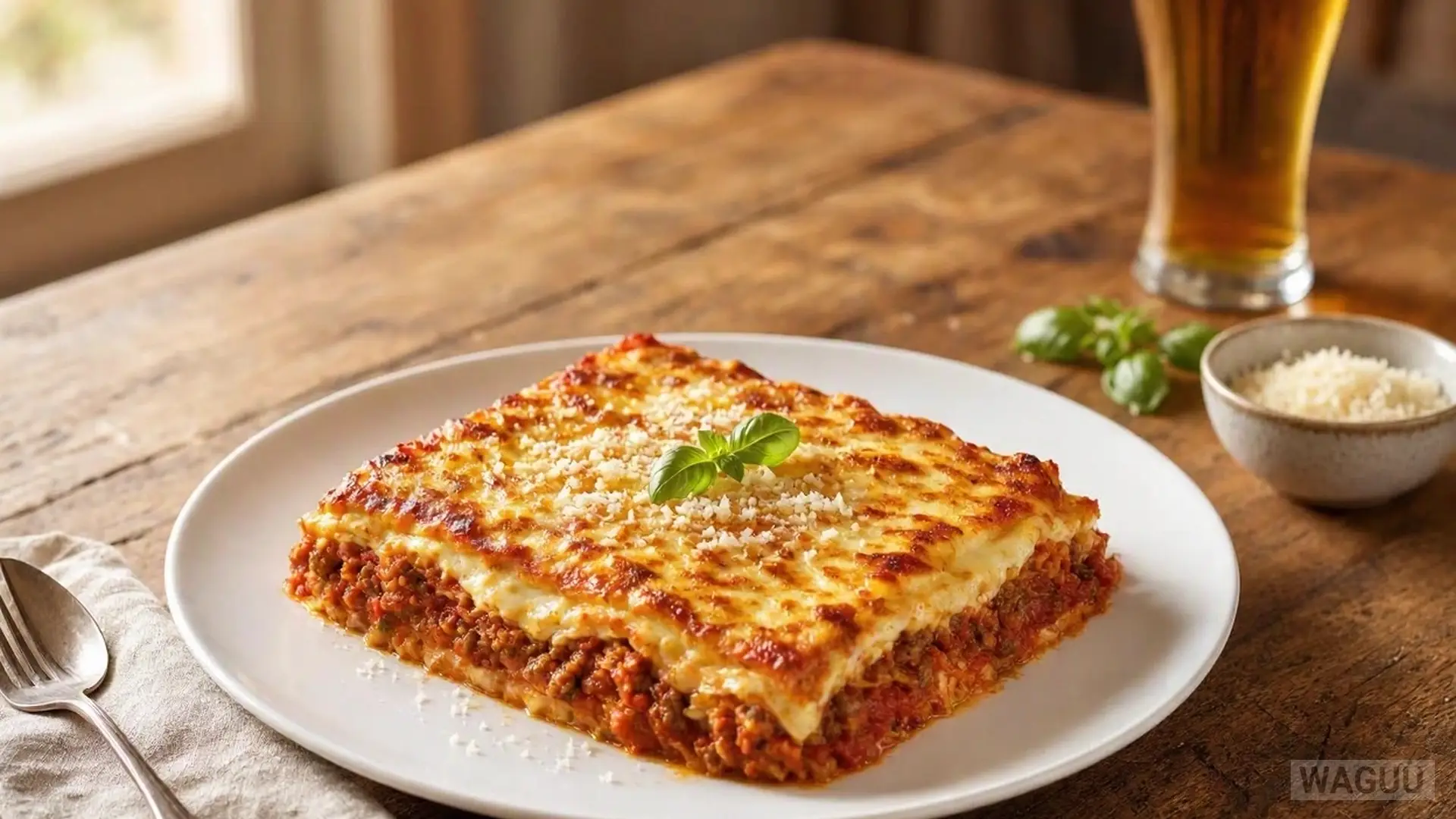
Summary: Lasagne alla Bolognese is a timeless masterpiece of Italian cuisine, featuring delicate layers of green spinach pasta sheets alternated with a rich, slow-cooked beef and pork ragù, silky béchamel sauce, and freshly grated Parmigiano Reggiano, baked until bubbling and golden brown. This traditional preparation method requires patience and precision, taking 150 minutes in total, designed to yield 6 generous portions of authentic culinary excellence.
Did you cook this recipe? Share the result with the community.
Category: Pasta, Italian Cuisine
Success rate: 98% of users successfully made this recipe
Quick overview
- Dish: Lasagne alla Bolognese
- Category: Pasta, Italian Cuisine
- Cuisine: Italian
- Main ingredient: Fresh spinach pasta sheets, 450 g (premium grade)
- Guide: 12 most popular Italian dishes: favourite recipes of Italian cuisine
- Total time: 150 minutes (60 min prep + 90 min cooking)
- Difficulty: Advanced
- Portions: 6 portions (Portion weight: 420 g)
- Key technique: Layering and slow simmering
- Preparation types: Braising, simmering, and baking
- Dietary info & Allergens: Contains milk, eggs, wheat gluten, and celery
- Suitable for: Festive dinners and weekend family gatherings
- Nutritional values (per 1 portion): 715.4 kcal, Protein: 34.2 g, Fat: 38.5 g, Carbohydrates: 62.1 g
- Storage: 3 days in the fridge, 3 months in the freezer
- Pairing: Craft Pilsner, Chianti Classico, Sparkling mineral water
- In short: The ultimate baked Italian pasta featuring layered spinach sheets, slow-cooked meat ragù, velvety béchamel, and melted cheese.
- Last updated: 21 September 2026
WAGUU says: “True lasagna requires patience; allowing the ragù to simmer gently for hours develops the depth of flavor necessary for an authentic Emilia-Romagna experience.”
How to take it further: Add a pinch of freshly grated nutmeg to the béchamel sauce, and infuse the ragù with a single dried porcini mushroom for an elevated umami profile.
Key facts
| Prep time: | 60 minutes |
| Cooking time: | 90 minutes |
| Temperature: | 180 °C |
| Number of portions: | 6 portions |
In a nutshell
Experience the pinnacle of Italian comfort food with homemade spinach pasta sheets layered meticulously between a rich, slow-simmered beef and pork ragù, creamy béchamel sauce, and generous blankets of Parmigiano Reggiano, baked to absolute golden perfection.
Ingredients
Base portions: 6 portions • Portion weight: 420 g
| Ingredient | Amount | Quality |
|---|---|---|
| Fresh spinach pasta sheets | 450 g | Rolled thin |
| Minced beef chuck | 500 g | High fat content 15% |
| Minced pork belly | 300 g | Freshly ground |
| Pancetta | 100 g | Cured, finely diced |
| Yellow onions | 150 g | Finely chopped |
| Carrots | 100 g | Finely diced |
| Celery stalks | 100 g | Finely diced |
| Tomato passata | 400 g | Smooth puree |
| Beef stock | 500 ml | Rich and homemade |
| Whole milk | 900 ml | Full fat 3.5% |
| Dry white wine | 150 ml | Crisp and dry |
| Plain flour | 90 g | For béchamel roux |
| Unsalted butter | 90 g | European style 82% fat |
| Parmigiano Reggiano | 200 g | Aged 24 months, grated |
| Extra virgin olive oil | 30 ml | Cold pressed |
| Fine sea salt | 22 g | Pure sea salt |
| Ground black pepper | 4 g | Freshly cracked |
| Nutmeg | 2 g | Freshly grated |
Why you will love this recipe
- Authentic Heritage: Follows the traditional Emilia-Romagna culinary standards with a rich meat ragù and velvety béchamel.
- Unmatched Texture: Combines tender spinach pasta sheets with a perfectly browned, crispy cheese crust on top.
- Deep Flavor Profile: Slow-simmered meats and aromatic vegetables create an intensely savory and comforting dining experience.
Why it works: Layering alternating sheets of pasta with generous amounts of warm sauce ensures even moisture absorption and structural integrity during baking.
Recipe overview
Prep: 60 min | Cooking: 90 min | Difficulty: Advanced | Portions: 6 portions | Type: Main dish | Origin: Italian
Detailed instructions
Overall progress: 0% complete
Phase 1: Preparing the soffritto and browning the meats – 25 min
Appliances: Hob
1. Place a large heavy-bottomed casserole dish over medium heat. Add 30 ml of extra virgin olive oil and 100 g of finely diced pancetta. Render the pancetta fat for 5 minutes until translucent and lightly browned. Add 150 g of finely chopped yellow onions, 100 g of finely diced carrots, and 100 g of finely diced celery stalks. Sauté the vegetables gently for 10 minutes, stirring frequently until soft and fragrant. Add 500 g of minced beef chuck and 300 g of minced pork belly to the pan. Cook the meat over medium-high heat for 10 minutes, breaking up any clumps with a wooden spoon until completely browned and moisture has evaporated.
VKB: Visual check point (VKB): The minced meat is thoroughly browned with no pink remaining, and the soffritto vegetables are tender and translucent.
Before moving to the next step:
Ensure the meat is deeply browned to develop essential caramelized fond at the bottom of the casserole before introducing liquids.
Phase 2: Simmering the Bolognese ragù – 65 min
Appliances: Hob
2. Pour 150 ml of dry white wine into the casserole with the browned meat and vegetables. Simmer uncovered for 5 minutes until the alcohol aroma dissipates and the wine reduces by half. Stir in 400 g of tomato passata, 500 ml of beef stock, 10 g of fine sea salt, and 2 g of ground black pepper. Reduce the heat to low, cover with a tight-fitting lid, and let the ragù simmer gently for 50 minutes, stirring occasionally. Remove the lid for the final 10 minutes to thicken the sauce to a rich, glossy consistency. Taste and adjust seasoning if necessary, then set aside off the heat.
VKB: VKB: The ragù has reduced into a thick, cohesive meat sauce with minimal excess watery liquid.
Before moving to the next step:
Keep the heat low during the simmer phase to prevent the meat proteins from tightening and becoming tough.
Phase 3: Preparing the classic béchamel sauce – 20 min
Appliances: Hob
3. Melt 90 g of unsalted butter in a medium saucepan over medium-low heat. Add 90 g of plain flour and whisk continuously for 2 minutes to cook out the raw flour taste, forming a pale blond roux. Gradually pour in 900 ml of whole milk in a thin stream while whisking vigorously to prevent any lumps from forming. Cook the mixture over medium heat, stirring constantly with a flat wooden spoon or whisk, for 10 minutes until the sauce thickens and coats the back of a spoon. Season the béchamel with 10 g of fine sea salt, 2 g of ground black pepper, and 2 g of freshly grated nutmeg. Remove from heat and cover the surface directly with plastic wrap to prevent a skin from forming.
VKB: VKB: The béchamel sauce is completely smooth, velvety, and coats the back of a spoon without any flour lumps.
Before moving to the next step:
Ensure milk is added gradually while whisking aggressively; dumping all milk at once will cause stubborn lumps.
Phase 4: Blanching the pasta sheets – 15 min
Appliances: Hob
4. Bring a large pot filled with 4 litres of water to a rolling boil and add 20 g of fine sea salt. Prepare a large bowl filled with cold water and ice cubes nearby. Drop 450 g of fresh spinach pasta sheets into the boiling water in small batches of 3 to 4 sheets at a time. Cook each batch for precisely 45 seconds to 1 minute until pliable. Remove the blanched pasta sheets using a slotted spoon and plunge them immediately into the ice water bath to stop the cooking process. Gently lift the sheets out, pat them dry with clean kitchen towels, and lay them flat in a single layer on parchment paper.
VKB: VKB: Pasta sheets are pliable and tender after blanching, cooled in ice water, and laid flat without tearing.
Before moving to the next step:
Do not overcrowd the boiling water pot, or the delicate spinach sheets will stick together and tear.
Phase 5: Layering the lasagne in the baking dish – 15 min
Appliances: Oven
5. Preheat your oven to 180 °C conventional heat. Take a rectangular 30×20 cm ceramic baking dish and spread a thin layer of meat ragù and béchamel sauce across the bottom. Arrange a layer of blanched spinach pasta sheets over the sauce, trimming edges to fit snugly without excessive overlapping. Spread a generous layer of meat ragù evenly over the pasta, followed by a ladleful of béchamel sauce and a sprinkle of grated Parmigiano Reggiano. Repeat this layering process for 4 to 5 tiers until the ingredients are depleted, ensuring the top layer consists of pasta sheets covered generously with remaining béchamel, a final layer of ragù, and an abundant dusting of the remaining 200 g of Parmigiano Reggiano.
VKB: VKB: The lasagne is assembled evenly with alternating pasta, ragù, and béchamel layers, topped with a heavy coating of cheese.
Before moving to the next step:
Ensure the corners of the pasta sheets touch the edges of the baking dish so the pasta does not dry out during baking.
Phase 6: Baking and resting the lasagne – 50 min
Appliances: Oven
6. Place the assembled baking dish on the middle rack of the preheated oven at 180 °C. Bake uncovered for 40 minutes until the edges are bubbling vigorously and the top crust turns golden brown and slightly crisp. Switch the oven to broiler mode for the final 3 minutes to achieve an exceptionally golden crust, watching carefully to prevent burning. Remove the lasagne from the oven and let it rest undisturbed at room temperature for 10 minutes to allow the layers to settle and firm up before slicing into portions.
VKB: VKB: The top crust is golden brown and bubbling, and the interior has set sufficiently to hold its shape upon slicing.
Required equipment
| Utensil | Ideal size | Alternative | Risk |
|---|---|---|---|
| Casserole dish | 5 litres | Heavy saucepan | Food burning due to thin bottom |
| Ceramic baking dish | 30×20 cm | Glass baking dish | Uneven heat distribution |
| Whisk | 25 cm wire whisk | Fork | Lumps in béchamel sauce |
Shopping list
Nutritional profile
Values per 1 portion (excluding side dishes). Calculated from average nutritional values of ingredients.
| Nutrient | Per 100 g | Per 1 portion | Per 6 portions |
|---|---|---|---|
| Energy | 170.3 kcal | 715.4 kcal | 4,292.4 kcal |
| Fat | 9.2 g | 38.5 g | 231.0 g |
| of which saturates | 4.8 g | 20.1 g | 120.6 g |
| Carbohydrates | 14.8 g | 62.1 g | 372.6 g |
| of which sugars | 3.6 g | 15.1 g | 90.6 g |
| Protein | 8.1 g | 34.2 g | 205.2 g |
| Salt | 0.9 g | 3.7 g | 22.2 g |
Reference intake of an average adult (8400 kJ / 2000 kcal).
WAGUU Pro Level
- Pro standard: Verified recipe with precise ratios and visual control points.
- Tip 1: Use a combination of beef chuck and pork belly for the ragù to ensure optimal fat content and tenderness.
- Tip 2: Blanching fresh pasta sheets briefly in salted water prevents them from absorbing excess moisture from the sauce during baking.
- Tip 3: Whisk the béchamel continuously over medium heat to achieve a silky texture without any starch lumps.
- Tip 4: Let the baked lasagne rest for 10 minutes before slicing to ensure the layers hold their structural integrity.
Scientific background
The prolonged simmering of connective tissue-rich beef and pork in the ragù induces collagen hydrolysis, transforming tough muscle fibers into gelatin that thickens the sauce naturally. Meanwhile, starch gelatinisation in the flour-butter roux thickens the continuous milk phase of the béchamel, while the Maillard reaction between amino acids and reducing sugars during baking creates the characteristic savory crust.
Fine Dining – Professional techniques
- Plate composition: Serve a clean, geometric square cut in the center of a warm porcelain plate, garnished with a single basil leaf.
- Textural contrasts: Contrast the tender, yielding pasta layers with the crisp, caramelized Parmigiano Reggiano crust on top.
- Temperature contrast: Ensure the dish is served piping hot while maintaining structural layers upon cutting.
- Aromatic garnishes: Finish with freshly grated nutmeg and aged Parmigiano Reggiano shavings just before serving.
Sensory radar
- Appearance: Vibrant green spinach pasta sheets interlaced with rich red ragù and crowned with a golden-brown melted cheese crust.
- Aroma: Rich buttery notes of béchamel combined with savory slow-cooked meats, tomatoes, and aromatic aged cheese.
- Taste: Deeply savory, balanced with natural sweetness from tomatoes and onions, complemented by dairy richness.
- Texture: Velvety and tender layers yielding softly to the bite, anchored by a slightly crisp baked top.
Pairing
- BEER: Craft Bohemian Pilsner with crisp malt bitterness that cuts through the rich béchamel.
- WINE: Medium-bodied Chianti Classico featuring bright acidity and earthy cherry fruit notes.
- NON-ALCOHOLIC: Sparkling mineral water with a slice of fresh lemon.
Various preparation variants
- Vegetarian Mushroom Lasagne: Substitute the meat ragù with a rich medley of finely chopped wild mushrooms and porcini stock for an earthy vegetarian alternative.
- White Lasagne alla Bolognese: Omit the tomato passata entirely from the ragù, simmering the meats exclusively in white wine and rich stock for a lighter profile.
Allergens and dietary information
Contains: Milk, eggs, wheat gluten, celery • Gluten: Contains wheat flour in pasta and roux • Not suitable for: Vegans and individuals with lactose intolerance or celiac disease
Suitable for
Festive dinners and weekend family gatherings
Substitution catalog
- Minced beef chuck: Minced venison or minced veal
- Pancetta: Smoked bacon or guanciale
- Whole milk: Semi-skimmed milk blended with single cream
FAQ
Can I use dried lasagne sheets instead of fresh spinach pasta?
Yes, though traditional Bolognese lasagne relies on fresh pasta. If using dried sheets, ensure your sauces are slightly more liquid and baking time is extended by 10 minutes.
Why did my lasagne fall apart when serving?
Lasagne must rest for at least 10 minutes after baking to allow the melted cheese and starches to set. Cutting it immediately while piping hot will cause the layers to slide apart.
Can I prepare the lasagne in advance?
Yes, you can assemble the entire dish up to 24 hours in advance, cover it tightly, and keep it refrigerated before baking. Add an extra 10 minutes to the baking time.
How do I prevent lumps in my béchamel sauce?
Whisk the milk in gradually while keeping the heat moderate and stirring constantly. If lumps form, pass the finished sauce through a fine-mesh sieve.
WAGUU Petr advises: Cooking for 12 or more people?
12–16 people: Double all ingredient quantities and bake in two separate large ceramic dishes side by side in the oven. Rotate the dishes halfway through baking to ensure even heat distribution. • 20+ people: Prepare the ragù and béchamel sauce in large commercial stockpots the day before. Assemble three separate baking dishes, bake them sequentially or use a convection oven, and allow sufficient resting time before portioning.
Sides and Serving
- Crispy green leaf salad with lemon vinaigrette – provides a bright, acidic contrast to the rich baked pasta (not included in the recipe)
- Storage and reheating
Fridge: 3 days • Freezer: 3 months • Reheating: Reheat covered with foil in an oven preheated to 160 °C for 25 minutes until heated through.
Author: WAGUU Petr & Team • Published: 21 Sep 2026 • Updated: 30 Oct 2026
More Recipes from This Article
Other recipes you might be interested in
Why WAGUU?
Recipes on WAGUU undergo checks for the accuracy of ingredients, procedures, and nutritional values.
Process photo gallery
Community photos: Cook, take a photo, and share the result.
You can upload photos in the comments below or send them via email.
Did you record a video guide for our recipe? Insert a link to YouTube, YouTube Shorts, TikTok, Instagram Reels, Facebook Reels, Pinterest, Vimeo, or X (Twitter) in the comment – we’d be happy to publish it and help promote you and your content.
Common mistakes
- Skipping the resting time – Cutting the lasagne immediately while piping hot causes the layers to slide apart and lose their structure.
- Using watery ragù – Failing to reduce the meat sauce adequately results in a soggy, waterlogged baked pasta dish.
- Lumpy béchamel sauce – Adding cold milk all at once instead of gradually while whisking leads to stubborn starch lumps.
- Overcooking pasta sheets – Boiling fresh pasta too long before baking causes it to disintegrate into mush in the oven.